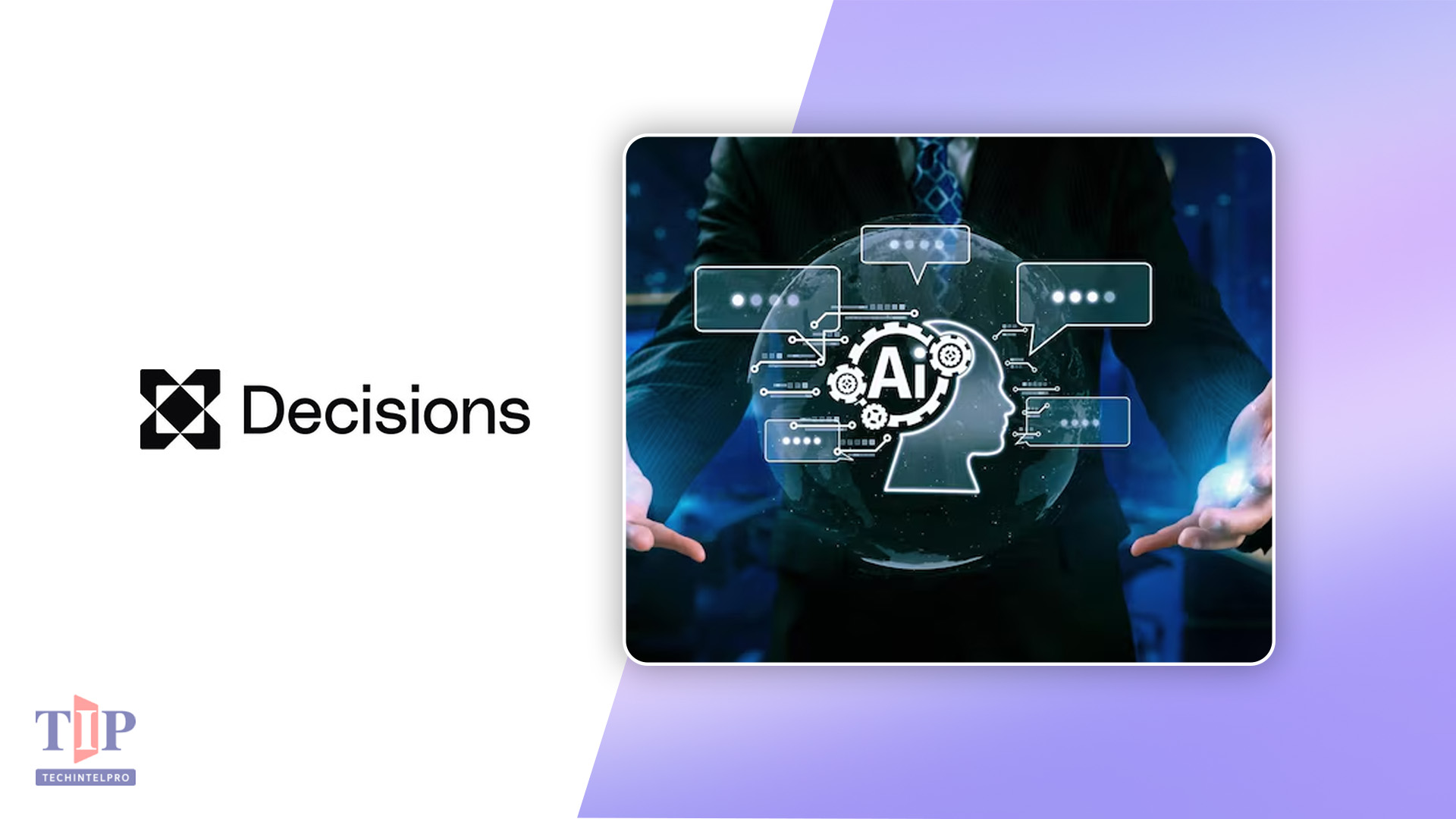

Decisions has unveiled its new unified brand following its 2025 merger with ProcessMaker, positioning itself as an enterprise control layer designed to orchestrate AI agents, bots, systems, and human workflows at scale. The rebrand reflects a strategic shift toward solving one of the most pressing enterprise challenges in the AI era: managing coordination, governance, and execution across increasingly complex automated environments.
As organizations rapidly adopt AI technologies, the focus is shifting from building intelligent systems to ensuring they operate in a controlled, coordinated, and compliant manner across business processes.
Decisions stated that the enterprise AI landscape is evolving from task automation toward full orchestration of outcomes across interconnected systems. As AI agents proliferate across business environments, organizations are increasingly facing challenges in coordination, governance, and operational control.
According to the company, the primary constraint is no longer building AI systems but managing how they interact across workflows, applications, and human decision points.
"Enterprises don't have an AI problem. They have an orchestration problem," said Giles Whiting, CEO of Decisions. "Right now, organizations are deploying AI faster than they can control it. Agents are multiplying across systems with no centralized way to coordinate or govern them. That's where things break down. Decisions delivers the control layer that brings it all together, so AI can actually execute with clarity and confidence."
The company referenced a Gartner® prediction stating that by 2029, 90% of enterprises deploying AI agents across multiple enterprise application platforms will implement a universal orchestrator to provide an interoperable control layer for AI agents, bots, and humans within business processes.
This concept reflects growing industry recognition that enterprise AI systems require centralized coordination layers capable of managing policy enforcement, exception handling, and operational governance across distributed environments.
Decisions’ platform is positioned as such a control layer, designed to unify fragmented automation tools and enable consistent execution across enterprise systems.
The rebranded platform emphasizes deterministic control through an enterprise rules engine combined with AI-driven orchestration capabilities.
Key capabilities include:
Decisions positions this architecture as critical for enterprises seeking to balance AI autonomy with operational control and compliance requirements.
The company confirmed that existing customers of both Decisions and ProcessMaker will continue using their platforms without disruption. The rebrand reflects a consolidation of identity and strategic direction rather than a product migration.
"This is just the beginning," said Whiting. "We have the platform, the team, and the focus to define how enterprises orchestrate at scale."
Decisions aims to establish itself as a foundational layer for enterprise AI execution, enabling organizations to coordinate AI systems, human workflows, and business logic within a single governed environment.
About Decisions
Decisions is the control layer for enterprise AI, bringing AI agents, systems, and people together under centralized governance. Built on a foundation of decisioning and process automation, it transforms fragmented automation into orchestrated outcomes across the business. Trusted by enterprises globally, Decisions helps organizations execute with speed, visibility, and control.