
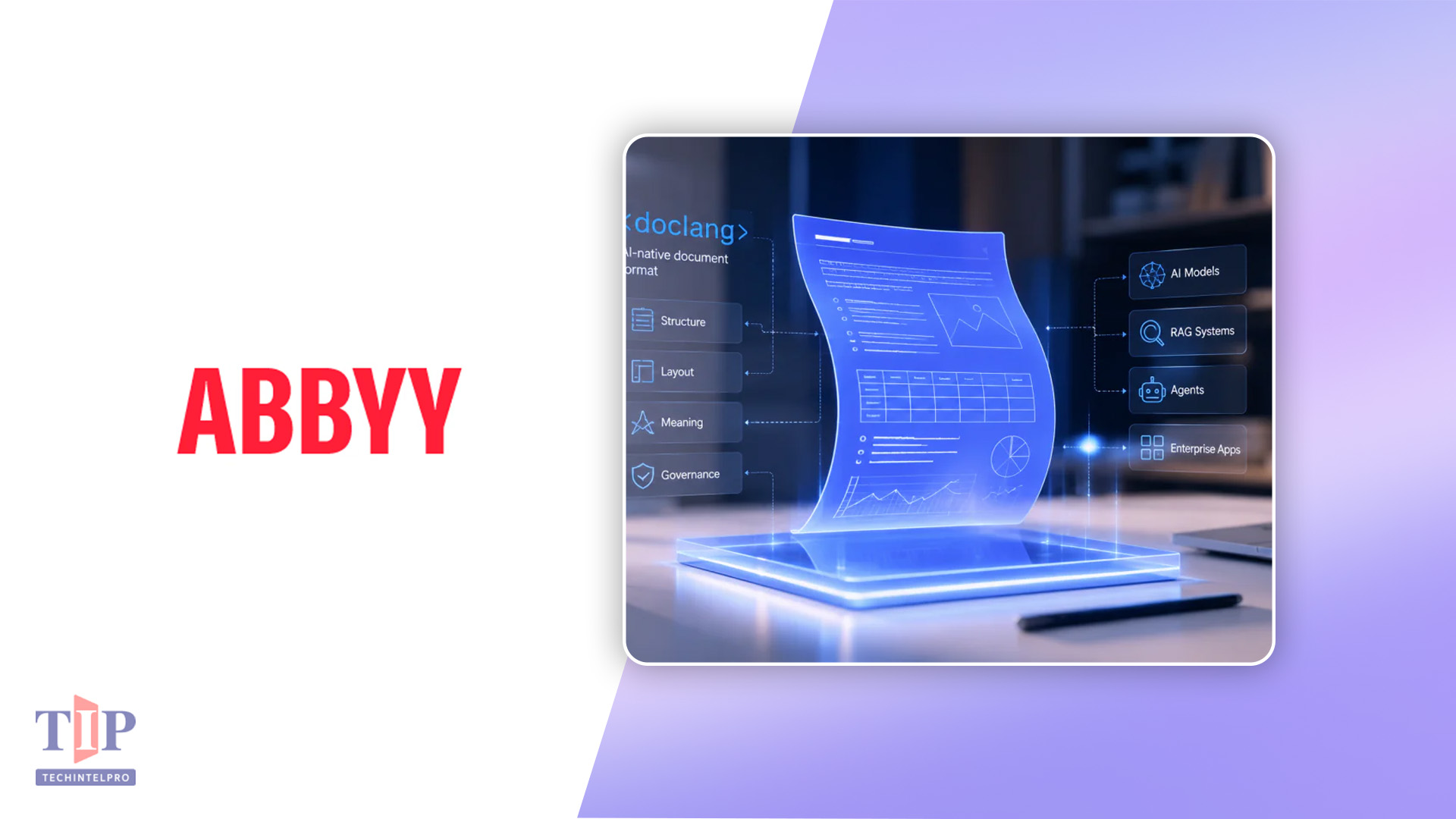

ABBYY has released ABBYY FineReader Engine 12.8.0, which now supports DocLang, the new AI-native document standard recently announced by the Linux AI & Data Foundation. The standard was founded by ABBYY, IBM, HumanSignal, Nvidia, and RedHat. ABBYY FineReader Engine with DocLang support provides developers a unified, AI-readable format to represent documents for language model and agentic AI consumption, saving time and increasing document processing performance. The release builds on ABBYY's demonstration of unprecedented processing speeds of 2,160,000 pages per hour at its ABBYY Ascend event.
ABBYY FineReader Engine 12.8 now exports to DocLang, the new AI-native document standard.
DocLang was founded by ABBYY, IBM, HumanSignal, Nvidia, and RedHat under the Linux AI & Data Foundation.
FineReader Engine with DocLang improves output quality, increases structural accuracy, decreases token usage, and reduces latency.
Current document formats like PDF and HTML were designed for human consumption, not AI interpretation.
DocLang creates a reliable abstraction layer between unstructured data and intelligent AI systems.
ABBYY demonstrated processing speeds of 2,160,000 pages per hour at its Ascend event.
Current document formats such as PDF, HTML, Markdown, and others were designed for human consumption rather than for AI interpretation. This creates a patchwork of partial solutions requiring custom parsing at every integration point, burdening developers with building custom parsers, increasing the risk of hallucinations, and complicating regulatory compliance. To address these challenges, ABBYY, IBM, HumanSignal, Nvidia, and Red Hat formed the DocLang working group to revolutionize AI document parsing. DocLang creates a reliable abstraction layer between unstructured data and intelligent AI systems, standardizing the cacophony of digital document formats that enterprises operate on and giving AI systems the deterministic structure they need to perform reliably at enterprise scale.
ABBYY FineReader Engine with DocLang support provides developers a unified, AI-readable format to represent documents for language model and agentic AI consumption. The controlled benchmark tested three types of enterprise documents: an annual report, a clinical study, and a vendor contract. These documents, designed for human interpretation yet complex for machines to process, demonstrated successful results during testing. In a side-by-side benchmark comparing processing of a PDF and DocLang document, the same document for the same complex task using the same AI model was configured identically, with the only variable being the document representation. FineReader Engine with DocLang significantly improved output quality, increased structural accuracy, decreased token usage, and reduced latency.
ABBYY recently demonstrated FineReader Engine processing unprecedented speeds of 2,160,000 pages per hour at its ABBYY Ascend event. This performance capability, combined with DocLang support, enables organizations to process massive volumes of documents efficiently while maintaining high accuracy and reliability. Max Vermeir, VP of AI Strategy at ABBYY, commented, "ABBYY FineReader Engine is already used by thousands of organizations processing billions of documents every year. Now with DocLang as an AI native format, more companies will be able to accelerate innovation and have faster access to their business data to make smarter, more impactful decisions."
DocLang is specifically engineered to address industry challenges with a minimal, standardized, and AI-native method for representing document structure, meaning, layout, and governance. FineReader Engine with DocLang support was designed for efficient machine processing and a predictable structure optimized for modern AI tokenization and modeling techniques. Organizations will see significant differences with more reliable interpretation, increased accuracy, and lower computational costs. The standard addresses the fundamental challenge of preparing documents for AI consumption by providing deterministic structure that enables reliable processing at enterprise scale.
Organizations can see the tangible benefits of AI-native document structuring firsthand by reviewing the ABBYY interactive benchmark at www.abbyy.com/ai/doclang/. The benchmark demonstrates how FineReader Engine with DocLang improves output quality and reduces computational overhead compared to traditional document processing approaches. More information about the DocLang working group, ABBYY FineReader Engine, and the FineReader Engine 12.8 release with DocLang is available on ABBYY's website.
About ABBYY
ABBYY helps organizations optimize processes, accelerate decisions, and drive better outcomes with purpose-built Document AI. More than 10,000 enterprises, including many Fortune 500 companies, rely on ABBYY's 35 years of innovation to turn business data into actionable insights that improve the way we work and live. Headquartered in Austin, Texas, and offices in 13 countries, ABBYY leads the way for smarter agentic automation.