
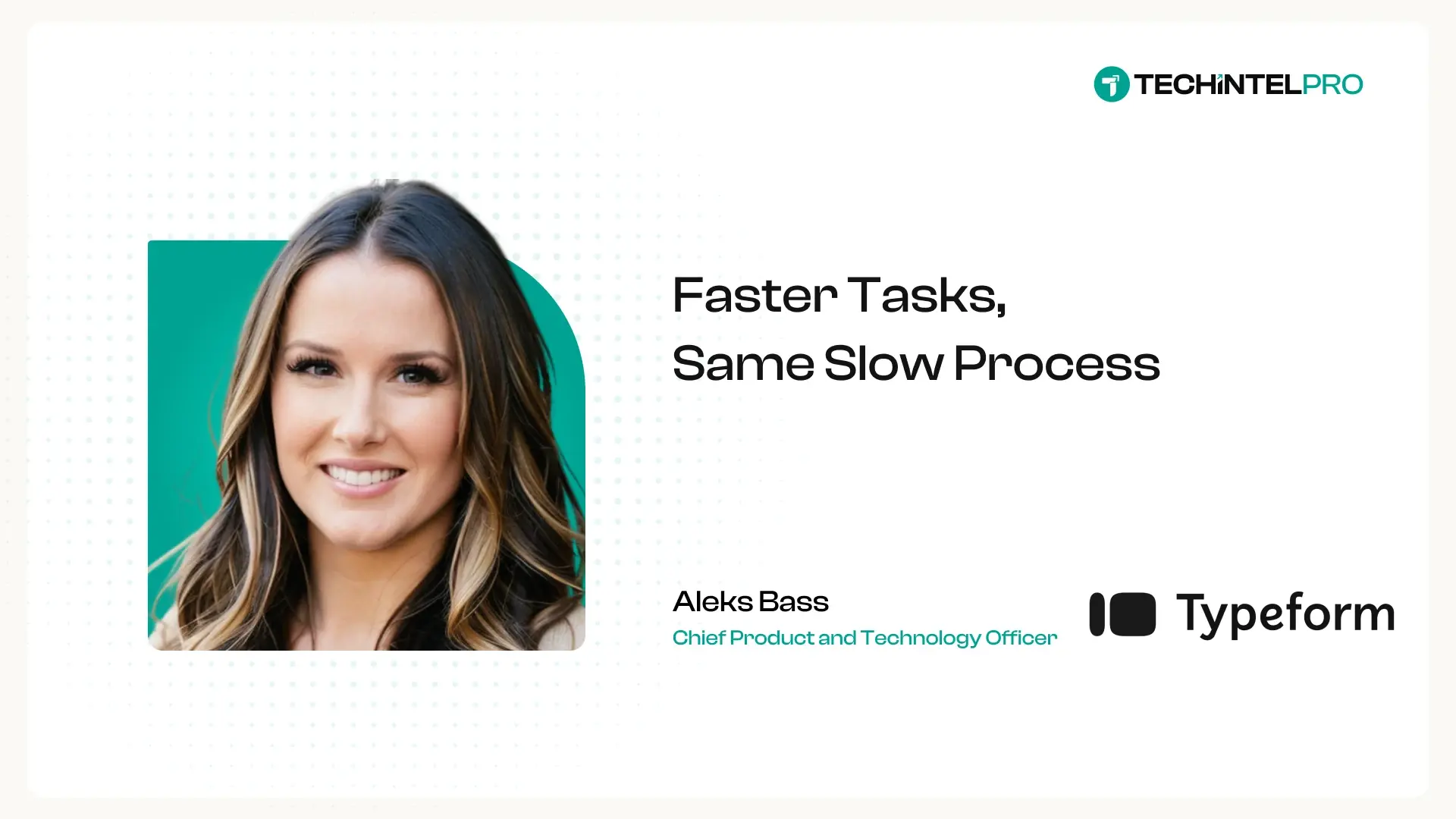
Typeform's research found that 97% of marketing teams use AI for lead follow-up, yet 69% still take more than 24 hours to respond to at least a quarter of their leads. For Aleks Bass, the gap reveals the difference between adopting AI and getting value from it: companies add AI to individual tasks without changing the workflow around them, so a lead still moves through four systems and two manual handoffs before anybody acts. Her test for any AI feature is whether the outcome improves over time.
Bass is a product and technology leader known for bringing a research-driven lens to AI, product development and decision-making, and at Typeform she is helping redefine how businesses move from data collection to action. In this conversation, she explains why her psychology background taught her to start with behaviour before technology, why she thinks in feature constellations rather than individual capabilities, and why AI should be treated like an intern who earns responsibility through demonstrated performance. She also describes Vibeformers, the program that gives non-engineers AI coding tools to make real product changes, and the legacy she is chasing: online interactions that feel less extractive.
Psychology taught me to start with behavior before I start with technology. In product and engineering, it’s very easy to get excited about what’s technically possible. I get excited about that too. But something being possible doesn’t mean anyone wants it, needs it, or will change their behavior to use it. A feature can work perfectly and still fail if it adds cognitive load, arrives at the wrong moment, or asks someone to change their behavior without giving them a compelling reason. I ask specific questions before building: What are people trying to accomplish? What is getting in their way? What context are we missing? Those questions are as important when you are designing a product as they are when you are leading the people building it.
The same principle applies to leadership. Product, design, research, and engineering have different disciplines, but they are all trying to solve the same customer problem. My job is to create enough shared context that teams can make good decisions without waiting for my sign-off at every step. I view my background in psychology as an advantage. It trained me to look beyond what people say, understand why they behave as they do, and build around that reality.
Most forms are designed around a company’s need to collect information, rather than the person’s experience of providing it. When a business starts with a list of required fields, puts them on a page, and treats completion as the user’s responsibility, of course they’d end up with an interaction that feels more like data entry than a conversation.
Typeform has always started from the belief that asking should feel human. We show people one question at a time, use thoughtful and aesthetic design to make it as easy as possible to complete, and help businesses distill their questions to ask only for what they genuinely need. We’ve seen that when people feel like someone is listening – when it feels like a conversation – they provide better answers.
But the experience can’t stop at submission. A beautifully designed form followed by silence is still a broken customer journey. That is where our playbook is expanding. We are connecting the interaction to what happens next, whether that is a personalized response, a routed lead, deeper research, or another action. We started by making forms more pleasant, but now the goal is to make the entire exchange more useful for both sides.
Fragmentation can be a sign that companies have been sold features instead of solutions. Each tool may perform its individual task well, but the respondent is left doing the connective work between them. Information has to be copied, enriched, routed, interpreted, and acted on from one tool to the next. Every extra handoff can then create a likelihood of errors, not just delays or lost context, as information moves between systems opening the potential for context to get lost along the way.
That is why I think in terms of feature constellations. A video response can be useful feedback to get, for example, but what a person notices can change as they review many clips, whereas AI can analyze them more systematically. There’s also a time advantage: manually coding all that feedback can take weeks, while AI can surface themes and sentiment much faster so teams can act sooner. The value goes beyond one added capability and comes from completing the workflow by removing work the respondent would otherwise have to do manually.
This same principle is what’s shaping Typeform’s next chapter. We are looking beyond the moment of data collection to the complete job a respondent is trying to accomplish. Where does the information need to go? What should happen next? What decision is the respondent trying to make? We’re focused on closing those seams so our customers can move from response to outcome without stitching together four or five different systems themselves.
That’s a pretty good example of why AI adoption and AI value are two completely different things. Companies have added AI to individual tasks without necessarily changing the workflow around those tasks. AI writes the email faster or summarizes the lead faster, but the lead is still moving through four systems and two manual handoffs before anybody does anything with it. You’ve made a task faster without making the process faster.
Of course, where a company is in its adoption cycle matters. If it is still learning how to use AI and redesigning the workflow around it, a 24-hour response time may be understandable at first. But if that response time hasn’t improved six months later, the company may have adopted AI without creating meaningful value.
I tell people to think about AI like an intern. You wouldn’t hire an intern on Monday, hand them every customer interaction on Tuesday and say, “Good luck.” You’d give them context. You’d explain what a good outcome looks like. You’d review the work, give feedback and gradually increase their responsibility as they prove themselves. AI needs the same treatment. I use this gradual-trust philosophy internally, too: humans remain responsible for decisions while AI earns a larger role through demonstrated performance.
That’s ultimately my test for an AI feature. Is the outcome improving over time? Does it help someone understand the customer better, respond faster or create a better experience? If not, I don’t particularly care that it’s AI-powered. Technology is only interesting when it changes the outcome.
Putting a bunch of teams under one leader doesn’t magically eliminate silos. You can just end up with all your silos sitting closer together. What I’ve found actually creates speed is shared context. Before product, research, design and engineering start debating what to build, we need to agree on the customer problem, who we’re solving it for and what evidence would tell us we actually solved it. Once that’s clear, people can make a lot of decisions independently. I give my team boundaries, but I don’t want them to feel like they need to follow a 47-step instruction manual just to get one thing done.
One of the more interesting ways we’ve been testing that at Typeform is through a program we call Vibeformers. We’re giving non-engineers (product managers, designers and others who already live very close to the product and the customer) AI coding tools and the ability to make real product changes, with an engineer buddy reviewing what ultimately ships. The idea is that we’re bringing together teams from upstream and downstream to collaborate on product solutions. I’ve noticed a significant increase in empathy across my teams. Now, everyone can understand the trade-offs of certain design or product decisions, which helps them collectively create products that are structurally sound and feel easy to use.
That changes the relationship between the teams, too. Engineers can spend more time on architecture and complex systems, while product and design can own more of the smaller customer-facing improvements that used to sit in an engineering queue. We still have very clear boundaries around what non-engineers can touch, and everything goes through engineering review. To me, cross-functional work looks like giving people enough shared context, trust and structure to solve the problem together.
Absolutely – the form is still an important interaction, but the greater value lies in what that interaction makes possible next. For years, software has helped businesses collect more information, but collection was never the end goal. A person fills out a form because they are expressing intent. They want an answer, a recommendation, a conversation, or some other next step. When that signal disappears into a spreadsheet or waits in a queue for 24 hours, the business has captured the data but lost the momentum.
The opportunity now is to connect understanding with action. This is also why context matters so much, and why AI becomes more useful when those inputs are connected thoughtfully. Businesses often think of data as fields in a database, but customer context includes conversations, research responses, purchase histories, support interactions, and behavioral signals. The next chapter of Typeform is about helping businesses do more with the answers they collect.
I would like to see online interactions feel less extractive five years from now. Too many digital experiences are designed to capture attention, collect information or push someone toward an action before the business has really taken the time to understand them. AI is a double-edged sword here. It could make that worse by allowing companies to produce mediocre, intrusive experiences at a much greater scale. Or it could help businesses listen more closely, ask better follow-up questions, and understand what people are actually trying to tell them so that the experience improves.
The legacy I care about is proving that better business outcomes and better human experiences aren't competing goals. I hope that customer understanding becomes something businesses can do continuously, not a research project they run once or twice a year. If Typeform can help make it normal for any team to have an ongoing conversation with its customers, learn from what they're saying, and use that understanding to make better decisions, that’s my measure of success. The future I want is one where AI helps businesses get much better at listening to their audiences.

Aleks Bass is a product and technology leader known for bringing a research-driven lens to AI, product development, and decision-making. With a background spanning consumer insights, product leadership, and enterprise-scale platforms, she challenges conventional AI narratives by focusing on where automation actually delivers value, where it breaks down, and why human judgement is the connective tissue between efficiency and automation and rich, customer-centric outcomes. At Typeform, she is helping redefine how businesses move from data collection to action, while building a more disciplined, human-centered approach to AI adoption.
More about Aleks: 
Typeform is the AI engagement platform that turns forms into workflows. Originally known for making forms worth filling out, Typeform now combines human-first design with AI-powered automation to help businesses turn every response into action, from lead capture and customer engagement to AI market research. Trusted by more than 150,000 customers, including 95% of the Fortune 500, Typeform integrates with tools including Slack, Zapier, Canva, and Klaviyo.
For more information, visit typeform.com.
Tell others what you think of TechIntelPro.


 Rate us on G2

