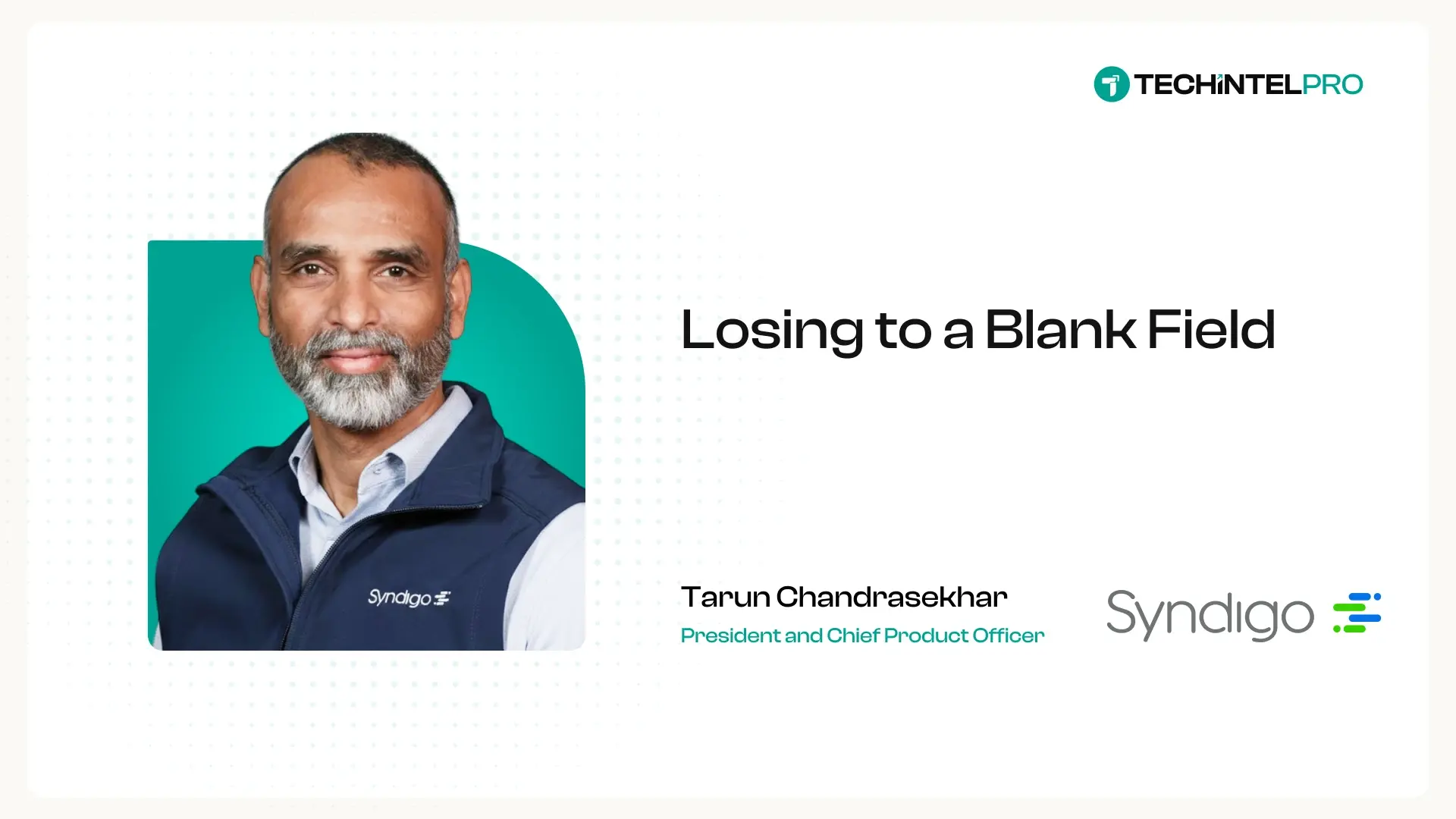
Tarun Chandrasekhar says the biggest shift in his own thinking wasn't a new framework, it was a single question he stopped asking. Early in his career, as President of Product Experience Cloud and Chief Product Officer at Syndigo, he thought the job was building the best version of a product. Now he starts with who's using it and what their day actually looks like, a distinction he says most enterprise software still gets backwards, optimizing for the demo instead of the job.
That instinct is what led Syndigo to rebuild entirely separate interfaces for brands and retailers using the same ratings-and-reviews capability, since a brand trying to syndicate reviews and a retailer trying to moderate them are doing opposite jobs with identical data. In this conversation, Chandrasekhar explains why Gartner pegs the average cost of poor product data at $12.9 million a year, why an AI model that can't verify a product fact simply won't recommend it, and no one gets an error message when that happens, and why he thinks most of the industry is still debating whether people will shop through ChatGPT while agent-to-agent commerce, one AI negotiating with another on a shopper's behalf, is already being designed.
Early in my career I thought the job was building the best version of the product. That's actually the second question. The first one is who is using it, and what does their day look like.
That sounds obvious, but most enterprise software gets built the other way around. You optimize for the demo, for the pitch, for the analyst's evaluation criteria. The result is one interface for everyone, and it fits nobody particularly well.
The clearest example in our world is ratings and reviews. A brand using reviews is trying to get them syndicated out to retail partners. A retailer using reviews is trying to moderate what's coming in and control quality. Identical capability, completely opposite jobs. When we rebuilt separate surfaces for each, adoption was noticeably different. You can't serve two different jobs with one interface and call that a product.
The biggest shift is this: I stopped asking what the product should do and started asking who has to get their job done faster because of it. That's the only question that matters.
It removes a place to hide. When you only own a product, a feature that doesn't sell is a go-to-market problem. When you own both, you own the business impact too.
Practically, it changes what I say no to. There are always features that demo beautifully and never get adopted. If you're accountable for the revenue, you notice those much faster, and you notice the unglamorous things customers actually pay for. Not the flashy stuff. Data validation that catches an error before it hits a retailer's portal. Onboarding that gets a brand live in days instead of months. A workflow that runs a thousand times a week and takes four clicks instead of twelve.
It also changes how I hear customer requests. Customers ask for features, but what they're describing is usually a business outcome they can't reach. If you sit on both sides, you can go after the outcome instead of building the feature they asked for, which is often not the same thing.
The core mistake is treating product data as an operations problem rather than a revenue problem. It gets staffed accordingly, funded accordingly, and prioritized accordingly, which is to say last.
The costs are more concrete than people expect. Time to shelf is the one that matters most. A product gets announced and then takes weeks or months to appear everywhere it should be selling. That's not a data quality issue, that's revenue arriving late or not at all. Then there are chargebacks, rejected listings, returns caused by content that set the wrong expectation. Gartner puts the average cost of poor data quality at around $12.9 million a year.
But the most expensive cost is the invisible one. When your data doesn't meet a retailer's requirement, you don't get an error message. Your product just doesn't appear. The sale goes to someone else and you never find out why.
In the AI era, that problem compounds. When a model surfaces product recommendations, it doesn't log why yours didn't make the cut. It just picks someone else. A blank field used to mean a rejected listing. Now it means you weren't in the consideration set at all.
Most companies aren't losing to a better competitor. They're losing to a blank field, and they don't know it.
It clicks the first time a customer adds a channel and realizes it isn't a project.
In a stitched-together stack, every new retailer, marketplace, or AI surface means new integrations, new mappings, new reconciliation between systems that each think they own the truth. When it's one record underneath, that same expansion is a configuration. That's when the light goes on.
The second moment is when someone asks a question that used to be unanswerable. Which content actually drove conversion? Where are you losing on the digital shelf to a competitor, and is it price or a missing attribute? You can only answer that if the data foundation, the content, the distribution, and the measurement are connected. If they're four systems, you get four partial answers and a meeting about whose number is right.
The theater is putting a conversational interface on top of data nobody trusts. It demos well and changes nothing, because the constraint was never the interface.
What's worth building comes down to a distinction the industry keeps getting wrong. Generative AI drafts something and a human reviews it. The cost of an error is low. Agentic AI doesn't draft, it acts, and by the time someone notices a mistake the agent has already propagated it across every downstream step. That asymmetry is why data governance is a prerequisite for agentic AI, not a follow-on workstream.
The honest test for any AI feature in PXM is whether it removes work while keeping a human accountable for the outcome. Match and merge with an approval step. Validation that catches an error before it ships. Enrichment that a person signs off on. That's the architecture we built Synapse around. Every agent action has a checkpoint before it touches production data. Not because we didn't trust the model, but because we've seen what happens when a wrong data point propagates at scale.
Before any company deploys an agent, they should be able to answer two questions: what does correct look like for the data this agent will reason over, and who is accountable when it isn't? If you can't answer both, you're not deploying an agent. You're deploying a liability.
Today's product experience assumes a human is assembling content for another human to read. Every convention we have comes from that: the page, the image carousel, the marketing copy written for skimming.
That assumption is breaking. An AI doesn't browse a product page. It extracts structured facts, weighs where they came from, discards anything it can't verify, and makes a recommendation from what's left. In our assessments, most brands score somewhere between 45 and 65 out of 100 on readiness for that. An AI can find them. It won't reliably recommend them.
If I were redrawing this from scratch, I'd stop thinking of the product record as something that gets displayed and start thinking of it as something that gets interrogated. It should be able to answer a question it wasn't specifically built to answer, prove where each fact came from, and do that identically whether the asker is a shopper, a retailer's system, or an agent acting on someone's behalf. Those are different consumers with very different requirements, and most product records today are built for exactly one of them.
The version of this people aren't ready for is agent to agent. Your assistant negotiating with a retailer's assistant, comparing on your history and preferences, and coming back with a decision. Most of the industry is still debating whether people will use ChatGPT to shop. That's phase one. Phase three is being designed right now.
Tarun Chandrasekhar serves as President, Product Experience Cloud (PXM), and Chief Product Officer (CPO) at Syndigo. He is responsible for the P&L, go-to-market strategy, and R&D of Syndigo’s PXM platform, which integrates MDM, PIM, Syndication, Content, and Analytics solutions into a cohesive ecosystem. In his role as CPO, Tarun leads Syndigo’s product vision, strategy, and roadmap development, ensuring delivery of innovative solutions that empower brands and retailers while maintaining Syndigo’s leadership in product experience management. Previously, Tarun held leadership roles at Riversand, Drillinginfo (now Enverus), and BP America. He brings extensive experience in building and scaling SaaS businesses, driving product innovation, leading M&A initiatives, and aligning cross-functional teams to achieve strategic business objectives.
More about Tarun: 
Syndigo helps great products get chosen. Every choice in commerce, whether by a shopper, a search engine, a marketplace, or an AI assistant, is made on product data and our software makes that data complete and trusted and moves it across the industry’s largest two-sided commerce network: 15,000+ brands and 3,500+ retailers. Backed by teams with decades of commerce expertise, brands and retailers including AutoZone, Colgate-Palmolive, Dole International, Unilever, and Walgreens trust Syndigo to get their products chosen.
Learn more at www.syndigo.com.
Tell others what you think of TechIntelPro.



 Rate us on G2