
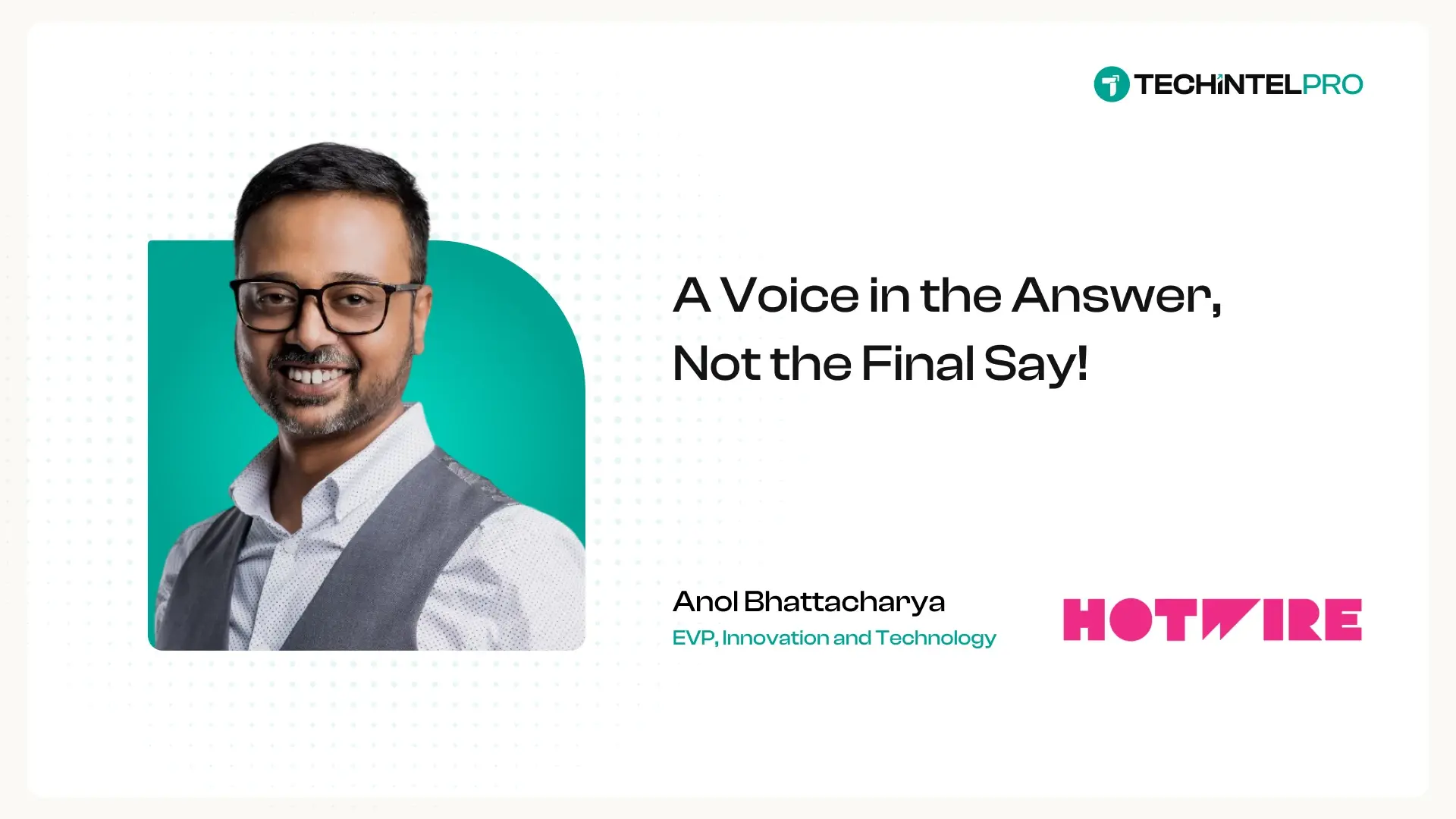
A beautifully built website can reach an AI crawler as an empty shell. Anol Bhattacharya says two decisions usually taken outside marketing, blocking AI crawlers and rendering pages with client-side JavaScript, can remove a company from AI answers while traffic and rankings look perfectly normal. For the leader of Hotwire's AI Lab, it is the clearest sign of how far brand storytelling has moved from the control marketing once had and the influence comms always relied on.
Bhattacharya is EVP of Innovation and Technology at Hotwire Global, where he built and runs the AI Lab. He founded GetIT in Singapore in 2002, which Hotwire acquired in July 2022. In this conversation, he explains why agencies using the same models are drowning in sameness, what Hotwire's analysis of 1,029,799 AI answers revealed, and how a CMO can measure visibility with a score anyone can audit. He also covers why senior buyers are the worst served by AI engines, where agentic account research still needs human judgement, and which parts of communications stay stubbornly human.
Every agency, every comms department and every marketing team has access to the same large language models. Give them the same prompts and they produce the same output, and that is exactly what is happening. Without proprietary tools to inform their decisions, and without a contextual layer to shape what the models produce, marketing and communications agencies worldwide are drowning in sameness.
That conversation started in 2023 and it has not gone away. It is the reason we set up the AI Lab. We wanted to go further than using LLMs as they come out of the box. We use them to build tools that monitor, optimise, write, create and co-create, and we feed those tools our own contextual knowledge of the market, the industry and the client. What comes out is unique to the client and unique to us, and a competitor with the same model subscription cannot reproduce it.
The harder problem showed up in client questions we could not answer. A CMO would ask how their brand appeared in ChatGPT compared with a rival, and the honest answer was that nobody knew. No tool had been built for a comms team to measure that, so we built one. We launched Hotwire Spark in March 2025, and it now covers both halves of the job: monitoring how a brand appears across AI engines, and optimising the content that shapes those answers.
Building our own tools means we control what gets measured, and we can ship a fix within days when a model update breaks something. Across 2026, Spark has absorbed roughly one major model update a month. It also means owning the data. Our State of AI Search research is built on Spark: 1,029,799 AI answers to 595,060 B2B buyer questions across six engines, as of October 2026.
Still, Hotwire is a services business that builds its own technology. Clients come to us to win in AI search, and that takes people who can read the data, advise on what to change, consult with the client's own teams and stay with them until the numbers move. Spark makes that advice faster and more specific. The outcome is what clients measure us on.
Hotwire's AI Lab employs data scientists, AI and machine learning engineers and developers, and they work side by side with our communications and marketing professionals. The people who understand the client's problem build directly with the people who can solve it, and both are measured on the same client results.
Building the bridge between two groups who want different things. Data scientists and AI engineers want to build something new and clever. Comms professionals and the account team want to serve the client and make them happy. Both instincts are good, and left alone they pull in opposite directions.
So we build the bridge from both ends. On the Lab side, we train our data scientists and engineers in the craft itself: how communications and marketing work, what the client's real pain points are, and which problem we are trying to solve. An engineer who understands why a journalist ignores a pitch builds a better media tool than one who has only read a brief. Every idea is tested against the client problem it solves, and a shiny new toy without one goes no further.
On the other side, we keep our comms and marketing practitioners and account teams up to date with what is changing in the market. That covers how AEO and GEO are reshaping brand visibility around the world, what AI now makes possible, and how our tools can make their working day easier. Those tools include our proprietary platforms and the skills and agents we have built inside the major LLMs, especially Claude. We also brief them on the new services we offer, how to put them in front of a client and which problem each one solves.
When the bridge works, ideas travel both ways. In January 2026, one of my colleagues, Frank, asked whether we could check which publications on a media list let AI crawlers in at all. It shipped in March 2026, now runs inside Spark, and shapes how teams build media lists. Nobody in the Lab would have prioritised it on its own.
The bridge also decides what we build first. Published methodology, security and data quality come before new features, because they are what let an account lead put a number in front of a client with confidence.
The biggest change is that two separate tracks for telling a brand's story have collided. Marketing was always about control. You wrote what you wanted and published it on your own properties. Comms was about influence through third parties, such as journalists and analysts, who told the story in their own words.
AI has become the great equaliser. For a buyer, and increasingly for the public, the front door is a chatbot screen that gives one answer, and that answer is assembled from owned, earned and social sources at the same time. Our analysis shows how fragmented it is: a vendor's documentation, a regulator's guidance and a trade title can all sit behind a single response. Even when the engine quotes your own website, as it does for most citations in B2B technology, it chooses the page, the passage and what sits beside it. Owning the source gives you a voice in the answer and no say over the final wording.
That leaves the two disciplines in very different places. Marketing teams are grappling with losing control of their brand narrative. Comms people never had that control. An analyst or a journalist always told the story, and comms could influence it, shape it and correct it, but never own it. Letting go comes far more easily to a comms professional, who already knows how to shape a narrative through trusted voices and the stories they choose to pitch. The same skill now applies to an answer written by a machine. That puts comms and marketing at the same intersection, in front of the same chatbot screen.
What surprised me most was the plumbing. Two decisions usually taken outside marketing, blocking AI crawlers and rendering pages with client-side JavaScript, can remove a company's site from AI answers while traffic and rankings look perfectly normal. The crawlers from OpenAI, Anthropic and Perplexity do not execute JavaScript, so a beautifully built site can reach them as an empty shell.
The engines also disagree with each other. ChatGPT and Gemini share only about half their cited sources, so visibility in one tells you little about the next.
Start with a number you can explain to your CFO. In Spark we call it the Brand Visibility Score, and the formula is public: the number of AI answers that mention your brand, divided by the total number of answers analysed. If we analyse 2,000 answers and you appear in 340, you are at 17%. Anyone can check the denominator, which matters in a category full of proprietary indices nobody can audit.
Measure it per engine. ChatGPT and Gemini share only about half their cited sources, so a strong score in one says little about the other.
Underneath that score, the measures that matter most show where the answer comes from. Citations show which of your own pages the engines use as evidence, whether that is documentation, a blog post, a product page or a competitor's page in place of yours. Owned media now belongs in the comms brief, because your website is often the first source the machine reads. Position and sentiment against named competitors show whether you are the first recommendation or the fourth mention with a caveat. Source mix shows which publications, analysts, regulators and standards bodies shape the answers in your category. That measure puts the comms function at the centre. It tells you which journalists and analysts the engines lean on, which relationships deserve more investment, and where a briefing or a byline will change what the machine says.
It also changes the job of the communications professional, starting with the media list. Reach and relevance used to decide it. Now there is a third test: whether AI crawlers can read the publication at all. Plenty of respected titles block AI crawlers, and coverage behind that block may never reach an answer, however good the story. Spark checks crawler access across a client's media list, and the results regularly change which outlets a team prioritises. A good media list now balances three things: the readers a title reaches, the analysts and buyers who trust it, and whether the engines can read and cite it.
Then measure reachability, because it fails silently. If AI crawlers are blocked or your pages only render in JavaScript, every other number drifts down with no change in traffic or rankings to warn you.
Visibility in the Synthetic Age, the report our CEO Grant Toups wrote with Till Grusche of House of Beautiful Business, puts the problem with the old yardsticks plainly: "appearing more often tells us less about whether an organization is actually being noticed, remembered, trusted, or acted on." These measures cover the part machines answer. A score on its own changes nothing, though. Our consultants spend most of their time on what comes next: turning the source mix into a media and analyst relations plan, turning the reachability findings into fixes a client's web team can make, and consulting with the client's teams so the work keeps going.
Because executives publish in the formats machines read worst. Practitioner questions get answered from documentation, help centres and technical explainers. Executive questions about integration readiness, operating model fit or the economic case meet opinion pieces, gated reports, PDFs and webinar recordings. Engines struggle to reach or parse most of that, so they fall back on whatever the model absorbed in training. In our data, executive questions about integration readiness went unsourced 64.4% of the time.
The first problem is executive visibility itself, and it is one we work on with clients and with partners such as Lilypath. Many senior leaders stay quiet in public. We encourage them to be present, and to share their opinions on LinkedIn and in the publications their peers read. Buyers want to hear from the people who run a business, and other executives look for exactly those views when they research a decision. A leader who never publishes a point of view leaves a gap, and the engines fill it from somewhere else.
The second problem is consistency, and it takes marketing and comms working together. Marketing has to address what executive buyers need in its own content, with open, specific pages on integration readiness, operating model fit and the economic case in place of gated PDFs. Comms has to make the executive's voice visible and consistent everywhere else, from trade publications and analyst briefings to the leader's own social channels. When the message, the products and the values sound the same in every place, they add up to one consistent narrative, and AI crawlers have something coherent to pick up.
It is your story to tell, and you need to own it. You cannot leave a machine to interpret it from haphazard, inconsistent sources.
Agentic AI replaces most of the desk research. Ignite's agents search the web the way a researcher would, only far faster, and turn what they find into market, industry, account and ABM reports. The bigger change is in the data. Each report combines that desk research with a client's first-party data, such as CRM and marketing automation records, and with third-party data such as intent signals, wallet data, IT budget data and technographics. The agents write the report, but the data is what makes it worth reading.
That makes research much faster and much cheaper, and speed matters because buyers decide earlier. 6sense found first contact with a vendor now comes about 61% of the way through the buying process, so the window to reach the right account keeps narrowing.
What agents get wrong is context. Out of the box, an agent knows nothing about the client's business, its market or its competitors, so it confuses entities with similar names or reads last year's programme with a new name as a fresh buying signal. Providing that context is Ignite's job. Our proprietary systems act as a context engineering layer, giving the agents what they need to know about the business, the marketplace and the competition before they start work.
Sourcing the data is the other half of the job, and it is where most of Ignite's value sits. Ignite brings the best desk research together with first-party and third-party data and assimilates all of it into one report, which a human researcher then verifies before it is published. That human role is getting lighter. The models improve with every release and hallucinate far less, and most of the errors our researchers caught in early 2026 no longer appear.
Judgement about people. Automation is very good at the research, reporting and optimisation layers, and we should let it take them. A model cannot sit across from a journalist who has covered storage for fifteen years and know which story will interest her and which will irritate her. Relationships run on memory, trust and the occasional favour, and none of those transfer to a model.
Our latest report with House of Beautiful Business ends on a paradox I agree with: the easier it becomes to be seen, the more valuable the invisible becomes. Trust built over years, and the conversations a brand never hears, are exactly the things automation cannot produce on demand.
Executive positioning is similar. A model can draft a point of view. It cannot tell you whether your CEO believes it, whether she can defend it on stage when an analyst pushes back, or whether it contradicts something the company told investors last quarter.
When Hotwire rolled out Claude licences across the agency, we did not hand our people a black box and leave them to figure it out. Nobody, from junior executives to senior leaders, was asked to work out alone what to use it for, or how to use it safely.
We started by sitting down with practitioners across the agency to agree which workflows to automate, which skills we needed to build, and what context layer had to exist before anyone used AI on client work. That produced a large library of skills and a context engineering layer, built on Claude, that holds what we know about each client, their market and their competitors.
Claude is only part of the picture. The AI Lab's own tools, Spark and Ignite, plug into the same environment through MCP, the open standard that connects AI assistants to other tools. A consultant working in Claude can draw on Spark's AI visibility data or an Ignite research report without leaving the conversation. We are training everyone, from junior executives to senior leaders, to use those tools together, so that every answer they give a client has our own data and our own context behind it.
Governance came with it, at Hotwire level and at the level of our parent company, Enero Group. We spent a long time on our AI and data privacy policies. Each client's data sits in its own box, with its own parameters and a Chinese wall between them. A human is in the loop, by rule, at every stage. We do the thinking and the ideation; our practitioners use AI to augment the work, and the judgement stays with people.
So this was never about handing the work juniors used to do to a machine. Efficiency is one goal, but if it is the only goal, it becomes a race to the bottom. The bigger goal, and the one we are still working towards, is effectiveness: serving clients faster and better, and bringing them more value as an augmented agency.
More advice, built on better evidence. Clients will expect a standing view of how every major AI engine describes them, which sources it trusts in their category, and how that moved after each announcement. The monitoring is the easiest part to buy and the least valuable on its own. What clients will pay for is the consulting that turns it into outcomes: a stronger reputation, a place on the shortlist, a pipeline they can measure.
AEO and GEO will be the biggest part of it. Brands still on the fence will come off it, because every one of them will need to know how to be described favourably by AI when they have no control over the model. That question will come to agencies that can measure the answer and change it.
Clients will also want to know how a message will land before it reaches the market. Ember, our synthetic persona platform, is in beta as of October 2026. A team can build synthetic personas of the buyers it wants to reach and test a hypothesis before launch: how will this message, this article or this campaign land with them? It works for comms and marketing content alike.
The assumption I think the industry has wrong is that AI visibility belongs to one team, as if it were a settled discipline you could hand to someone and leave alone.
The biggest change AI has brought is the rate of change itself. People used to plan for what next year would look like. We plan for next quarter. We still have a long-term plan, guided by our value compass: serving clients better, faster and with more value, measured on outcomes rather than outputs. But predicting what AI will be able to do next, or what an augmented agency will look like three months from now, is hard. That uncertainty is the reason the AI Lab exists. Its job is to stay at the frontier, to read the pace and the scale of each shift as it happens, and to put what it learns to work for our clients ahead of everyone else.

Anol Bhattacharya is EVP of Innovation and Technology at Hotwire Global, where he built and runs the Hotwire AI Lab. The Lab brings data scientists, AI and machine learning engineers and developers together with Hotwire's communications and marketing professionals to build, test and launch AI products for marketing and communications, including Hotwire Spark for AI search visibility and Hotwire Ignite for agentic research. Its work helps clients find the signal in the noise, personalise outreach and measure campaign impact as it happens.
Anol has worked in B2B technology marketing for more than two decades. In 2002 he founded GetIT in Singapore and grew it into a leading B2B technology and telecoms marketing consultancy across Asia Pacific. Hotwire Global acquired GetIT in July 2022 to form Hotwire APAC, combining integrated communications with the marketing services business he had built. Across both chapters he has advised enterprise technology brands including Equinix, Cisco, Lenovo, StarHub, NTT, Telstra and Telekom Malaysia on digital marketing, account-based marketing and AI-driven marketing technology.
He treats innovation as a commercial discipline, judged by measurable client outcomes. Anol speaks at marketing conferences around the world on AI adoption in B2B marketing, the evolution of account-based marketing, and where marketing technology meets communications strategy.
More about Anol: 
Hotwire Global is a tech-focused PR, communications and marketing consultancy that includes ROI·DNA. Leading technology brands work with Hotwire to grow their businesses, and its more than 400 people across 11 countries combine global experience with local expertise to run campaigns that build reputation, relationships and revenue. Hotwire's AI Lab brings data scientists and AI engineers together with communications and marketing practitioners to build products such as Hotwire Spark and Hotwire Ignite. With more than 20 years of experience in communications and marketing, Hotwire is part of The Enero Group.
For more information, please visit www.hotwireglobal.com
Tell others what you think of TechIntelPro.


 Rate us on G2

