
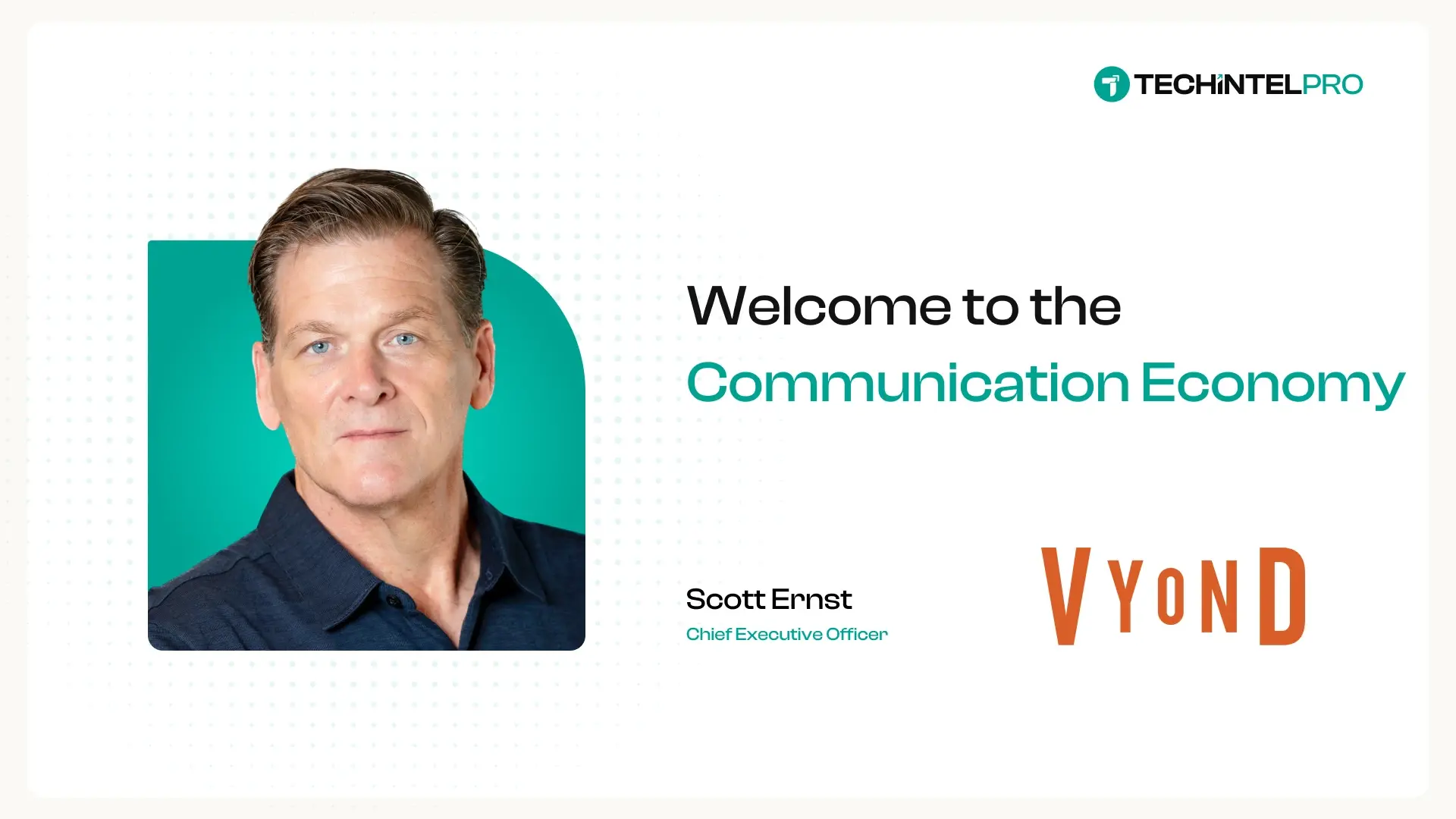
What he's hearing in those conversations is a shift Ernst thinks most companies are underestimating: AI has decentralized content creation, and marketing, HR, sales, IT, and customer success can now all produce it directly. He calls the result “Communication Chaos,” and it's the problem Vyond, now used by more than 15,000 organizations including 65% of the Fortune Global 500, is built to solve. In this conversation, Ernst discusses why enterprise buyers are no longer evaluating Vyond as a video tool but as communication infrastructure, why governance and trust convert AI pilots into durable revenue faster than raw capability does, and why a company that can't forecast itself can't manage itself.
A few things haven't changed regardless of the company or the era. The first is that you earn trust by listening before you lead. Every company I've joined (including Vyond) I've spent the first 30 days doing more listening than talking: sitting in on leadership meetings, getting in front of customers, reading the financials and the win-loss data, forming a point of view based on evidence rather than opinion.
The second is transparency. I tell teams what I know, what I don't know, and what I'm still figuring out. People can handle hard truths. What they can't handle is silence.
Third is what I'd call tight alignment, loose coupling: the more clearly a company agrees on where it's going, the less it needs to micromanage how people get there. That's the difference between a team executing a shared vision and strategy and a team waiting for instructions.
And finally, evaluate people on where the company is going and what they're capable of, not just where they've been. Growth companies need people who want to grow with them.
I saw this play out at Drift when ChatGPT launched and we had to decide, in real time, whether to defend a profitable, proprietary AI product or cannibalize it and rebuild around generative AI. The leadership principle that carried us through wasn't having the right answer on day one, it was building enough trust and alignment that the team could move fast together once we had conviction.
The biggest challenge isn't finding talented people, most growth companies have that. It's alignment: making sure everyone is rowing from the same set of facts and the same definition of success. I've seen firsthand what happens when a budget is written against one metric, sales targets against another, and strategic focus against a third. Accountability becomes impossible, not because anyone is avoiding it, but because the organization literally can't agree on the score.
The second challenge is what I'd call being data-rich but insight-starved. Most companies today have more dashboards and more numbers than ever, but not the discipline to turn data into decisions, data to insight, insight to impact. Building that muscle, especially a forecasting muscle that lets a company predict its own performance, is table stakes now. A company that can't forecast itself can't manage itself.
The third is giving teams a real, vivid picture of the future, not just a quarterly target. We run a formal process at Vyond we call the Envisioned Future State: debrief the current state, agree on the key assumptions that have to hold true, describe in detail what the company looks like three years out, and then define the handful of strategic growth initiatives that get us there. That destination, combined with a map and a compass, is what lets a team adapt without losing coherence when the market shifts underneath them.
My view has always been that the only truth that exists is outside the building. In my first months at Vyond, I set a goal of 30 customer and partner conversations by Labor Day, and I ended up ahead of that pace, meeting with customers across retail, financial services, technology and defense. Reading a win-loss report tells you what happened. Sitting across from the customer tells you why.
What's changed in the age of AI is the nature of the questions customers are asking. It used to be "does this tool do the thing I need." Now it's organizational: one of our customers, a Fortune 100 technology company, put it perfectly…the company is so large that different parts of it barely communicate with each other. Their VP of marketing technology wasn't evaluating a video tool. He was asking whether our platform could become the standard way his entire company creates video, and using that decision to drive consistency and governance across dozens of teams that had been solving the same problem in different ways.
That's the shift businesses need to make: stop thinking about AI adoption as a feature question and start listening for the bigger operational problem the customer is actually trying to solve. Speed and automation get someone to try your product. Trust, governance and control are what get an enterprise to standardize on it.
The thing that separates winners is enterprise trust. Buyers today aren't paying for AI for its own sake, they're paying for outcomes, and they need confidence that AI will stay true to their source material, respect their brand, and protect their data. We had a defense-sector customer whose security team initially wouldn't clear AI for use at all. Rather than walking away, we worked with their procurement and security teams to build the protections they needed, including a guarantee that their content would never train external models. That unlocked the partnership and it's the same pattern across the enterprise: the companies that pair genuine AI capability with real governance and control are the ones that convert pilots into durable revenue.
I use the same framework at every company I've scaled: if you want to get somewhere fast, you need a destination, a map, and a compass. Although it's rigorous, weekly check-ins, working sessions, and leadership pressure-testing keeps innovation pointed at a shared destination instead of scattering it.
Operational discipline shows up in what you choose to measure. At Vyond, I've anchored the team around net revenue retention as the single metric that ties everything together, because it combines retention and expansion into one number every function touches across sales, customer success, product, and marketing. When a company is capital efficient, has strong gross margins and real enterprise penetration, the discipline isn't cutting back on ambition, it's making sure innovation is matched by the forecasting and reporting rigor to know whether it's actually moving the number that matters.
The balance, in short, is: move with real urgency on the innovation, but never let the destination get fuzzy. Near-term execution isn't a distraction from transformation, it's the down payment on it.
We're at the front edge of what I'd call the Communication Economy. Three forces are converging. First, a knowledge explosion. Enterprise information is fragmented across more systems than ever, and most of those systems were never designed to work together, which creates real friction: time spent searching, routing, recreating and correcting content that already exists somewhere. Second, a visual shift. People increasingly want to watch before they read; short videos are becoming the preferred way people learn about a product or an idea. Third, and most disruptive, AI has decentralized content creation. It's no longer a specialist function as marketing, HR, sales, IT, and customer success can all create content directly now.
Put those three together and you get what I call Communication Chaos: more knowledge, more tools, more content, and more fragmentation, with real costs to the business even though it rarely shows up as its own line on the P&L.
The winners over the next three to five years won't be the organizations that create the most content, they'll be the ones that turn fragmented knowledge into trusted, governed, visual communication that moves seamlessly across a company's existing workflows. That's a bigger, more durable opportunity than video production ever was on its own, and it's why we're building Vyond around it.
Simplifying content creation starts with meeting people where they already are. Most employees aren't trained video producers, and they shouldn't need to be. Our AI-powered platform is built so that anyone, regardless of skill level, can turn existing knowledge (a document, a training outline, a policy) into professional, on-brand video without a production team. That's the effortless side of the equation.
But speed alone doesn't win enterprise trust, governance does. Buyers want the confidence that AI-generated content will stay true to their source material, respect brand and customization guardrails, and protect their data. We've built Vyond around that requirement from the ground up, including customer-specific data protections for highly regulated industries like defense and financial services.
The bigger pattern we're seeing, and it shows up again and again in customer conversations, is that enterprises are no longer asking us to be a video tool for one team. They're asking whether Vyond can be the standard platform their entire organization uses to communicate: one system that scales across languages, business units and geographies, replaces a patchwork of point tools, and turns fragmented institutional knowledge into communication people can actually understand and act on. That's the shift from content creation to communication infrastructure, and it's where we're focused. We also have exciting new capabilities coming later this year that will push this even further, more to share on that soon.
Scott Ernst is Chief Executive Officer of Vyond and a veteran technology leader with more than two decades of experience scaling SaaS, AI, data, and marketing technology companies. He previously served as CEO of Uptempo, Drift, Tubular Labs, and Macromill, where he led the company through its initial public offering and its growth into a global digital insights leader. Across these roles he has driven significant growth, transformation, strategic acquisitions, and successful exits. Earlier in his career, he helped build Compete from an early-stage startup into a global digital marketing business generating more than $100 million in annual revenue. Scott is known for developing high-performing teams, sharpening go-to-market strategy, and translating product innovation into durable customer and shareholder value.
More about Scott Ernst: 
Vyond helps organizations transform enterprise knowledge into clear, engaging visual communication that drives action. Its AI-powered video creation platform combines instant video generation, full-featured editing, and enterprise-grade controls to help teams accelerate onboarding, simplify compliance, enable sales, educate customers, and communicate consistently at scale. For nearly 20 years, Vyond has helped businesses move from information to understanding—and from understanding to measurable outcomes. Today, more than 15,000 organizations, including 65% of the Fortune Global 500, rely on Vyond, with customers creating more than 40 million videos since the company’s founding in 2007.
Learn more at vyond.com
Tell others what you think of TechIntelPro.



 Rate us on G2

