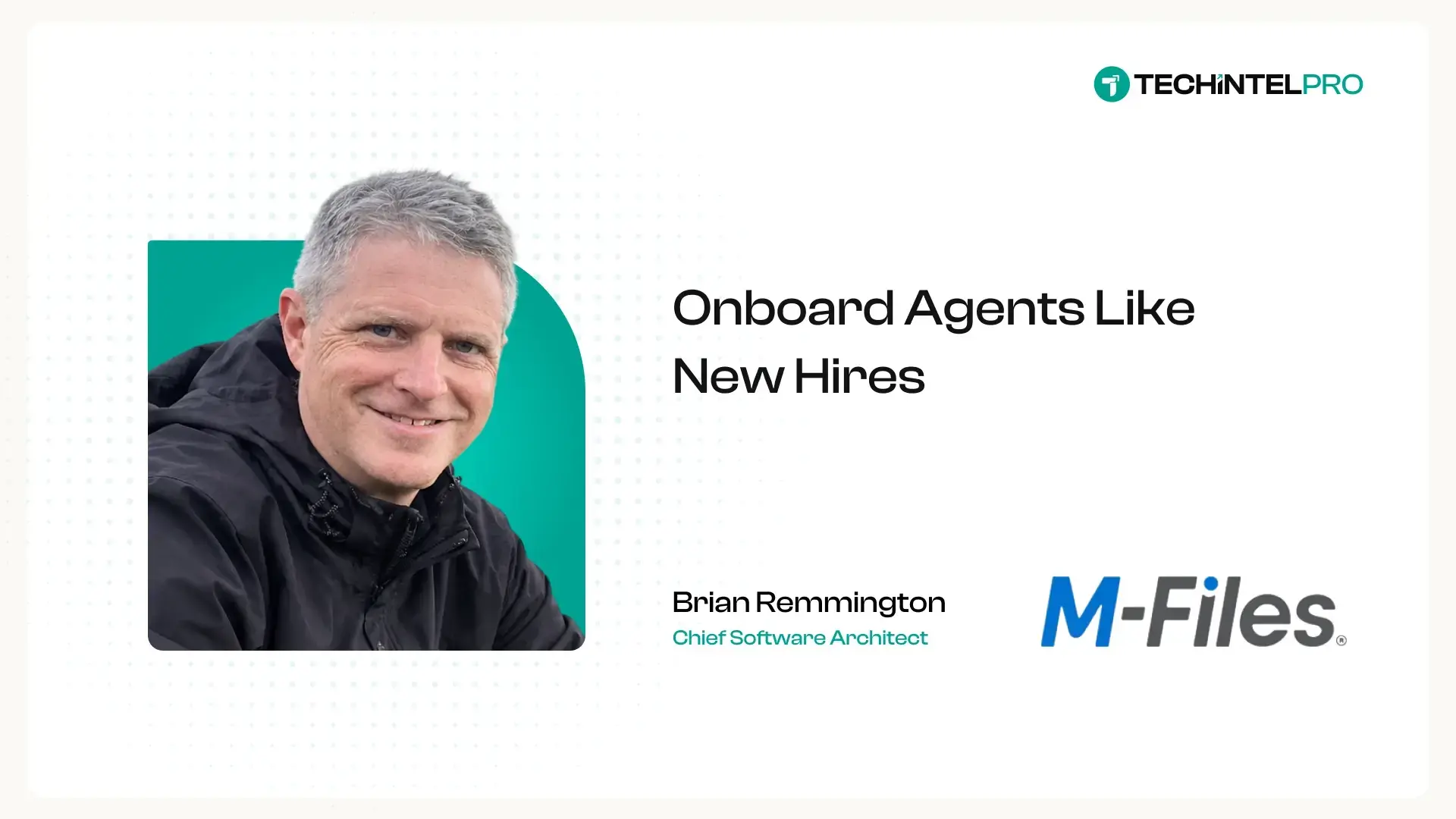
Brian Remmington, Chief Software Architect at M-Files, says being “AI-ready” starts with the decisions and actions an organization wants AI to take, then working backward to curate the business context needed to take them accurately. Without a curated, governed content foundation and a knowledge graph, he warns, AI agents can surface uninformed responses that expose sensitive information or use it in the wrong context. His view is that the value is not in giving an agent everything and expecting it to judge quality, but in giving it information that is trustworthy and appropriate for its task.
In this TechIntelPro conversation, Remmington explains how a knowledge graph differs from vector search or RAG over a folder-based repository, why AI amplifies the problems of dark data and content sprawl, and why he treats agent autonomy like onboarding a new employee, with latitude earned through track record. He describes how a governed context layer can serve tools such as Copilot and ChatGPT over MCP without weakening permissions or audit trails, how M-Files complements Microsoft 365, and why regulated, process-heavy work is where agents start.
Unstructured information and structured information are generally managed in separate systems by separate teams following separate processes and guidelines. What I like about M-Files is that its architecture is built around the idea that unstructured and structured information share a common need for versioning, access control, and interconnectivity, and users are encouraged, through the user interface, to treat documents and business objects as peers. Many content management systems map files into folders first, while M-Files focuses on what the file is and how it relates to business objects rather than where it sits in a hierarchy.
This, along with the way M-Files works in the Microsoft ecosystem, aligns with my view of what AI agents need to achieve their tasks efficiently and securely. Bringing data together, layering a single, coherent permission model over it, providing tools to curate and manage the data, and offering simple ways to traverse graphs of related data mean that agents can obtain relevant, trustworthy context quickly.
I believe AI generally has an amplifying effect, both for good and for bad. AI agents may be able to find your dark data now, but the question is what will they discover and how will they use it. Dark data is, by definition, unknown, unmanaged, and probably inadequately secured. No organization wants an AI agent to find a piece of dark data and then base an action on it that can't later be tracked back to its cause.
While I don't think AI increases the number of places content can leak and sprawl, it certainly increases the amount of content produced. Organizations that don't have the right policies, practices, and tools in place to handle that content effectively will definitely find that AI increases their content headaches.
Every company wants to be “AI-ready”. To achieve it, organizations should start by reviewing decisions and actions they want AI to make, then work backward to identify and curate the specific business context required to take those actions accurately. Efficiently interrogating information and then acting on that information in a trustworthy way relies on the quality and the provenance of the data behind it. That's fundamental to enabling “AI-ready” agents to be effective with information.
Without a curated, governed content foundation and knowledge graph, uninformed responses surface that can expose sensitive information or use information in the wrong context. As organizations move from AI-assisted tools to agentic workflows, the role of trustworthy, context-aware content becomes the prerequisite for effective AI adoption.
RAG is an approach that takes a prompt, finds information that appears to relate to it, and passes both the prompt and the information to an LLM as context. Vector search is a way of finding information that appears semantically similar, one approach to the 'R' in RAG.
In both cases, the word "appears" is important. If using only inference based on the content, documents may appear relevant or similar even when their broader context would make it clear they're out of scope. In a folder-based repository, the task "find every contract relating to data migration projects in EMEA during 2026 and list the contracting parties" becomes a very intensive operation requiring an LLM to read large numbers of contracts.
An important distinction is whether an AI has the context to use information appropriately, rather than just find it. A knowledge graph allows an agent to efficiently find that information along with connected context without having to sift through every document ever written in an organization.
The connections between pieces of information are only part of the picture. Curation and governance are essential to making that context meaningful. In practice, this looks like removing all documents that are not trustworthy, separating what is usable and what is irrelevant, and understanding what decisions and actions are likely to be taken based on each piece of content.
The practical value is giving an agent access to information that is trustworthy and appropriate for its task, rather than giving it everything and expecting it to judge the quality for itself. Content management has traditionally been about getting the right information to the right person at the right time. A contextual knowledge layer can also tell you why it is relevant, how it relates to other information, and whether it should be used in the first place.
Our approach to agent autonomy is similar to onboarding a new employee. Organizations don't typically give new hires keys to everything on day one. They start with a clear job description, access to the information, data, and people they need, and a leader that evaluates their work. That's what we've built with our Custom Agents, giving their "manager" control of what they're permitted to change and ensuring there's an audit trail to record reasoning, sources, and actions. Latitude is earned in a similar way that people earn it, through track record. If decisions are consistently right and traceable to authoritative information, you widen the scope. Accountability ultimately stays with the people who configured it, so the boundaries need to be something that people can actually reason about.
We see redundant, outdated, and trivial material everywhere: in multiple versions of the same document, scans of varying quality, and files no one has looked at in decades. In these environments, an agent must decide what a document is, whether it's still relevant and authoritative, and where it belongs. All that needs to be done quickly and consistently across millions of enterprise documents at an acceptable cost. Getting that right is a real challenge.
The hardest engineering problems generally relate to balancing speed and cost. Achieving accuracy by processing documents slowly and with the most expensive models is straightforward. Layering the processing so that as little time and money as possible is spent filtering out the redundant, obsolete, and trivial information is important. Below that layer comes another layer, and then another. Only the most valuable information gets through the layers.
Every AI-set value has a confidence level recorded against it. For the human review, I'd start where a wrong value would matter most to the business—legal, compliance, or financial records—and where the AI's confidence was lowest.
M-Files's mission is to provide the trusted context layer that agents and AI applications rely on. Our knowledge graph is a fundamental part of that mission because it allows agents to efficiently access information with the right context, provenance, and trustworthiness behind it, rather than having to trawl through every document across an organization.
Enterprises are going to use multiple AI experiences and agents, so the goal should not be to recreate governance independently inside every AI tool. The more scalable model is to establish a governed context layer that AI systems can draw from consistently.
MCP provides a standardized way for external AI platforms and agents to access that context, while M-Files remains responsible for the underlying information model, governance, and access controls. The critical principle is that an agent should never gain broader access simply because it is an AI agent.
Requests are still evaluated in the context of the human user, with activity captured for traceability and audit. That allows organizations to adopt tools such as Microsoft Copilot, ChatGPT, and other agentic platforms without disconnecting AI from the governance model already applied to enterprise information.
We see the two layers as complementary. Microsoft 365 is where a huge amount of knowledge work happens, and tools such as Copilot are becoming an increasingly important interaction layer for users. M-Files does not need to replace that experience, and with our native experiences for Microsoft, it doesn't. Rather, it strengthens those applications, making the information underneath them more contextual and governed.
Architecturally, the distinction is between the productivity experience and the enterprise information layer. Employees can continue creating and co-authoring content in Microsoft applications—using Copilot natively to draw on information managed by M-Files—while M-Files applies business context, lifecycle controls, and governance across that information, including information that may sit outside the Microsoft ecosystem.
Regulated, process-heavy work is where the cost of getting something wrong is the highest, and where trust is earned. Quality events, contracts, and project plans are process-heavy. There's a defined policy and process, and usually an audit at the end. This gives an agent a clear job with clear guardrails and the process owner a clear way to evaluate whether the agent did well. Highly regulated businesses can't accept a black box; they need to know the specifics around what an agent saw, what it did, and why. As for what's next, I think it will be other processes that have the same pattern: document-centric workflows that have clear policies, measurable outcomes, and people who stay accountable. Agents take action within the mandate people give them. The people stay accountable both for the guardrails provided to the agents and the outcomes achieved.
The bulk of what organizations need to achieve value is baked into the core of the M-Files architecture. Metadata, permissions, versioning, workflow, audit, and collaborative content authoring with Microsoft applications are instantly available to every M-Files customer, with scale and security a given. M-Files has refined its architecture over decades to surface these capabilities in a way that allows customers to unlock their value quickly. The hard work isn't repeated for every project. Documents are connected to the customer, project, or contract they belong to, permissions follow the content at every stage in the workflow, and every change leaves a trail. So when a customer picks a use case, they configure the foundation that already exists and enrich the enterprise knowledge graph further with every use case they choose.
Our customers are using M-Files at ever greater scale and for an increasing number of agentic AI use cases. In my first months at M-Files, I've had deeply insightful conversations with customers, and I'm excited to continue evolving the platform to support those customers as they explore what it takes to build trust in AI.

I partner with CIOs, CDOs, and Heads of Information Governance to fix the information challenges that quietly increase risk, slow down change, and make AI adoption harder than it needs to be. My work focuses on information management strategy, governance, content architecture and AI readiness with a practical, business-first approach.
I’ve spent over two decades helping organisations across every domain overcome their information management challenges. I have led the development of some of the most widely used content management and process management platforms in the world.
I use this expertise to help customers develop information strategies, strengthen governance, improve search and findability, simplify content estates, and establish the foundations needed for responsible AI and audit-ready knowledge flows across M365, collaboration tools, and legacy content platforms.
My approach sits at the intersection of people, process and technology. I bring clarity and structure to complex environments, helping organisations operate with more confidence because their information is trustworthy, well-managed, and ready for automation and AI.
More about Brian Remmington: 
M-Files is redefining document management with a Context-First approach that eliminates operational friction and gives business and IT leaders a performance advantage. By capturing the knowledge and relationships surrounding documents, M-Files transforms static files into a connected ecosystem that fuels AI, automation, and better decision-making.
Our AI-native, metadata-driven platform unifies content across systems, strengthens governance, and multiplies the impact of Microsoft 365 and other business-critical systems. More than 6,000 customers across 100 countries rely on M-Files to drive faster decisions, smarter processes, and sustainable business performance.
We’re a global team of innovators, document geeks, compliance champions, and technologists pushing the boundaries of what document management can be. Join us as we help organizations around the world eliminate friction and unlock their full potential.
Learn more at: https://www.m-files.com/m-files-platform
Tell others what you think of TechIntelPro.

 Rate us on G2