
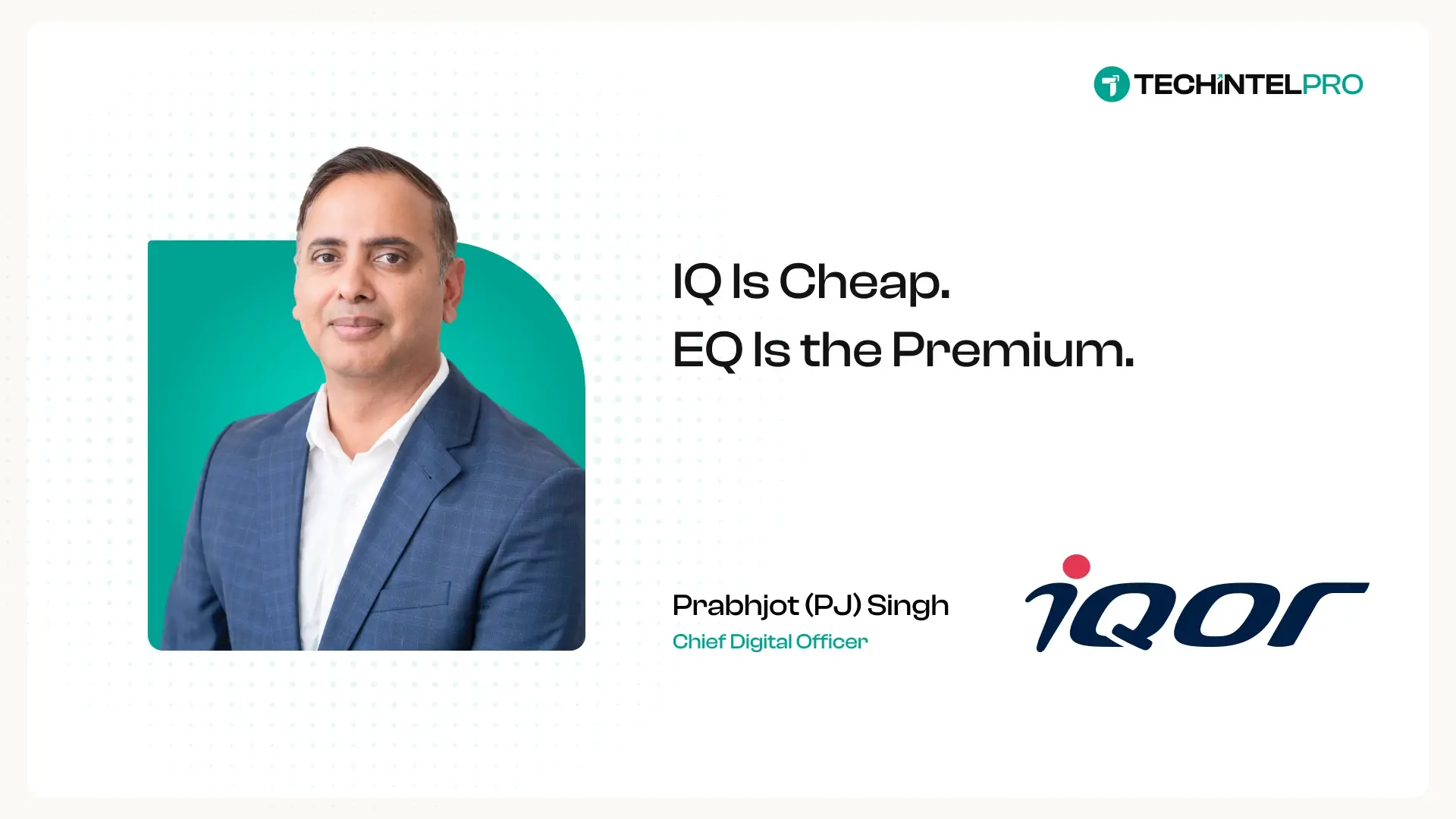
Pj Singh has watched a lot of companies pour money into AI and come away disappointed, and he thinks he knows why. The struggle, he says, is rarely the technology; it is the operating model. Organizations buy tools faster than they change workflows, run pilots faster than they build governance, and create dashboards faster than they create accountability. In customer experience, where recruiting, training, knowledge, quality, coaching, and analytics all have to connect, he argues that automating a single task just adds another layer of complexity.
Singh has spent nearly two decades at iQor, where he joined in 2007 and now serves as Chief Digital Officer, helping take the company from a $150 million enterprise to a $700 million business. In this conversation, he explains why iQor treats clean, secure data as the foundation for tools such as Insights iQ, AnalystGPT, and Coach iQ, and the five questions he asks before betting on an emerging technology, starting with whether it solves a real business problem and ending with whether it creates a durable advantage. He also describes where AI should lead and where people must stay in control, arguing that as AI makes IQ rapidly and cheaply available, the value of EQ will become exponentially higher.
Throughout this time, I’ve had the benefit of seeing iQor through a lot of different chapters: experiencing both personal and corporate growth, transformation, technology shifts, tough resets, and shared successes. That gives me a grounded view of what ultimately works.
The biggest takeaway has been that technology only matters when it improves the business. A new platform, a new AI model, or a new workflow does not mean much unless it helps our people perform better, helps our clients get better results, or helps the company run with more speed and discipline.
I’ve also learned that transformation doesn’t happen overnight with a big announcement. It is a long series of practical decisions: modernizing infrastructure, improving data, building better tools, tightening security, and making sure the frontline can use what we build.
That experience shapes how I lead today as Chief Digital Officer. I focus on business value first, then the technology follows. My goal is to ensure that IT and digital are seen as a force multiplier for iQor, rather than just a support function.
I’ve noticed that the pressure and expectations have gone up everywhere. Customers want instant answers, more personalization, and fewer inconsistencies. Clients expect better performance, better insights, and better cost discipline. And employees expect tools that help them instead of slowing them down.
A lot of companies are investing heavily in AI and automation, but the struggle is usually in the operating model. They buy tools faster than they change workflows, run pilots faster than they build governance, and create dashboards faster than they create accountability.
That is where CX gets hard because it is not enough to automate a task. It’s important to understand the full operation: recruiting, training, knowledge, quality, coaching, workforce planning, analytics, security, and client outcomes. If those pieces are not connected, AI just becomes another layer of complexity.
The companies that will win are the ones that make AI practical. It must naturally weave into the daily workflow, and it must be measured against outcomes that matter.
I’m a firm believer that if the data is poor, the intelligence will be poor. So, we have spent a lot of time on our foundation, ensuring the data is clean, secure, and accessible.
From there, we focus on turning that data into action. That is where our tools like Insights iQ, AnalystGPT, Coach iQ, and our broader AI capabilities become powerful. They help our teams see patterns faster and identify exactly where a team member might need extra support.
The goal, as I mentioned, is to embed intelligence into the daily workflow. An agent should get better guidance in the moment, a lead should know where to focus coaching, an operations leader should see what is driving performance, and the client should understand what is changing and why.
That is how you make AI practical. It moves from being something people talk about to something that helps the business run better every day.
It doesn’t always need to be viewed as AI versus humans; it is a mutual partnership. AI can often lead if the work is repetitive, data-heavy, or time-sensitive.
When the work requires empathy, judgment, trust, negotiation, or accountability, humans need to stay in control. As AI allows us to access IQ rapidly and cheaply, the value of EQ will become exponentially higher.
Our focus is the human experience while letting AI remove the cognitive burden that gets in the way.
I start by asking, does it solve a real business problem? If the answer is unclear, it’s crucial to not spend too much time admiring the technology.
Second, can it scale inside our operating model? Anyone can build a good demo, but delivering a reliable, high-performing deployment is much harder.
Third, can we govern it properly? Security, compliance, cost, and adoption are all big factors that matter. Especially when it comes to AI, you cannot separate innovation from control.
Fourth, how do we prove the value? I need to see a direct, measurable impact on things that make a difference, whether that's speed, employee experience, or client outcomes.
The last question is whether it gives iQor a durable advantage. We don’t need to chase every trend, but we need to make smart decisions that improve how we operate and how we compete.
I would start even earlier with data discipline and operating alignment.
A lot of transformation work becomes harder when data, systems, and workflows are designed in separate lanes. If I were to start from scratch, I would focus heavily on ensuring we had a stronger common foundation from day one.
I would also push earlier on adoption and change management. Technology teams sometimes underestimate how much effort it takes to get people to change how they work. You can build the right tool and still miss the value if adoption is weak.
The other thing I would do is connect every digital investment to business outcomes from the beginning.
That keeps the organization honest and helps teams understand why the work matters.
I want iQor’s legacy to be that we didn’t just look at AI as a tech upgrade, but as a total evolution of our operating model.
I hope people look back and say that we used AI responsibly, practically, and with discipline and that we strengthened our team instead of trying to work around them. We proved that improving performance, coaching, speed, and consistency fueled the company's rapid growth while delivering quantifiable business impact for our clients.
The biggest opportunity is not just automating work but building a smarter operation where humans and AI work in cohesion, where data turns into action faster, and where the business keeps learning every day.
If people say iQor made AI real for CX operations before the market fully understood what that meant, I would be very proud of that.
Prabhjot “Pj” Singh serves as Chief Digital Officer of iQor, an award-winning global provider of intelligent customer experience solutions. Since joining iQor in 2007, he has led the company’s digital strategy, driving AI-powered innovation to enhance operational efficiency and customer engagement.
Pj oversees iQor’s AI initiatives, data intelligence, and technology infrastructure, ensuring that cutting-edge solutions solve meaningful business challenges. His leadership focuses on three key pillars: building intelligence from data, creating intelligent solutions for clients, and integrating AI into every aspect of the business. A cornerstone of this strategy is Symphony [AI]™, iQor’s AI ecosystem, which leverages large language models and next-generation technologies to equip employees with advanced tools while delivering actionable insights to clients.
Pj previously served as Senior Vice President of Technology and Innovation, where he played a key role in transitioning iQor to a cloud-based environment and implementing AI-driven tools like real-time agent assist technology. His expertise has been instrumental in helping iQor grow from a $150 million enterprise to a $700 million powerhouse.
Pj’s strategic leadership and commitment to innovation continue to position iQor as a leader in digital transformation and customer experience excellence.
More about Pj Singh: 
iQor is a trusted partner in customer experience solutions for global brands and a portfolio company of Mill Point Capital. With 45,000 employees across 10 countries, iQor combines three decades of expertise with AI-driven innovation to optimize performance across the entire customer lifecycle. Through its three delivery pillars — Grow, CXBPO, and infinityAiQ — iQor delivers scalable solutions that drive acquisition, engagement, and retention. Powered by advanced analytics and a people-first culture, iQor transforms customer interactions into measurable growth. Recognized as a Great Place to Work® and a leader in CX excellence, iQor empowers brands to grow smarter.
Learn more at iQor.com.
Tell others what you think of TechIntelPro.



 Rate us on G2