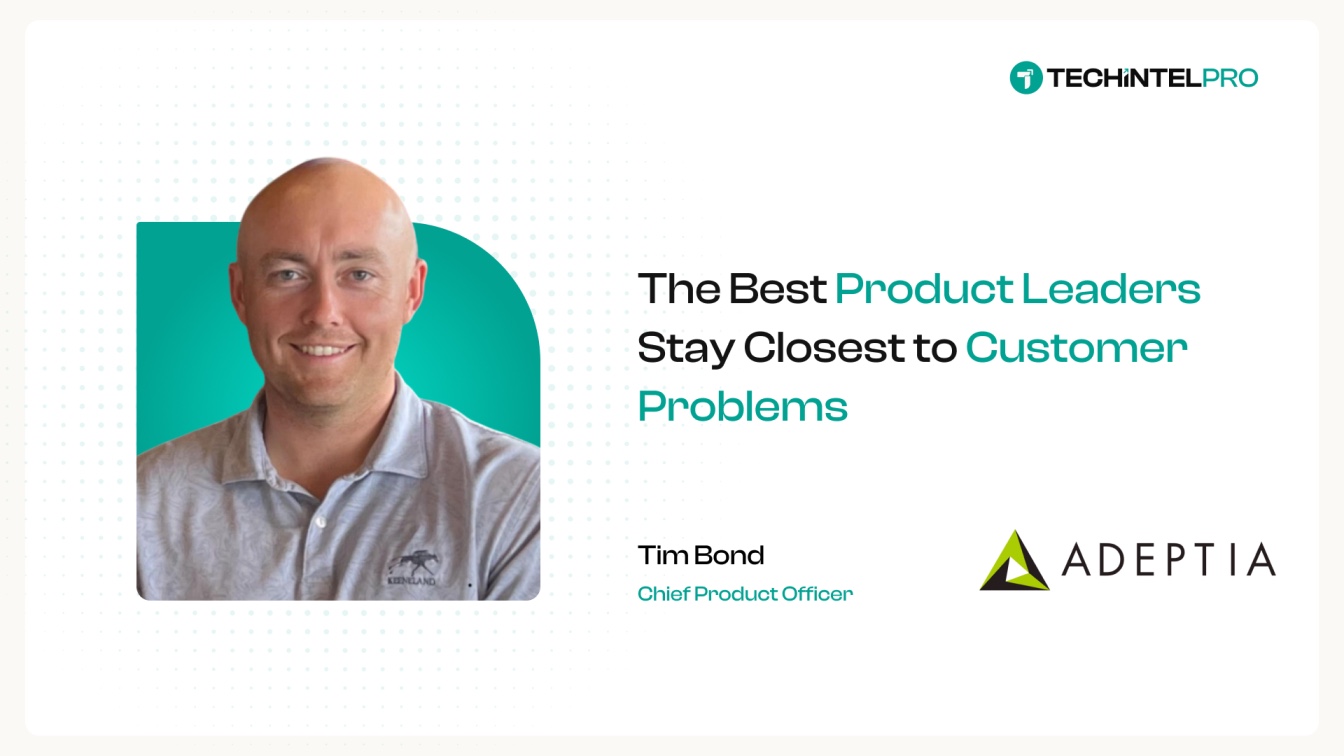
Enterprise customers rarely wake up hoping to buy another software platform. They just want yesterday's complexity to disappear.
That's the lens Tim Bond, CPO at Adeptia, brings to product leadership. Instead of chasing feature parity, he focuses on building products that integrate naturally into existing enterprise environments, earn trust through execution, and solve real operational problems. We also discuss AI's evolving role in enterprise software, customer-led product strategy, and what the next generation of enterprise applications will look like.
Two chapters shaped how I lead. First was how to operate, and second was why people buy. First, at PTC, I was fortunate to be part of a small group within a global company, so I wore many hats and worked on everything from pre-sales to pricing and packaging to marketing. I really got to understand how a software company actually operates, not just how a product gets built. Second, at Zudy, we were small and moved fast, and I was on the front lines with customers, watching how they used the software every day. When we sold to a prospect, we offered a free 40-hour POC. We would build what they asked for within a week and show them a live, working app. We used to joke that we could only lie to you for a week, because plenty of prospects were skeptical we could move as fast as we claimed. Their faces when they saw that velocity was the best part. That taught me that nothing builds trust faster than showing someone the real thing.
We watch where the next wave of technology is heading and what it means for us, then set vision and strategy in partnership with our board, investors, and leadership team. We vet that vision with our customer advisory board, which is made up of executives at Fortune 500 companies, so it is pressure-tested against real enterprise reality. At the same time, we leave room for customer requests. We are not a take-it-or-leave-it SaaS product. We are a partner, and a customer should never be slowed down by a missing small feature or setting. The vision sets our direction. The partnership keeps us honest day-to-day.
Enterprises expect you to fit into their world, not the other way around. You have to slot into their existing infrastructure and meet their security and compliance requirements before the conversation even gets to features or price. More recently, there is another layer on top of that. Many large organizations now have an AI center of excellence or an AI governance committee, so anything related to AI goes through an additional round of vetting. What it comes down to is that when you build a product today, you need to be ready to answer any questions a CTO or CIO might have, from how you handle their data to how your AI makes decisions. The product has to be strong, but so does everything around it. That reality is a big part of why we focus on meeting large organizations where they actually are, across their infrastructure, their security posture, and now their AI governance process.
We start with expansion and renewals because that work has clear dollars you can put next to the development cost. For new business, we constantly evaluate how our current capabilities and vision resonate with prospects. My colleague Michael Bevilacqua has operationalized an opportunity into a revenue pipeline that tells our product team what deals are out there and which use cases or features we’re missing to convert them. Our priorities are tied to real revenue and prospects, not to whomever is the loudest in the room.
The way we build software is changing as much as the software itself. We root every line of code in a specific use case: the scenario, the actor, the trigger, and the expected result. AI then executes from those specs. That approach lets us move from a customer describing a problem to a working proof of concept in days, and it means every capability we ship is tied directly to a measurable outcome rather than a feature checkbox.
On the customer experience side, natural language is becoming the primary interface. Products need to be accessible not just to human users but to AI agents operating autonomously inside a customer's environment.
The platforms that will matter in three years are the ones building domain-specific depth now.
Organizations do not need more tools; they need their data to move cleanly and reliably between their existing systems, without an army of specialists to keep it running. What matters most at scale is accessibility and trust. Accessibility so that a business user or an AI agent can build a pipeline without waiting on a developer, and trust so that what gets built is governed and dependable. Our whole approach is to make that process smarter through a self-learning system, so that building integrations gets easier over time rather than harder as complexity grows.
The trick is being clear about where you can take risks and where you cannot. A good example is how we are using AI. We add AI during the design phase, helping you build a pipeline faster and smarter. But in production, we run code, so the outcomes are deterministic and repeatable. The AI helps you get there, but it is not improvising while your business is running on it. Beyond that, the core pipelines our customers rely on have to be dependable, full stop, so we contain experimentation to where it is safe and lean on our customer advisory board and close partnerships to test new ideas with people who want to be on the edge with us. That way, we move fast on what is next without ever gambling with the reliability an enterprise customer is counting on.
What excites me most is that the audience for software is widening. We are no longer building only for humans. We are building for AI agents, and that changes what a good product even looks like. My advice to the next generation of product leaders is to stay as close to the customer's real problem as you can for as long as you can. It is easy to get promoted into rooms that are further and further from the people who actually use what you build. The leaders I trust most never lost that proximity.
Tim Bond is the Chief Product Officer of Adeptia, where he oversees product strategy and innovation, advancing the company's AI-native platform as the foundation organizations rely on for building, orchestrating, and scaling their data workflows. Prior to joining Adeptia, Bond was a senior product advisor at various software companies, including Nymbl, Jitterbit, and Zudy, bringing more than a decade of experience leading product strategy and development across data, integration, and enterprise software.
More about Tim: 
Adeptia is the Intelligent ETL platform that helps enterprises automate complex operational workflows across systems, teams, business partners and AI agents. Unlike traditional ETL tools designed for point-to-point integrations, Adeptia is purpose-built to handle complex, real-world data across highly regulated industries where accuracy, compliance, and reliability are critical. Drawing on more than 25 years of enterprise automation experience, Adeptia combines AI-native automation, industry templates, document intelligence, and curated knowledge bases to transform fragmented data into trusted operational outcomes. The result is trusted, AI-ready data that powers operational workflows, business decisions, partner ecosystems, and enterprise-ready AI initiatives with speed, accuracy, and confidence.
Learn more at www.adeptia.com.
Tell others what you think of TechIntelPro.


 Rate us on G2