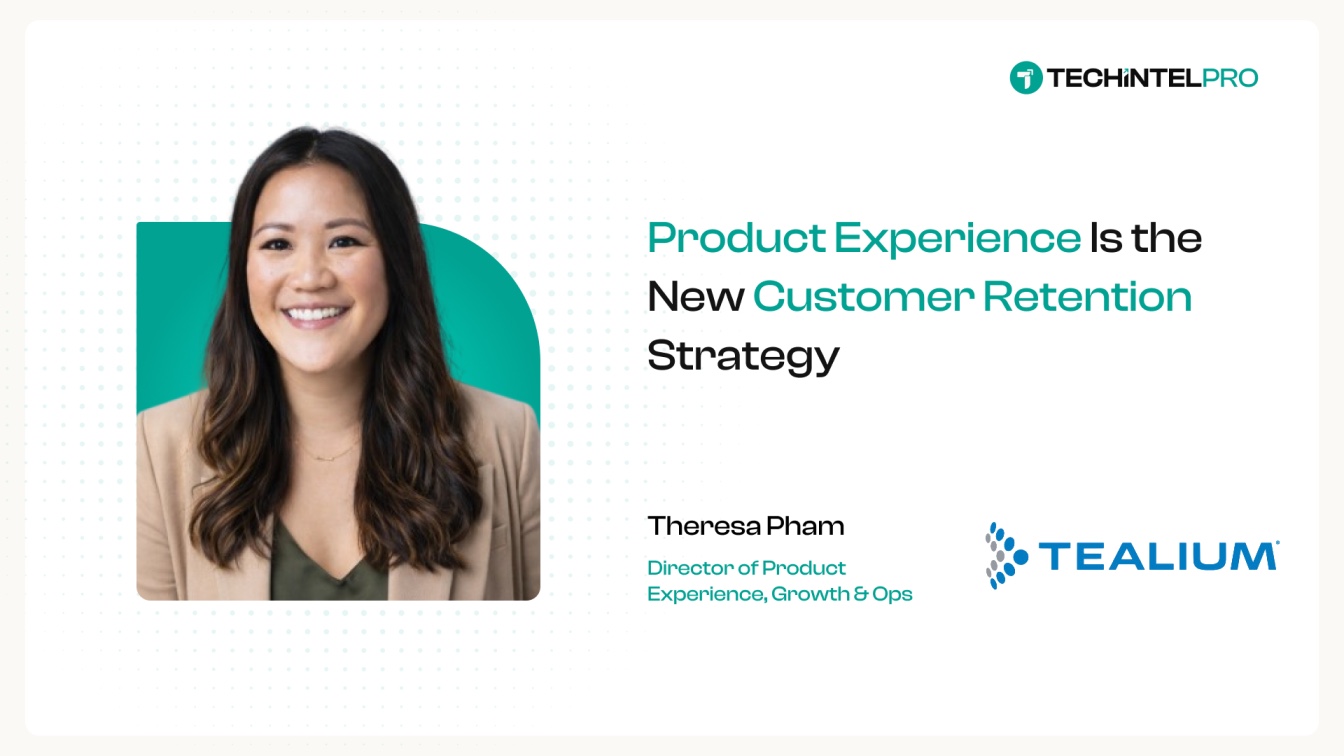
As AI makes products look increasingly similar, experience becomes the only thing customers truly remember.
Theresa Pham, Director of Product Experience, Growth & Ops at Tealium, explains why clarity, emotional connection, and customer confidence are becoming critical differentiators in modern software. She shares how teams can simplify complexity, create stronger feedback loops, and design experiences that keep customers engaged long after onboarding.
The products people genuinely love tend to share the same core patterns. They reduce friction, create confidence, and help people feel capable. The best products make complicated things feel approachable.
Having worked in marketing and digital experience for more than 20 years across many brands and industries, I’ve also seen firsthand how much brand shapes perception long before someone even touches the product. I’ve watched countless organizations invest heavily in rebrands because they understand how powerful emotional connection, identity, and trust are in influencing customer decisions. People do not choose products based only on functionality. They choose brands that feel credible, aligned with their values, and safe to bet on professionally and personally.
What’s changed dramatically today is the pace of customer expectations. Especially now, working in enterprise software, products are no longer compared only against direct competitors. Customers compare every experience to the best consumer products they use every day. The expectations around usability, personalization, speed, and polish continue rising rapidly.
AI has accelerated that shift even further. Conversational interfaces, intelligent guidance, and reducing manual work are quickly becoming expected parts of modern experiences. Customers increasingly want software that understands intent and helps guide them toward outcomes instead of forcing them through rigid workflows.
But despite all of that change, one thing has stayed consistent: technology alone does not create attachment or make you love a product. As AI capabilities become more accessible and digital experiences start looking more similar, differentiation becomes less about features and more about trust, confidence, and emotional connection.
I believe that makes brands even more important in the AI era. The products that win will not simply be the ones with the smartest technology, but the ones customers consistently trust to help them succeed.
At the end of the day, we’re all trying to achieve the same outcomes: keeping customers successful and helping new customers see value quickly. But there’s a big difference between partnering with these functions and actually having accountability across them.
Bringing these areas together helps close the gaps that naturally happen between teams. Product may be optimizing for feature delivery, growth for adoption, operations for process, and content for education, but customers experience all of it as one connected system. They don’t separate those functions in their minds.
Having these practices under one umbrella allows us to connect signals faster, align teams around the same priorities, and react more quickly when we learn something new. It creates tighter feedback loops between what customers are struggling with, what we’re building, how we educate, and how we drive adoption. That alignment becomes even more important in a fast-moving AI environment where customer expectations are changing quickly.
I’ve always believed simple experiences are much harder to design than complicated ones. The easiest thing to do is expose the underlying technology directly to the customer and force them to think like the system. But users should not have to think like an engineer in order to achieve their business outcomes.
For me, it starts with understanding human behavior as much as technology. Good product experiences reduce cognitive load. They guide people progressively, help them build confidence, and create moments of clarity along the way.
That’s why I believe so strongly in design thinking and broad ideation before narrowing toward solutions. AI is incredibly powerful, but large language models often reproduce familiar patterns. What creates real delight is observing real customers, noticing friction they may not even articulate, and designing around those moments.
AI can automate work in ways we could barely imagine a few years ago, but automation alone is not enough. Customers still want transparency, control, and trust. Especially in data and AI platforms, people need to understand what the system is doing, why it’s doing it, and where they remain in control. Building trust becomes an even more important component of the experience.
There’s a fine balance between guiding users and overwhelming them with information. In the age of AI, it’s easier than ever to generate content, explanations, recommendations, and guidance, but more information does not automatically create more clarity.
I think one of the biggest mistakes enterprise software makes is assuming simplicity means removing capability. Good design is not about making powerful things less powerful. It’s about making power feel approachable.
First, we focus on defining repeatable patterns that can be used consistently. We want users to build familiarity as they move through the product rather than constantly relearning interactions. We focus on creating patterns with clear guardrails for what is fixed, flexible, and free. This model helps teams make the right decisions to stay consistent, while not sacrificing nuance if the problem they are trying to solve doesn’t exactly fit the mold.
We support a wide range of users, including marketers, analysts, developers, and data scientists. Each persona can have very different needs within the same experience. But what is true is that not every user needs every detail exposed at every moment. As we evolve our product and bring in more people into the platform, we lean much harder into design principles like progressive disclosure to reveal complexity at the right time, in the right context, as users grow more advanced or need deeper control.
We have always believed that our documentation is a critical part of our product’s success. For many customers, documentation is the product experience when they are onboarding, troubleshooting, learning, or deciding whether they trust your platform enough to scale with it.
Additionally, it works not just to support our customers, but is a critical marketing tool for us as well. In early vendor evaluations, many of our customers build awareness of our capabilities through our documentation, long before they talk to someone at our company. It’s setting our product up for success long before a user gets their hands on our product.
Good documentation also reduces dependency on support, accelerates adoption, and helps customers achieve value faster. But beyond that, it creates confidence. In complex enterprise platforms, customers want reassurance that the company behind the product is thoughtful, organized, and invested in helping them succeed.
What’s especially important in the AI era is that documentation is no longer just for humans. It is now the context for AI systems themselves. The quality and structure of your documentation directly impact the quality of AI-generated guidance, copilots, and agentic experiences. If the documentation is fragmented or unclear, the AI experience will be too.
I also think we’re moving away from the old model where users stop what they’re doing to search through documentation portals. The opportunity now is intelligently surfacing the right guidance at the point of need, based on user intent, workflow context, or signals that suggest where someone may be struggling.
As interfaces become more conversational and AI-driven, customers still need grounding. They want transparency, clarity, and confidence in how systems behave. The best technical writing is not just accurate; it understands user intent, anticipates friction, and helps people move forward with confidence instead of frustration.
I think one of the most important moments in the customer journey actually happens after the initial implementation success is celebrated.
At Tealium, we work very closely with customers to help them achieve value early on. But the real challenge begins once the launch is over and customers are left to drive momentum on their own. That’s where product experience becomes incredibly important.
Customers often hit a point where they ask, “Now what?” They may have solved the original use case, but they do not always know what additional value is possible or what next opportunity they should tackle with their customer data.
That’s why I think modern product experiences need to do more than support workflows. They need to continuously inspire new ones. The product should help customers identify opportunities, surface relevant next steps, recommend use cases, and reduce the effort required to go from idea to execution.
Especially in a platform like Tealium, where customers have a rich foundation of real-time consented customer data, the opportunity is enormous. But if customers cannot easily see what’s possible next, value creation can stall.
To me, a great product experience is about keeping that momentum and curiosity alive long after onboarding ends.
A few principles consistently guide how I think about products:
I also strongly believe product teams should spend more time observing real customer behavior instead of relying only on assumptions or internal perspectives. Some of the most valuable product insights come from watching where users hesitate, second-guess themselves, or create workarounds. While AI can do some research for you, it’s much harder to see and react to those subtle human cues that indicate friction. Those are the moments to dig in with a good old-fashioned “tell me more.”
The products people remember are the ones that show up when it matters most.
Technology will continue changing rapidly. Interfaces, AI capabilities, and interaction models will all evolve. But what customers remember is whether your product helped them respond confidently in a high-pressure moment.
Some of my favorite customer stories are not about flashy features. They’re about moments where a business had to react quickly to a market shift, natural disaster, breaking event, or sudden business pivot, and they were able to move fast because of Tealium. They didn’t have to wait months on IT backlog or untangle operational overhead. They could act in real time and trust the platform to support them.
To me, that’s what great products do. They create confidence under pressure. They remove friction when the stakes are high. And when customers consistently feel like your product helped them succeed in moments that mattered to their business, that’s what creates long-term loyalty.
Theresa Pham is a product leader with 20 years of experience spanning enterprise SaaS, consumer platforms, and product modernization. At Tealium, she leads product experience across UX, design systems, product operations, growth, technical documentation, and AI-powered workflows for a real-time customer data platform. Previously at Intuit, she worked on personalization and growth initiatives for TurboTax across more than 30 million users.
Her work focuses on helping brands create better customer experiences by simplifying how teams use customer data to drive personalization, engagement, and measurable business value. She is particularly focused on improving how cross-functional teams build, ship, and scale modern software through clearer operating models, better product experiences, and AI-assisted workflows.
More about Theresa: 
Tealium delivers trusted data for AI at enterprise scale with its leading customer data orchestration platform. As the foundational data layer, Tealium delivers a hybrid customer data platform (CDP) built for both composable architectures and real-time activation, including intelligent data streaming, a context engine, enterprise tag management, and a robust API Hub. Its turnkey integration ecosystem connects seamlessly with leading data clouds and technology providers, including more than 1,300 prebuilt integrations and a growing AI Partner Ecosystem. By delivering real-time, contextual, enriched, and consented data, Tealium helps enterprises accelerate AI performance, improve operational efficiency, and power customer experiences in the moments that matter. More than 850 global businesses trust Tealium to deliver their customer data strategies.
For more info, visit tealium.com
Tell others what you think of TechIntelPro.



 Rate us on G2