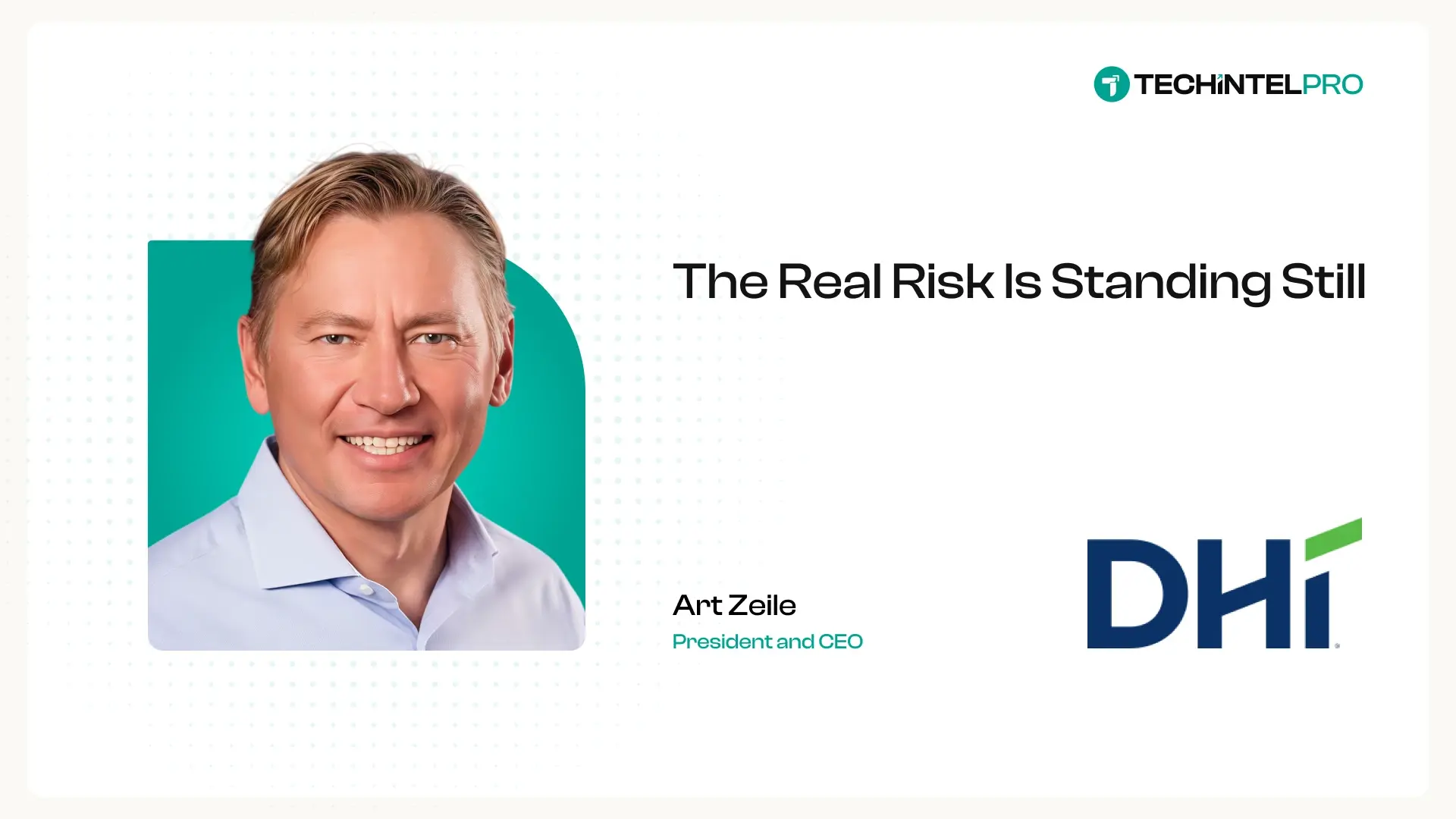
Art Zeile has a data-backed answer to the question haunting every technologist: should I worry about AI taking my job? According to DHI Group's latest figures, AI/ML tech postings grew 101% year over year in August 2026, against 18% for tech overall. His reading is that AI is coming into jobs rather than for them, creating new demand while changing the skills employers expect in existing roles. The danger, Zeile says, is not the technology itself but a career in which capabilities stay static while the work changes around them.
As President and CEO of DHI Group, the parent company of Dice and ClearanceJobs, Zeile watches the market from both sides of the hiring table, having previously co-founded HOSTING, led QTC Management, and served in the U.S. Air Force. In this conversation, he explains why there is no single tech labor market, why strong hiring is showing up in finance, manufacturing, insurance, and aerospace and defense, and why employers are still hiring but with far greater precision. He also makes a contrarian prediction: that AI will make proven technical expertise more valuable, not less, pointing to a 15% year-over-year rise in demand for professionals with more than 10 years of experience, while entry-level postings remain 38?low 2019 levels.
I don’t think this is a short-term phenomenon. AI is becoming embedded in how technology work gets done, and demand for AI/ML talent continues to grow much faster than the broader tech market. We’re seeing AI/ML tech postings grew 101% year over year in August 2026, compared with 18% for tech overall. And this demand is not limited to people with AI in their job title; it is increasingly showing up across technology functions. Over time, AI proficiency will likely become less of a distinct category and more of an expected part of being a technology professional. .
The aggregate numbers obscure a lot of what is actually happening in technology hiring. There is no single tech labor market. Demand varies considerably by skill, experience level and industry, and some of the strongest hiring is happening outside the companies people traditionally think of as technology employers. Our latest data show that demand for AI/ML talent continues to grow significantly faster than the broader tech market, while tech hiring is also showing strong growth in industries such as finance and banking, manufacturing, insurance, and aerospace and defense. So describing the tech job market as simply weak overlooks the significant variation in demand across skills, experience levels and industries. Employers are still hiring, but they are doing it with considerably greater precision. The market has become more specialized, and the skills you bring increasingly determine which version of that market you experience.
Employers have more leverage than they did at the height of the talent shortage, but I would not confuse leverage with a permanent change in what technology professionals value. In fact, remote tech postings actually increased 6% year over year while nonremote and hybrid postings declined 7%. We also see professionals putting greater weight on stability alongside compensation and flexibility. That tells me the conversation has matured from people not just looking at remote work in isolation, but that they are evaluating the entire employment proposition. Employers can certainly be more selective today, but when you need scarce technical expertise, you are still competing for talent, and flexibility remains part of that competition.
Building a company forces clarity. You have finite resources, you are very close to the customer, and you learn quickly whether the decisions you are making create value. A public company operates at a different scale and has a broader set of stakeholders, but I think the discipline is remarkably similar. You need to understand the customer exceptionally well, be clear about where the company is differentiated and allocate resources accordingly. As organizations grow, there is always a risk that complexity begins to obscure those fundamentals. One of the most important responsibilities of a CEO is to prevent that from happening.
I have never thought of mission and growth as competing objectives. A strong company has to understand precisely whom it serves and the value it creates for them. At QTC, that was particularly tangible because the work directly affected veterans and military personnel. The business still had to perform, but its success depended on fulfilling that responsibility. I think that principle carries across industries. At DHI, our purpose is different, but there are still real people on both sides of our marketplaces making consequential decisions about careers and talent. If you remain focused on creating meaningful value for them, growth becomes an outcome of executing the mission well.
Specialized hiring is not a volume problem. It is a precision problem. If a position requires a security clearance, a highly specialized technical capability or both, the addressable talent pool is constrained before the search even begins. That changes the recruiting equation. Employers need to be much more rigorous about identifying which capabilities are truly essential and how a candidate can demonstrate them. We are starting to see the same dynamic across the broader technology market as roles become more specialized. That is one reason skills-based hiring is becoming more important. A degree, job title or number of years of experience can tell you something about a candidate, but employers ultimately need evidence that the individual can perform the work. In the right context, a relevant certification can be a useful part of that evidence.
The more useful way to look at AI is that it is coming into jobs, not simply coming for them. Our data shows that overall tech postings increased 18% year over year, while AI/ML tech postings increased 101%, suggesting that AI is creating new demand even as it changes the skills employers expect within existing roles. There will certainly be tasks that are automated and occupations that are disrupted, but for most technology professionals the immediate challenge is adaptation. The real career risk is not that AI exists. It is allowing your capabilities to remain static while the work changes around you.
I believe that AI will make proven technical expertise more valuable, not less. There is a fairly common assumption that greater productivity from AI necessarily translates into less demand for technology talent, but the more consequential change will be in how employers define talent. As AI takes on more routine work, judgment, technical depth and the ability to apply these tools to real business problems become more valuable. We are already seeing employers favor demonstrated expertise. Our research has found that demand for professionals with more than 10 years of experience increased 15% year over year in the first quarter of 2026, while entry-level postings remain 38?low 2019 levels. Over the next two years, I expect employers to become much more rigorous about determining what candidates can actually do. Experience will matter, but so will current skills and credible ways of demonstrating them, including relevant certifications.
Art Zeile is the President and CEO of DHI Group, Inc., the parent company of tech career marketplaces like Dice.com, ClearanceJobs, and eFinancialCareers.
A tech entrepreneur and veteran, he previously co-founded cloud hosting provider HOSTING and public data center company Inflow Inc., and served as CEO of QTC Management. He is a U.S. Air Force veteran and a graduate of the U.S. Air Force Academy and Harvard University.
More about Art: 
DHI Group, Inc. (NYSE: DHX) is the parent company of Dice.com and ClearanceJobs.com. We are a leading provider of career marketplaces connecting technology talent with employers to find ideal career opportunities and recruiters with skilled technologists to move business forward. Today, we serve multiple markets primarily located throughout North America.
More information is available at www.dhigroupinc.com.
Tell others what you think of TechIntelPro.



 Rate us on G2