As AI becomes more accessible, the technology itself is rapidly losing its competitive edge. The real question is no longer "who has AI" but "who knows how to use it better."
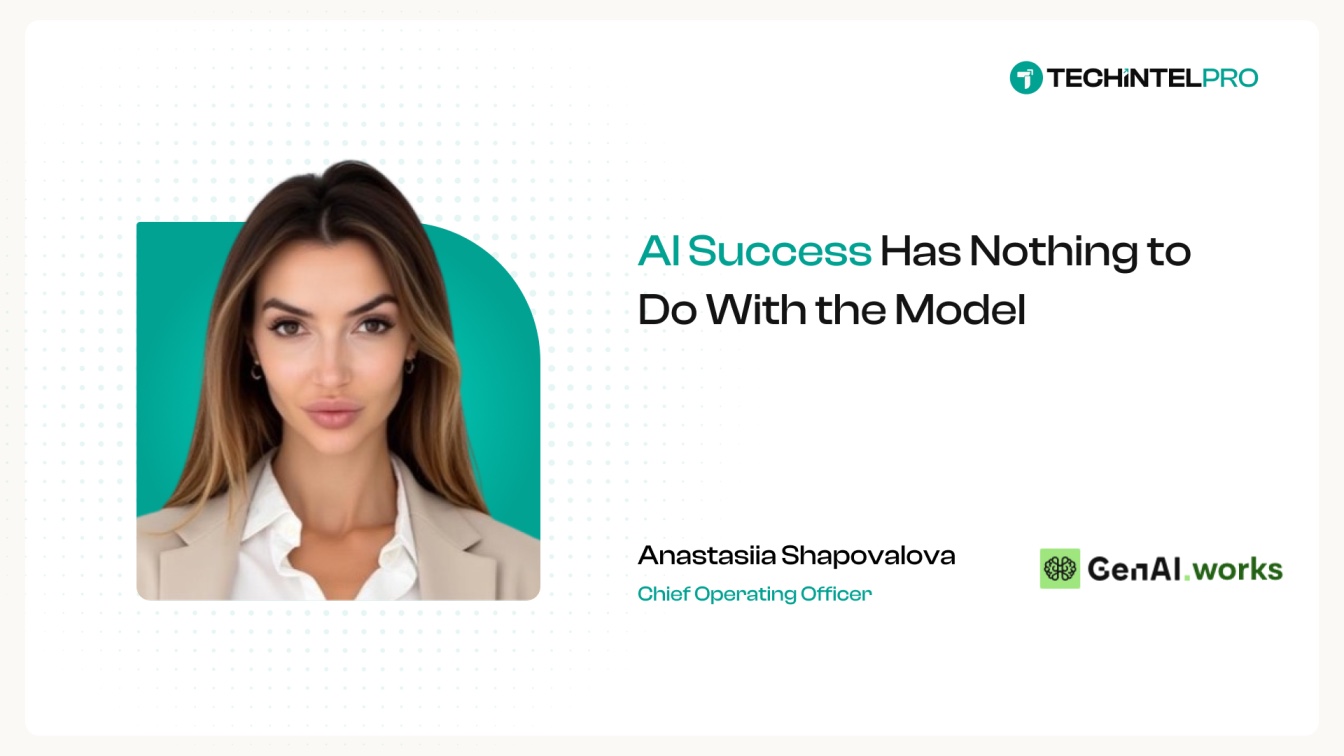
Anastasiia Shapovalova, COO of GenAI Works, shares why continuous learning is becoming every organization's biggest AI advantage. She discusses how education, community, partnerships, and practical frameworks can accelerate adoption, help businesses uncover real opportunities, and prepare their teams for an AI landscape that's evolving almost daily.
I came into AI from three directions at once. I spent years in academia (I hold a PhD and taught computer science and information security), I’ve operated and advised on the business side, and I’ve always cared about how real people actually learn a new technology. That mix shapes how I run GenAI Works. In a field that changes weekly, I don’t try to predict the perfect answer; I build systems that adapt. The academic in me insists on rigor and evidence, the operator in me cares about shipping and revenue, and the educator in me keeps asking, “will a real person be able to use this?” In practice that means we test quickly, kill what doesn’t work, and turn every trend into something practical, like a workflow, a course or a template, rather than hype. Evolving daily isn’t a threat if your operating model is built to learn faster than the market does.
A community only matters if it changes what people can do. We’ve grown to roughly 14 million people (founders, enterprises, educators and practitioners), with a newsletter that reaches around 3 million. But the value isn’t the size, it’s the proximity. A founder building an AI product is one connection away from the enterprise that needs it, the educator who can teach it, and the audience that will try it. We deliberately convert that into outcomes: media collaborations that put startups in front of millions, hackathons (including our work with partners like Oracle, IBM, NVIDIA, G42 etc.) that produce real prototypes and talent, and an Academy that turns attention into skills. So knowledge-sharing is the front door; the real product is acceleration: faster distribution, faster hiring, faster validation. When the right people are densely connected and we remove the friction between them, innovation and business growth become a byproduct of the network rather than a separate program.
Traditional GTM assumes a stable product, a known buyer and a long sales cycle. In AI, the product shifts under you, the buyer is still defining the problem, and the cycle has to move fast. We rethink GTM around community-led and education-led growth. Instead of interrupting people with ads, we earn attention by being genuinely useful, through news, practical content and courses, and let that trust shorten the path to a conversation. We also start from real demand signals rather than assumptions: what are people actually searching for, hiring for, and struggling with? Then we meet them there. For our partners, that means we can help an AI company find and engage the right audience at the speed the market moves, through voices people already follow, channels they already read, and formats that teach rather than sell. In the AI economy, GTM is less of a funnel and more of a flywheel of usefulness.
The honest answer is that the hard part is rarely the model. From our conversations, the blockers are organizational. First, people: most teams don’t yet have the AI literacy to spot where AI actually creates value, so pilots stall. Second, workflow: companies bolt AI onto a broken process instead of redesigning the process around it, and they get only marginal gains. Third, trust and governance: without clear rules on data, accuracy and human oversight, promising pilots never earn permission to scale. And fourth, measurement: teams can’t answer “what did this save or earn?”, so the budget quietly evaporates. The organizations that cross over treat adoption as capability-building, not a tool purchase. They upskill their people, pick a few high-value workflows, put guardrails in place, and measure ruthlessly. That’s exactly why our work pairs tools with education and practical frameworks: value comes from changing how people work, not from buying access to a model.
Different markets are at very different points, and pretending otherwise is how you become irrelevant. Some of our markets are deep into enterprise deployment and governance questions; others are in a fast, energetic skilling phase with enormous grassroots demand. We stay globally relevant by keeping a consistent core (credible, practical, vendor-neutral AI knowledge) while localizing the application. How a model works doesn’t change across borders; the use-cases, the regulatory context and the learner’s starting point do. Operating across time zones also forces good discipline: clear systems, asynchronous work, and a team that genuinely reflects the regions we serve. And being global is itself an advantage for the people we work with. A lesson learned by an enterprise in one region often becomes a shortcut for a startup in another, and we try to be the connective tissue that moves that insight around the world.
Those four functions are really one promise viewed from different angles. Community is where trust and demand are built. Education is how we turn that into durable capability: not a one-off webinar, but skills people keep. Partnerships are how we connect the players who need each other. And revenue operations is the discipline that keeps the whole thing sustainable and accountable. A tech provider sells you access and walks away. A growth partner stays in the loop: we help you reach the right audience, build your team’s skills, plug you into the right people, and keep showing up as the technology changes. Because these functions sit together, a relationship that starts with a piece of content can grow into education for your team, a partnership for your product, and a long-term GTM engine. We’re not trying to be one more vendor in your stack; we’re trying to be the partner you grow with.
In three years, access to models will be commoditized: everyone will have the same tools. What will separate the leaders is organizational fluency, meaning how quickly their people can turn a new capability into a working process, and how well they’ve built trust, judgment and governance around it. The laggards will still be running pilots; the leaders will have AI woven into how they operate, supported by a culture that keeps learning. We prepare our customers for that first group very deliberately: we keep them current through the community, build real skills through the Academy, give them practical frameworks and templates so adoption sticks, and connect them to the people and partners who accelerate them. Our whole bet is that the winners won’t be the ones who bought the most AI; they’ll be the ones who learned the fastest and applied it best. That’s the muscle we help them build.
Anastasiia Shapovalova is COO of GenAI Works, a global, market-informed GTM AI platform that helps AI startups, SaaS companies and Fortune 500 enterprises read realtime market demand and execute go-to-market strategies. She leads a community-focused initiative on LinkedIn with over 14 million followers. An AI specialist and academic, Anastasiia holds a PhD in Engineering Science and has been an Associate Professor at KNURE since 2015. Over more than a decade in the tech industry she has led large teams, developed operational strategies and established R&D centers, scaling AI systems across education, cybersecurity and technology. Her work centers on using AI ethically and responsibly, with a focus on transparency, explainability and mitigating bias, and she is a recognized thought leader who speaks regularly at international conferences and academic forums.
More about Anastasiia: 
GenAI Works is a global AI platform, a market-informed GTM AI company serving AI startups and enterprises worldwide. The company helps organizations understand real-time market demand and execute go-to-market strategies, enabling faster growth, lower customer acquisition costs, and more adaptive GTM execution.
GenAI Works serves a global customer base across enterprise, SMB, and education markets, with operations spanning the United States, Europe, and Central & South Asia.
Learn more at genai.works.
Tell others what you think of TechIntelPro.



 Rate us on G2