
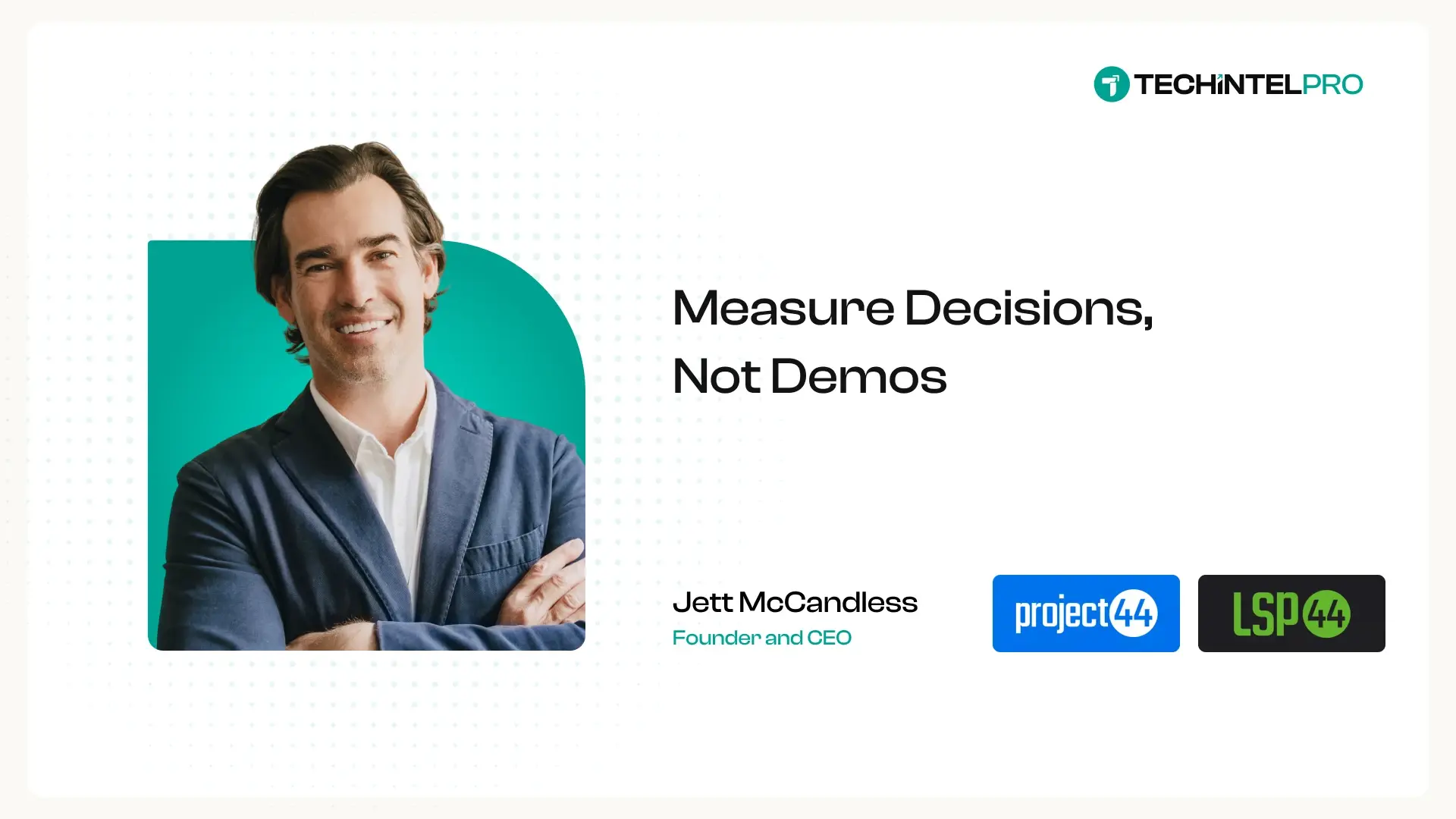
“I’m not particularly interested in winning the race to have the best demo. In logistics, the demo isn’t the hard part.”
Jett McCandless, Founder and CEO of project44 and LSP44, says the company he started in 2014 was always rooted in logistics service providers, and that separating them from its shipper business was as much a correction as a strategic move. A shipper wants technology to run its supply chain, he explains, while a logistics provider wants infrastructure it can build into its own technology to differentiate its service. AI made that tension impossible to ignore, so LSP44 now has its own engineering, go-to-market and roadmap, while sharing the carrier network, APIs, agent infrastructure and logistics data graph with project44. In his words, sharing infrastructure doesn’t mean sharing priorities.
In this TechIntelPro conversation, McCandless draws on his own years running a 3PL to explain what logistics providers want from vendors, why he has set 600 people as a forcing function for how the company scales, and why he is wary of competitors racing to build the most impressive AI agent. He explains why trust, context and years of carrier relationships matter more than a polished demo when something goes wrong at 2 a.m., what he expects a 3PL’s tech team to build and stop building over the next five years, and why the one metric he checks first is the number of decisions the system can analyse and execute.
A little of both. Our first customers were logistics service providers. They took a chance on us when we were basically trying to convince an industry running on phone calls, faxes and EDI that APIs were going to change how freight moved. We built a lot of the network alongside them.
Then project44 grew into the shipper market, and over time we were serving two customers that happened to participate in the same ecosystem but wanted fundamentally different things from us. A shipper wants technology that helps run its supply chain. An LSP wants infrastructure it can build into its own technology and use to differentiate its service.
For a while, we could accommodate both. AI made the tension much more obvious because both sides started moving faster in completely different directions.
So yes, separating them was strategic. But personally, LSP44 also feels like correcting the organizational structure around something that has always been true. We locked in on the LSP market and finally gave it a company built entirely around it.
I would have wanted someone to give me opportunities and leverage without telling me move-for-move how to run my business. That's a distinction I probably appreciate more because I've been on that side of the table. Logistics providers have their own processes, carrier relationships and ways of serving customers. That's their differentiation. A lot of technology companies come into logistics assuming the industry needs to be standardized around their software. I've always thought that's backwards.
When you've actually operated a logistics business, you realize how much of what makes it work is specific to that business. Two 3PLs can move the same freight and still have completely different ways of sourcing capacity, managing exceptions or serving their customers. I wouldn't have wanted a vendor to flatten those differences. I would've wanted one to take care of the underlying complexity so my team could spend more time on what made us competitive.
It's the infrastructure underneath: connecting carriers, normalizing messy data, understanding how freight moves and automating the repetitive work, so I can put my own technology and people toward what differentiates my business. That's much closer to what we're able to give LSPs today.
The separation itself.
If this were two product lines inside project44, that's a legitimate concern. That's part of the reason we didn't structure it that way. LSP44 has its own engineering organization, go-to-market team, and roadmap. project44 has the same, dedicated to shippers.
My job isn't to sit in the middle every week and decide which company gets another engineer. It's to make sure each leadership team has the mandate and resources to solve for its customer.
They share an incredibly valuable technical foundation: the carrier network, APIs, agent infrastructure, and the world's largest, most accurate, real-time logistics data graph, built over more than a decade. Sharing infrastructure doesn't mean sharing priorities.
The old structure created more risk of one customer winning than the new one does. When one product organization serves two fundamentally different buyers, every roadmap decision becomes a negotiation. Now each team can move faster against the priorities of the customer it was built to serve, and that's a much healthier way to build.
At a certain point, you start adding people to manage the complexity created by having added so many people. That's what I never want to repeat.
When you're smaller, an issue can go from the customer to the person capable of fixing it very quickly. As you scale, it's easy to convince yourself that every new problem needs another team, another manager or another process. Eventually, people spend an enormous amount of time coordinating the work instead of doing the work.
AI changes that equation pretty dramatically. The company of the future should not automatically add headcount every time revenue or workload increases. If technology can absorb repetitive coordination, analysis and administrative work, then a smaller group of really strong people should be able to operate at a scale that used to require twice as many.
So, 600 is a forcing function for how we think about scale. Growth shouldn't automatically mean increased headcount. Before we solve a challenge by adding people, I want us to ask whether the process should exist at all, whether software can handle it, or whether we've made the organization unnecessarily complicated.
The idea was to make our existing team more valuable with AI. We've used our productivity gains to expand into new initiatives like LSP44 so we can serve more customers.
Parts of team members' jobs are changing, such as how much of our code is now generated with AI. But those team members are still here, doing different work. There is still plenty of work to do to make sure we release a production-ready, scalable product that is valuable for our customers.
Most AI-native logistics startups are burning venture capital chasing product-market fit. LSP44 skipped that phase entirely. What do you think those competitors are optimizing for that you've deliberately decided not to chase?
A lot of them are optimizing for how quickly they can build an impressive agent. We're optimizing for whether that agent can be trusted to touch a customer's freight, and those are very different problems.
You can build an agent quickly now. What you can't manufacture quickly is ten-plus years of carrier relationships, integrations, shipment history and all the context that tells the agent what a piece of logistics data actually means. Raising another $50 million doesn't make a model understand why one carrier performs differently on a particular lane, or what an exception means for a particular customer.
We've already spent the better part of a decade building that underlying infrastructure. LSP44 also didn't have to go find a hypothetical market for it, as nine of the ten largest logistics providers already use the infrastructure.
So, I'm not particularly interested in winning the race to have the best demo. In logistics, the demo isn't the hard part. The hard part is what happens at 2 a.m. when something goes wrong with a real shipment and your customer's business is depending on the software making the right call. That's what we're optimizing for.
Most of the insights our system surfaces are ones humans weren't catching even before AI.
Our customers' teams typically don't have the scale to manage every exception our platform generates. Where our products have been most successful is helping customers serve more of their own customers. Instead of reacting only to the most urgent exceptions, teams can use AI in our platform to be proactive for the ones they never would have had time to triage.
They're building a lot more of what makes their company unique and rebuilding a lot less infrastructure that already exists. The best logistics providers are going to become much more technically sophisticated because technology increasingly determines the service they can deliver to a customer. But being a technology company doesn't mean you should build everything yourself.
A 3PL shouldn't have its best engineers spending months maintaining hundreds of carrier connections, building another document workflow or recreating basic visibility infrastructure. That's plumbing. In five years, those teams will spend much more time designing proprietary customer experiences, building new services, encoding their operational expertise into agents and deciding where automation creates a competitive advantage.
They'll spend much less time maintaining the connective tissue underneath all of it.
That's ultimately what I want LSP44 to be: the infrastructure layer they don't have to think about, so their technical talent can go work on the reasons a shipper chooses them instead of somebody else.
I'd look at decisions made.
I'm less interested in how many agents we've launched or whether AI made a process 20?ster. What matters is how many decisions the system was able to analyze and ultimately execute that otherwise would have required someone to stop, assess the situation and decide what to do next.
There are tens of thousands of decisions happening across a supply chain every day. Which carrier should take this load? Does this exception actually require intervention? Should a shipment be rerouted? Is there a better option based on what changed five minutes ago?
Historically, people could only get to a fraction of them.
That's the shift I'm looking for. If project44 and LSP44 are each helping their customers make and execute more of those decisions, with the context of their specific businesses behind them, then we've built each company around the right problem.

Jett McCandless is the Founder and CEO of project44 and LSP44, with more than 25 years of experience transforming global supply chains. A supply chain technology pioneer, he previously built and scaled companies including GlobalTranz and Metafora, and has advised senior U.S. government officials on supply chain issues. Under his leadership, project44 has become a global leader in supply chain decision intelligence, serving more than 500 Global 2000 brands, including Nike, Amazon, Toyota and Starbucks. Jett is also a frequent Bloomberg TV commentator and founder of Blue Water Companies, through which he supports philanthropic and sustainability initiatives.
More about Jett McCandless: 
project44 is the Decision Intelligence Platform for the modern supply chain. Its context-based AI transforms fragmented logistics management into unified intelligence, bringing certainty to global supply chain operations. With intelligent transportation management, end-to-end visibility, yard management and last mile solutions, and a preferred carrier network of 285,000 carriers, project44 connects over 1.5 billion shipments annually for over 1,000 leading brands in manufacturing, automotive, retail, life sciences, food and beverage, CPG, and oil, chemical and gas.
Learn more at project44.com.
Tell others what you think of TechIntelPro.


 Rate us on G2