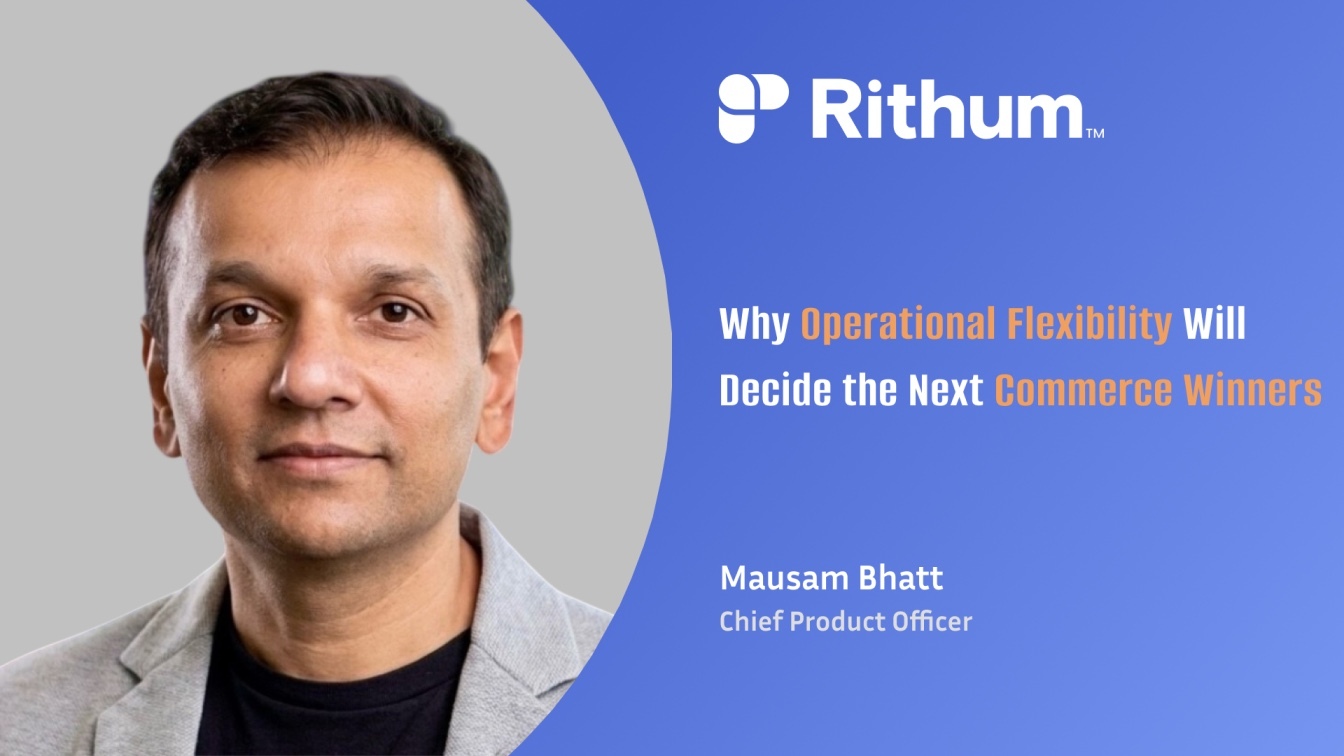
Commerce is getting harder to operate, not easier to grow. As brands expand across marketplaces, retailers, and channels, operational complexity is becoming the real bottleneck, and AI alone is not fixing it.
Mausam Bhatt, Chief Product Officer of Rithum, explains why the next phase of commerce will be shaped by connected systems, operational discipline, and AI embedded directly into workflows. He shares how brands can reduce friction at scale, simplify fragmented commerce operations, and build the kind of flexible, data-driven infrastructure needed to compete in an increasingly networked commerce ecosystem.
My first priority is understanding how the system actually operates end-to-end across customers, partners, product, engineering, and go-to-market teams. Companies often underestimate how much complexity accumulates as platforms scale, especially in commerce ecosystems.
From there, the focus is on three things: improving execution consistency, simplifying the customer experience, and making better use of the network and data advantages Rithum already has.
AI is clearly a major shift in commerce, but the real opportunity is not just adding AI features; it’s using AI to help customers operate more effectively at scale, whether that is improving assortment decisions, accelerating channel expansion, streamlining onboarding, or increasing operational efficiency. My focus is on making sure those capabilities translate into measurable customer outcomes, not just experimentation.
Most strategies break down at the operational layer.
It is relatively easy to create a strategy for expanding across marketplaces, retailers, dropship programs, and emerging channels. What becomes difficult is executing consistently across all of them while maintaining data quality, inventory accuracy, pricing consistency, fulfillment reliability, and profitability. That is where scale creates friction.
What makes Rithum interesting is that we sit at the center of a very large commerce network connecting brands, retailers, suppliers, and channels. That gives us a unique vantage point into how commerce actually operates at scale.
The opportunity is to turn that network, data, and operational footprint into a more unified and intelligent commerce platform that reduces complexity for customers instead of adding to it.
The most immediate value from AI today is around automation, decision support, and reducing operational friction. There is a lot of attention on conversational commerce and agentic experiences right now, but for most brands and retailers, the bigger opportunity is improving the underlying operational system that powers commerce.
That includes things like onboarding and catalog enrichment, identifying assortment gaps, improving channel recommendations, surfacing operational risks earlier, and helping teams make better decisions using data across the network.
One of the biggest mistakes companies make is treating AI as a separate layer instead of embedding it directly into workflows where users already spend time. The goal should be measurable improvements in efficiency, speed, and outcomes, not just AI-driven experiences for their own sake.
The scale and connectivity of the network.
Rithum sits at the intersection of brands, retailers, suppliers, marketplaces, and fulfillment partners. That creates a unique combination of operational reach and data visibility that is difficult to replicate.
What is especially compelling is the ability to support both sides of the commerce ecosystem. Many platforms are optimized for either brands or retailers. Rithum has the opportunity to create value across both simultaneously, which becomes increasingly important as commerce networks become more interconnected.
As AI becomes more embedded in commerce, that combination of network, data, and execution will matter even more.
You have to start with customer outcomes and strategic leverage.
In large platforms, there is always pressure to add more features or support highly specific requests. The harder and more important question is whether a capability meaningfully improves the platform, simplifies the customer experience, or creates repeatable value at scale.
I generally look at whether something is solving a meaningful customer problem, strengthening the platform instead of adding fragmentation, and creating value that can scale operationally over time. From there, the question becomes whether it improves adoption, retention, or growth and whether it aligns with where the market is heading.
Equally important is being willing to simplify. Over time, complexity compounds, and part of product leadership is knowing what to consolidate, streamline, or retire so the platform becomes easier to operate and easier for customers to understand.
A stronger connection between product investment and measurable outcomes.
The best product organizations balance customer empathy, strategic thinking, technical depth, and operational discipline. They are clear on priorities, move with urgency, and continuously learn from customer behavior and data.
A few areas I care deeply about are stronger product and engineering alignment, tighter feedback loops with customers and go-to-market teams, clearer prioritization and sequencing, more disciplined product lifecycle management, and better measurement of adoption and customer impact.
I also want teams to embrace AI-native ways of working internally, whether that is in product development, research, analytics, or operational workflows. The pace of change in technology is too fast for organizations to operate the same way they did even a few years ago.
The biggest shift is that commerce is becoming increasingly networked, automated, and data-driven. Brands and retailers should be thinking beyond individual channels and instead optimizing for how their entire commerce ecosystem operates together. That includes marketplaces, owned channels, retailers, fulfillment partners, social commerce, and emerging AI-driven discovery surfaces.
Operational flexibility is going to matter a lot. The companies that win will be the ones that can adapt quickly to new channels, onboard partners efficiently, maintain high-quality data, and make better decisions faster.
AI will accelerate all of that, but the companies that benefit most will likely be the ones that already have strong operational foundations and connected commerce systems in place.
Mausam Bhatt is Chief Product Officer at Rithum, bringing extensive experience as a product and technology leader across global digital platforms, marketplaces, and commerce organizations. He has led large-scale platform transformations, built high?performing product and engineering teams, and driven innovation at scale. Prior to Rithum, he has held senior leadership roles at companies including Google, RetailMeNot, and Flipkart, and most recently served as Chief Product and Technology Officer at Realtor.com, where he led product and engineering and drove platform modernization and AI adoption.
More about Mausam: 
Rithum (formerly CommerceHub and ChannelAdvisor) is a leading global commerce solution that supports the entire commerce journey—from product listing and discovery to order fulfillment and performance optimization. By streamlining the path to purchase, Rithum enables brands and retailers to operate more efficiently, so they can maximize profitability.
With AI-powered automation, unified insights, and seamless integration across commerce and media channels, Rithum enables your team to focus on growth strategies while we handle the complexity of omnichannel orchestration. Whether you’re launching new products, expanding into new markets, or optimizing retail media campaigns, Rithum helps you turn every customer touchpoint into a revenue-driving opportunity.
Learn more at rithum.com
Tell others what you think of TechIntelPro.



 Rate us on G2