Companies are racing to deploy AI. Their operating models are standing still. That disconnect sits at the heart of enterprise AI adoption today.
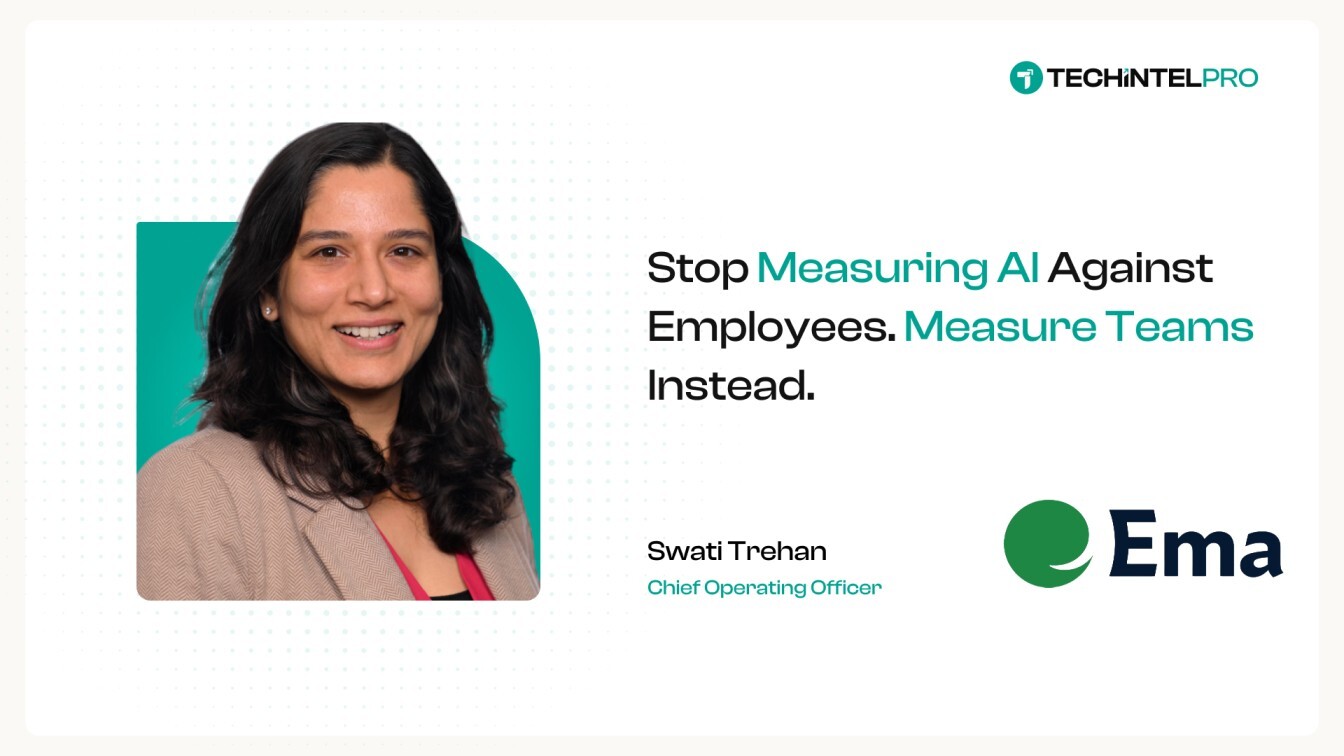
Swati Trehan, COO of Ema, shares why organizations need to rethink how work flows before expecting AI to deliver meaningful outcomes. She discusses practical approaches to embedding AI employees into business operations, coordinating them across teams, and creating governance models that allow people and AI to work together at scale.
Most organizations still think of AI as software or a tool, so they expect it to be right 100% of the time or assume its value comes from replacing the person doing the work. That framing misses AI’s bigger opportunity. AI behaves much more like a teammate than traditional software, and the real value comes from building an operating model where humans and AI work together, each contributing what they do best.
The bigger opportunity is designing work around the strengths of both. AI should handle repetitive, high-volume work while people focus on judgment, escalation, and complex decision-making. When organizations stop treating AI as a competitor and start measuring the performance of the combined team, they unlock much greater value.
Leaders should start with the business outcome they’re trying to achieve, then identify the bottlenecks, repetitive tasks, and manual work slowing them down. From there, map the workflow to determine where AI can take ownership, where humans need to supervise, and where decisions should be escalated. You quickly see that there are more opportunities for AI to handle repetitive tasks while people spend their time on work that truly requires experience and judgment.
Ownership shouldn’t become more complicated simply because AI is involved. The same managers who oversee people today should also oversee the AI employees supporting their teams. Department leaders can monitor performance across functions, while someone like a CIO provides enterprise-wide governance. AI should fit into an organization’s existing operating model rather than forcing companies to invent an entirely new one.
We’re seeing companies recreate the same fragmentation they experienced with enterprise software. Instead of dozens of disconnected applications, they now have dozens of disconnected AI agents that can’t work together across functions. That’s why at Ema, we don’t begin with technology. Our initial goal is always to bring together HR, IT, finance, and other business leaders to understand their biggest operational bottlenecks.
Once everyone aligns around the business problem, Ema becomes the orchestration layer across the enterprise, coordinating multiple AI employees that can take action across the existing technology stack. The platform enables those AI employees to work seamlessly across functions while maintaining role-based access controls, governance, and enterprise security, so organizations get one coordinated AI workforce instead of another collection of isolated tools.
Enterprise workflows are complex because businesses are complex. Every organization already has reporting structures, approval chains, and governance models, so AI should work within those existing structures rather than outside of them.
At Ema, managers can monitor AI employees the same way they monitor human employees, by tracking performance, accuracy, completeness, and adherence to business rules in real time. Human oversight doesn’t disappear. It simply shifts from doing repetitive work to supervising outcomes and making higher-level decisions when judgment is required.
The technology is moving incredibly fast, but that’s no longer what slows organizations down. The hardest part is organizational change. Leaders have to answer questions that technology alone can’t solve. How should work be divided between humans and AI? What new skills do employees need? Who owns governance? How do you bring security, procurement, HR, and IT together before deployment instead of after? Those conversations determine whether AI becomes another pilot project or a true business transformation.
One of the biggest mindset shifts is realizing that AI should follow the business problem, not the other way around. Last year, many organizations had large AI budgets and felt pressure to spend them without first identifying where AI would create measurable value.
The organizations seeing the strongest results ask a different question. They bring together business leaders, identify the highest-impact bottlenecks, and then determine where AI fits into the solution. That’s a very different conversation from shopping for AI features.
I hope organizations stop asking whether AI can replace people. That’s the wrong question because it frames AI as something separate from the workforce rather than a part of it.
I’d rather see leaders asking, “What business problem are we trying to solve, and what’s the best combination of people and AI to solve it?” Eventually, managing AI employees shouldn’t require specialized technical expertise. Business leaders understand their operations better than anyone else, and they should be able to manage AI through natural interactions without worrying about prompt engineering or the underlying technology.
Swati Trehan, COO at Ema, has extensive experience in strategy and operations. She has built and led various R&D Operations teams at Shopify. Starting her career at McKinsey & Co., Swati has also used her product strategy expertise to help grow Google brands, including Search, Maps, YouTube, Shopping, and Ads. She holds an MBA from Harvard Business School with a B.Tech and M.Tech from IIT Delhi.
More about Swati: 
Ema is a leading AI Employee platform helping enterprises transform work through autonomous AI agents. By bringing HR, IT and Payroll together on a single platform, Ema enables organizations to automate and orchestrate employee experiences and business processes end to end. Built for enterprise scale, Ema combines advanced AI reasoning with enterprise-grade governance, security and compliance, and integrates with more than 250 business applications and systems of record. Trusted by organizations including Wipro, Hitachi, ADP and PwC, Ema helps enterprises deploy AI in production in days and achieve measurable business outcomes.
Learn more at ema.ai.
Tell others what you think of TechIntelPro.


 Rate us on G2