
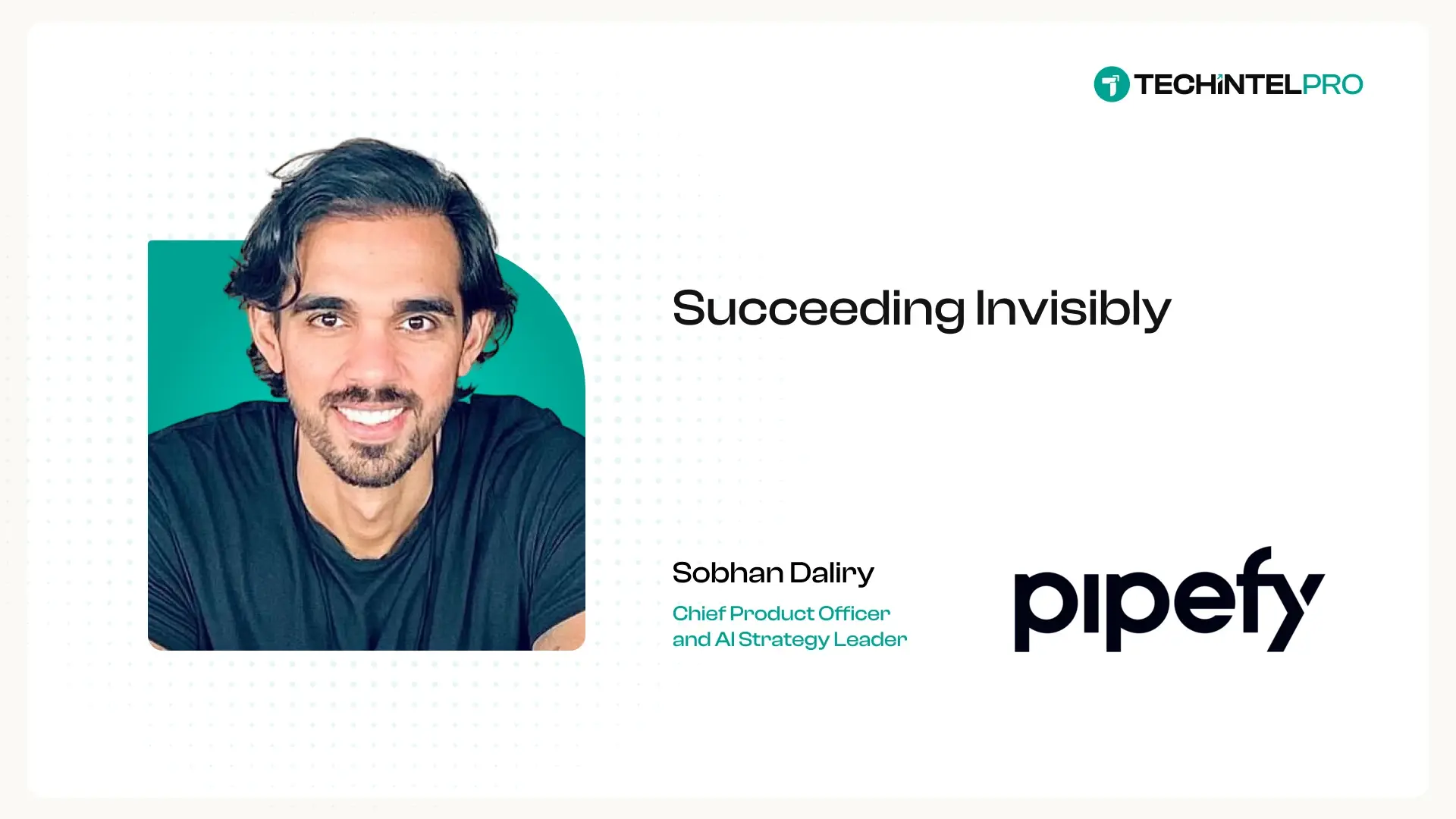
Sobhan Daliry, Chief Product Officer and AI Strategy Leader at Pipefy, says the real risk with AI agents is not that they fail visibly but that they succeed invisibly. An agent that approves invoices under a tolerance can get almost all of them right, cut cycle times and empty the exception queue, and months later nobody can say which rule, prompt version or model made the decisions that let one supplier’s prices creep up. His answer is to watch the exception rate, have people redo a sample of agent decisions blind, and measure how many agent actions can be traced to an input, a rule and an owner who could override it.
In this conversation, Daliry draws on a career that began in telecom in Brazil to explain why Pipefy’s customers keep asking for audit trails early, and what changes when an AI assistant such as Claude becomes the front door to a company’s workflows through MCP. He covers what localizing agentic AI means beyond language, when gallery agents work out of the box, how to orchestrate agents already scattered across marketing, finance and procurement, and why he expects most large-company back-office processes to run without a person touching the normal case, with the model chosen per task and the value sitting in the context around it.
I started in telecom in Brazil, Claro and Oi, where a dropped call is a customer leaving, so reliability got into my head early. Then consumer, Peixe Urbano and PSafe, where you find out in a week if the problem you're solving is real, then NZN, then Polen.me, and by now I've been wrong in front of customers in a few markets. What I learned is that the first question is the same everywhere: where does the work live today? In about half of the sales conversations we recorded since June, the answer was a spreadsheet, in Portuguese, English, and Spanish. A spreadsheet, an inbox, and somebody's memory—that's the process. What changes is what people want to see before an agent touches it. In Brazil, the company expects an auditor or the tax authority to ask how a decision was made, and has expected it for years, so audit comes up early in the conversation. So I keep it to three things for what customers need from AI. Get the process out of the spreadsheet. Put the agent inside the process. And make every decision leave a trail somebody else can read.
A failed agent is easy: somebody sees the wrong output, complains, and you fix it or turn it off. We've had agents in production in around 2,000 organizations for a while now, and the ones that stick run at real volume. One routing automation at one customer has run nearly 80,000 times. The risk is in those: the agent that keeps running and keeps looking right. Say it approves invoices under a tolerance. It gets almost all of them right; the few it gets wrong land inside the tolerance. Cycle time drops, the exception queue empties, everybody's happy. Six months later, finance asks why one supplier's prices crept up, and nobody can say which rule, which prompt version, which model approved those invoices. Every output was fine, and the decision behind it was never written down anywhere. That's what I mean by succeeding invisibly. To catch it early, watch the exception rate, because a rate that goes to zero should worry you more than one that stays steady. Take a sample of agent decisions every week and have a person redo them blind. And measure how many agent actions you can trace back to the input, the rule or prompt version in force, and who could have overridden it. Governance comes up in about one in four of our customer calls, so people already know they'll need that evidence; they just want it before the incident.
When the assistant is the front door, the company stops owning the screen. Every form, every dashboard, every training deck we built around a screen matters less to the person who tells Claude, “approve the three invoices from this supplier and tell me which ones are blocked.” We see it in the calls. MCP comes up in about one in nine conversations since June, and the share started by the customer, not by us, about doubled between June and September. Most mentions still come from our side, so we're early. On staying essential, an assistant can read a record, but it can't decide who's allowed to approve a payment above a limit, what happens when two approvals conflict, or prove to an auditor what happened to a case. That lives in the process, the permissions, the SLAs, the state of every case, the audit trail, and the assistant has to go through it to do anything that matters. Our MCP server exposes 187 tools today, and it can build a process, not only run one: pipes, phases, agents, automations. Plumbing is a risk if what's behind the door is a table of records. If it's the process, with its rules and its evidence, that's a different story.
Language is the cheap part, and we did it. What takes work is that a Brazilian company runs its backoffice against specific obligations and specific documents: LGPD, central bank rules, the electronic invoice, state vehicle registries, the fiscal calendar. An agent that extracts a Brazilian tax invoice or a vehicle debt notice has to read those documents the way they're actually issued, quirks included, and some of the highest-volume custom AI automations in our usage data are exactly those. Then governance has to hold up in front of a Brazilian regulator or auditor, in Portuguese, with the retention and access rules they expect. In the calls, Brazilian buyers ask about governance about as often as English-speaking ones; they just ask earlier. On what the rest of the world can learn, I agree with Alessio, and it's practical. In most of our Brazilian conversations, somebody says the process lives in a spreadsheet. That company can go from the spreadsheet straight to a process that agents run under rules, without ten years of heavy deployment in between. That's the leapfrog.
Both; depends on the agent. A gallery agent comes configured: the instructions, the knowledge it reads, the actions it can take, the fields it works on, for a use case we've seen enough times to package. A team turns one on inside an existing pipe, watches it work on their own cards, and then decides if they want more. What a template can't have is your approval limits, your rules, your systems, your definition of done, and somebody on the customer's side has to own that. If the agent has to reach an ERP, or sits in a regulated flow, a partner or our field engineers help. A triage or document extraction agent in a standard pipe, usually nobody does. What I'd add comes from our usage data. The agents that grew were doing a cognitive job: reading a document and pulling fields, classifying a request, judging an exception. What a plain automation already does, like moving a card when a field changes, we leave to automation, because the rule is cheaper and never wrong. If you can write the rule, write the rule. That's the test I'd run on any agent in the gallery, ours included.
Start by finding them, because most companies can't list their own agents. Marketing built a few, finance has some inside the ERP vendor's tool, procurement's came with a SaaS contract. Gartner calls it agent sprawl. And shadow AI comes from latency, I've said it before: a team waits months for central approval, then signs up for a tool with a credit card, so orchestration has to be faster than the shortcut or nobody uses it. What good looks like, concretely: one registry of every agent, with an owner and the data it touches. The same permission and approval rules on all of them, whatever model they run on. One trail per case that follows the work from agent to agent and to the human who finishes it. And you can swap a model without redoing the process. In our usage data, enterprise accounts run about three times as many agents as the smallest ones, across more processes, and the ones that grew did it by adding processes under the same rules, which is what keeps growth from turning into sprawl. So start with the rules and the registry; agents come after.
In two to three years, most backoffice processes in large companies will run without a person touching the normal case. People handle the exceptions and the approvals above a limit, and nobody cares which model did the work. Most of my peers still expect enterprises to standardize on one frontier model and pay for the best. I think the model becomes a per-task choice the runtime makes, like a database picking an index, and the value sits in the context around it: the process definition, the rules, the history of past cases. We already see it internally: a smaller model inside a harness matched a frontier model on correctness with about 6.5 times fewer tokens. Watch token volume, because that's what the work costs, whatever the price list says. The company that wrote its process down well enough for a small model to run it uses a fraction of the tokens of the one paying a frontier model to rediscover the process on every call. I'd bet on that over a better model, because the better model shows up for everybody at the same time.

Sobhan Daliry is Chief Product Officer and AI Strategy Leader for Pipefy. He leads AI strategy for Pipefy, positively impacting more than 4,000 clients across 150 countries and significantly improving operational efficiency and competitive positioning. With more than 20 years experience in product management, he served as CEO and CPO at NZN, PSafe Tecnologia S/A and Polen.me. Pipefy is an agentic orchestration platform that automates end-to-end processes with AI and low-code delivering measurable ROI in days—not months.
More about Sobhan: 
Pipefy offers an easy and agile way to digitize business processes through automation and AI agents. Its no-code platform enables teams to create, test, and continuously improve workflows in one place, adapting to their evolving needs. With intuitive tools and natural-language prompts, businesses can build workflows and AI agents to automate tasks and orchestrate processes end-to-end. Pipefy helps organizations save time, reduce errors, and keep teams focused on outcomes rather than setup.
Learn more at pipefy.com.
Tell others what you think of TechIntelPro.


 Rate us on G2