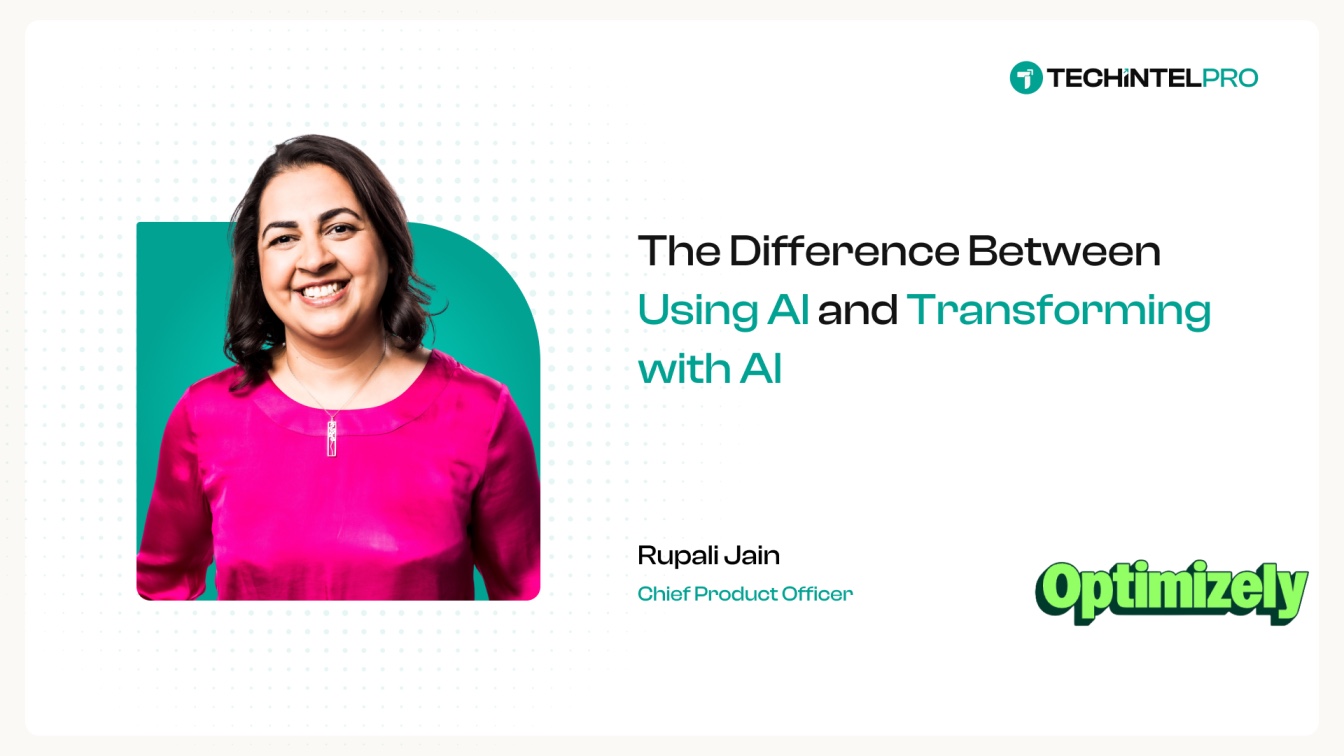
AI has made producing more easier than ever. Creating more value is a different challenge altogether.
Without rethinking how work flows across teams, AI risks making existing complexity move faster instead of making businesses better.
Rupali Jain, Chief Product Officer of Optimizely, shares why workflow redesign matters more than AI features, how enterprises can move from experimentation to transformation, what agentic AI means for the future of marketing, and why judgment, orchestration, and business impact will define the next generation of AI leaders.
What feels different this time is that this wave is 10x faster, non-optional pretty much from the get-go and is changing beliefs about who does the work. Most previous waves started slower and gave the world time to catch up, this one didn't.
The biggest shift though is about who does the work. In earlier SaaS shifts, we digitized processes or made them more efficient, but the underlying workflow stayed the same - i.e horses got faster. Humans still moved through defined steps, just with better tools. With AI, those steps begin to break down. The system can now take a goal and find ways to achieve the goals (you need guardrails in place of course). It's like going back to grade school math – agents can get you to the answer without having to go through the exact steps that humans would have to. This changes the shape of the work itself, not just the speed.
The other shift is expectations. Most teams are already experimenting with AI, but they have not yet redefined their operating model around it. That gap between experimentation and true workflow integration, combined with team level lift versus just individual, is where a lot of opportunity sits right now.
Companies are using AI; that's no longer the bar. It is whether they have updated their assumptions about how work actually gets done when agents become part of the system.
Often, yes. Our latest research makes this pretty clear: people are saving time with AI, but that time is not always translating into more strategic work. That tells me the issue is not whether AI works (it does), but whether companies are using it to fix the right part of the workflow. If the underlying process is still fragmented (and believe me they are), then the gains get absorbed by more output, coordination and higher expectations. An example internally was a process for how we capitalized our R&D spend, that used to take us about five to six people in a month. If we had just moved that to AI, it would probably still take multiple weeks, but we redesigned the process to get down to one person and about a week of work with reviews, and then moved it to an agent and are now down to 15 mins + 15 mins of review.
A lot of teams are optimizing for speed before they've solved for structure. AI can absolutely help teams move faster, but faster is not the same as better. If you take a fragmented workflow and make every step 20% faster, you still have a fragmented workflow. The chaos just arrives sooner.
Judgment is becoming a much more critical skill, and as we get the mundane out of the way, sharp teams will naturally transition to more creative and strategic work.
Smarter adoption starts with clarity on what role AI is actually playing in the workflow. If it is positioned as a content engine, then yes, you get more output, more drafts, more variation, more volume. But you also risk increasing noise if the underlying structure does not change.
Where we see more meaningful value is when AI reduces friction in the system. That includes turning unstructured inputs into usable direction, surfacing patterns faster than humans can, and removing coordination work that does not need to exist. This shows up in synthesis, drafting, edge case generation, and translating feedback into structured output.
And there's a human side to this that gets missed. The pressure on marketers right now is real. They're being told to do more, faster, with the same teams, and AI can either make that worse or fix it. Used badly, it just raises the bar on output and burns people out chasing volume. Used well, it takes the mundane work off their plate so the part they actually care about, the creative and strategic work, is what's left.
Even then, the constraint remains the same. AI does not own the outcome. It can accelerate and organize work, but humans still define what matters and whether the direction is correct. It's more important than ever to know the goals and clearly articulate them so AI can help achieve goals vs. its default state of simply “accelerating chaos”.
Honestly, the most interesting thing is that a lot of teams don't fully know yet. If you ask them directly, most will say more AI, because that's what the whole market is telling them to want. But when you watch how they actually work, that's rarely the real problem. The demand for more AI is mostly a reaction to the noise, not a clear read on what they need.
What they actually need, even if they don't always name it this way, is fewer disconnected systems and work that gets done for them rather than just helped along. The pain isn't a missing capability. It's that their content, their data, their testing, and their reporting all live in separate places that don't talk to each other, so they spend their time stitching things together instead of doing the work that matters. More AI bolted onto that mess just gives them more disconnected tools to manage.
The other thing I see is the tension between control and getting more done. Everyone rightly starts with a human reviewing everything. But teams move through that faster than they expect. Once they see the AI is good enough, the speed advantage is hard to argue with, and they start handing over more control than they thought they would. That shift is happening quietly, and it's a bigger change than the feature conversation everyone's having.
So part of our job is to help them get past the obvious answer. Everyone thinks they want more capabilities. What actually moves the needle is taking work off their plate and connecting the pieces so they can see what's happening and act on it in one simple flow.
A few decisions stand out, and they were really about how our thinking evolved over a few stages.
We started where everyone started, with buttons and assists. A generate button here, a recommend button there, little bits of help scattered through the products. It was useful, helped us learn about the technology and user behaviors with AI, but it wasn't transformative, and honestly it's not something you can really charge for anymore. Assists have become table stakes.
The next step was to stop treating AI as a feature inside each product and build it as a single layer across the whole platform. Marketing tools usually feel scattered not because of the screens people see, but because the content, the testing, and the customer data all live in separate systems that don't talk to each other. So we did the harder, less visible work of joining those up underneath, because you can't fix a disconnected foundation by making the interface prettier. That gave us one consistent place for AI to work across everything, instead of a dozen disconnected helpers.
Then came the real shift. We decided to build actual agents and workflows that get outcomes, not just assist with a task. Instead of helping a marketer do a step a little faster, the agent takes the work off their plate and delivers the result. That changed our business, not just our product. You can't really monetize an assist, but you can monetize an outcome and the real work an agent takes off your team. That's been a huge change for us, and it's where the value is now.
An example on the content side of our business is a customer who recently became a one person content team orchestrating their entire content strategy with the use of agents. I’ve also seen similar in experimentation where a hospitality customer was severely resource constrained and got an experimentation program off the ground and running with agents who ideate, build the tests, summarize results and then start over.
What ties it all together is that each stage took more complexity off the customer, even when it meant more work for us. And alongside the technology, it was a big cultural shift and how we work, so we could deliver the value our customers deserve.
Some of this is starting now, and in five years it looks very different. Today a marketer spends most of their time doing the work: building the campaign, writing the variants, pulling the reports, moving things between tools. Most of that execution is going to be done by agents, and a fair amount already is. Five years out, marketers probably aren't sitting there creating all this content by hand at all.
What changes is what's left for the person. You stop doing the tasks and start setting the goal and judging the result. You tell the system the outcome you want, more pipeline from this segment, better retention in this cohort, and the agents build the test, launch it, watch the results, adjust, and try again on a loop. The human sets the intent and the guardrails and decides what's good enough to keep.
So the value moves to judgment and taste. The marketers who win will be sharper at direction. The ones who struggle will be the ones whose value was mostly in doing the steps.
The thing nobody talks about enough is the gap between productivity and impact. The whole industry is celebrating how much faster teams can now produce. More content, more variations, more campaigns, in a fraction of the time. But producing more is not the same as creating value, and almost no one is asking the harder question: is any of this actually moving the business?
AI has made output essentially free. The risk is that we mistake that for progress. A team can be ten times more productive and deliver zero additional value if none of what they're producing changes what a customer does. That's productivity theater, and a lot of what I see in the market right now is exactly that. Activity going up, impact flat.
And the failure mode is expensive. You're paying for the tools, paying for the people to run them, and filling your channels with more stuff, while the actual return, conversion, revenue, retention, stays where it was. The cost goes up and the value stays flat or even down with the volume of “stuff”. That's the opposite of what AI was supposed to do for us.
So the conversation has to shift from how much can we make to how much value did it create and if we really moved the needle on business outcomes. The teams that win will connect the productivity boost to a real outcome and cut whatever isn't earning its place. Until the industry measures AI by impact instead of volume, we're just getting more efficient at producing things that may not matter.
Rupali Jain is the Chief Product Officer at Optimizely. Previously she has held product leadership roles at several SaaS software companies, including Microsoft's PowerBI and Qualtrics. Throughout her two-decade career, Rupali has shared Optimizely's vision of prioritizing the end user's daily needs. Rupali is committed to advancing practical, growth-driving applications of AI and machine learning to help marketers take control of their workflows, experiment at scale, and deliver digital experiences that meet and exceed customer expectations.
More about Rupali: 
Optimizely is the AI platform for marketing, built for the experience-makers who shape how brands show up in the world. Bringing together content management, content marketing, experimentation, commerce, personalization, and analytics into a single platform, Optimizely gives marketers the freedom to create, customers the experiences they remember, and AI agents the content they come looking for. With Optimizely, you're free to grow.
Learn more at optimizely.com.
Tell others what you think of TechIntelPro.



 Rate us on G2