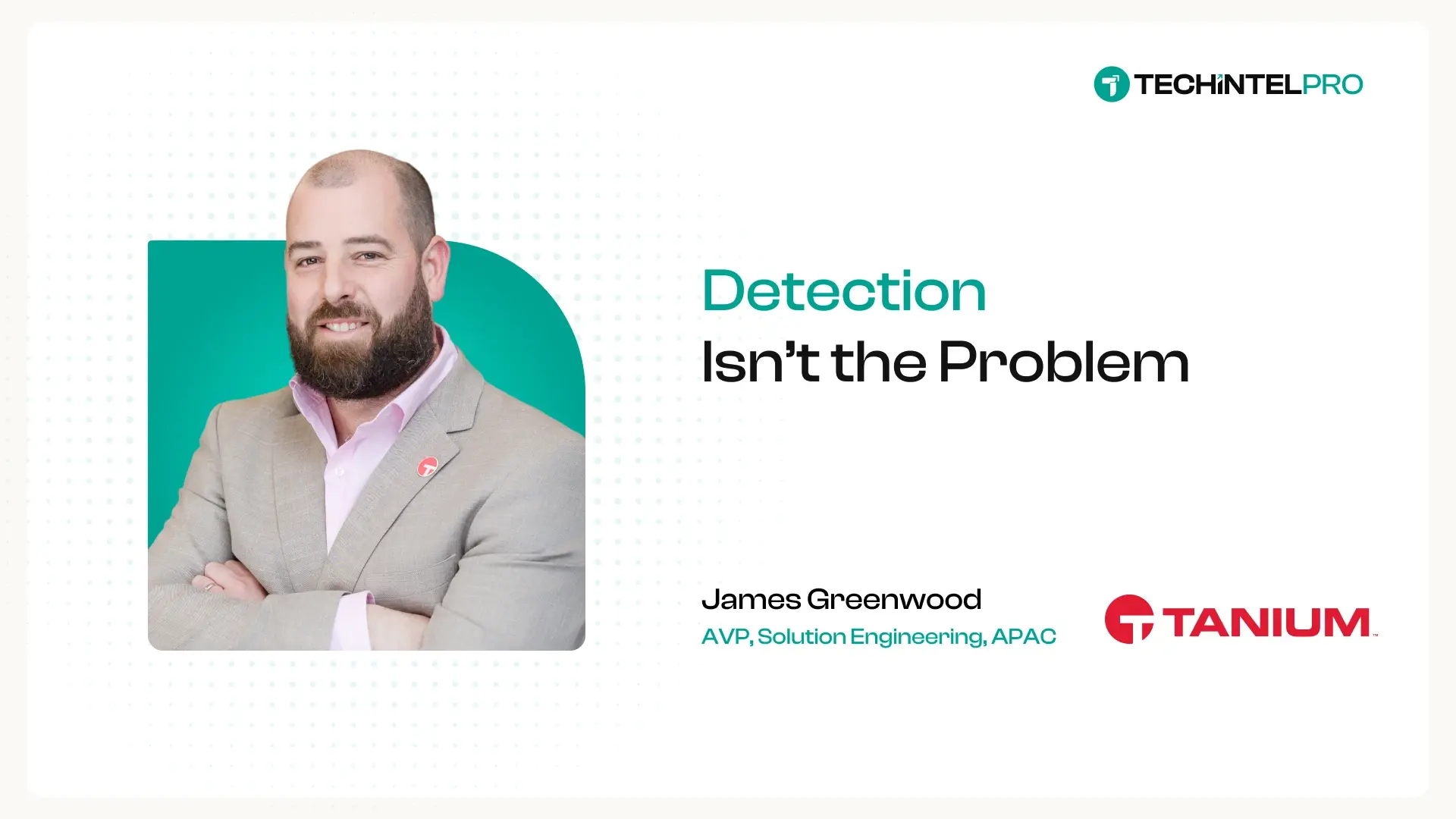
Every enterprise security team has more data than it knows what to do with. James Greenwood, AVP of Solution Engineering for APAC at Tanium, thinks that’s exactly the problem. In his view, the industry’s biggest misconception is treating cyber resilience as a detection challenge, when most organisations already have the visibility they need. What they lack is the ability to act on it fast enough, consistently enough, and with enough context to know what actually matters.
Greenwood leads solution engineering across a region where digital maturity, regulation, and infrastructure vary enormously from market to market, from organisations still running monthly patch cycles to those building AI-enabled operating models. In this conversation, he discusses why Tanium is betting on Autonomous IT rather than another dashboard, what separates a real operating-model shift from simply bolting AI onto existing tools, and why the biggest blind spot for leaders over the next five years won’t be a lack of AI features, but a lack of trusted, real-time data underneath them.
The value comes from combining intelligence, decision support and action in the same governed environment. AI can help operators interpret what is happening, but it is only useful when it is grounded in accurate, real-time data from across the endpoint estate.
Tanium’s approach brings telemetry, guidance and remediation together so teams can move from identifying an issue to acting on it without switching between disconnected tools or relying on stale information. That matters because many organisations do not struggle to detect vulnerabilities. They struggle to understand which ones affect their environment, which are being actively exploited, and what action should be taken first.
By automating routine work such as patching, compliance validation and vulnerability closure, organisations can respond at machine speed while keeping people focused on policy, exceptions and high-risk decisions. This reduces manual effort, simplifies operations and gives security and IT teams a shared source of truth. The result is not just better visibility, but faster and more consistent action across the enterprise.
Solution engineering has evolved from demonstrating product features to helping customers redesign how work gets done. The role now requires a much deeper understanding of operational constraints, regulatory expectations, workforce pressures and the outcomes the organisation is trying to achieve.
Detecting an issue is only one part of the problem for our customers. They want to know whether it can help them act faster, reduce risk, simplify operations and support change across complex environments. That means successful solution engineering must connect technical capability to measurable operational value.
In practice, this involves understanding where processes are still manual, where tools are fragmented, and where decision-making is slowed by incomplete data or unclear ownership. It also means being realistic about organisational readiness. The technology to improve patching, visibility and response already exists, but adoption is often held back by governance, operating models and resistance to change.
The strongest solution engineers today are therefore part technologist, part advisor and part change partner. Their role is to help customers move from isolated use cases to a more autonomous and resilient operating model.
APAC cannot be treated as a single market. Organisations across the region operate at very different levels of digital maturity, and they face different regulatory, infrastructure and workforce pressures.
The starting point is to understand the customer’s environment as it exists today. In some markets, the immediate priority may be consolidating fragmented tools and improving basic endpoint visibility. In others, the focus may be automating patching, strengthening operational resilience or supporting more advanced AI-enabled workflows.
The consistent value comes from the underlying foundation: real-time visibility, accurate endpoint data and the ability to take governed action across the estate. The way that capability is applied will differ by market and by sector.
For example, organisations in critical sectors may need to respond to stricter incident reporting, patching and resilience expectations. In Malaysia, Tanium has highlighted the gap between AI-accelerated vulnerability discovery and organisations that still depend on monthly patching cycles. The principle is the same across the region: customers need current, environment-specific information so they can prioritise and act based on actual risk rather than generic severity scores.
Real-time endpoint intelligence will become the operational foundation for AI across IT and security. AI models can reason, summarise and recommend, but the quality of those outputs depends on the accuracy and immediacy of the data underneath them.
For IT operations, this means moving away from periodic checks, static dashboards and manual investigation toward continuous awareness and automated action. Teams will be able to identify issues, understand their impact and remediate them in the same environment.
For cybersecurity, real-time intelligence will be essential because the window between vulnerability disclosure and exploitation is continuing to shrink. Defenders will need to know not only that a vulnerability exists, but whether it is present in their environment, whether it is being exploited and which systems should be prioritised first.
At an enterprise level, endpoint data will also support better decisions about software, compliance, risk, productivity and investment. Over time, the most valuable platforms will not simply present more data. They will turn trusted, real-time context into governed action, while keeping people accountable for the decisions that require judgement.
The biggest misconception is that resilience is primarily a detection problem. Most organisations already have large amounts of security data and multiple tools capable of identifying issues. The real challenge is acting on that information quickly and consistently.
Many leaders still assume that if a vulnerability has a lower severity score, or if a patch is scheduled within a monthly cycle, the risk is under control. That assumption is becoming increasingly dangerous. AI is making it easier and cheaper to identify and weaponise vulnerabilities, including those that may previously have been considered unlikely to be exploited.
Modern endpoint management therefore cannot be limited to inventory, monitoring or scheduled maintenance. It needs to provide real-time visibility, threat-informed prioritisation and the ability to remediate at scale.
There is also a misconception that technology is the main barrier. In many cases, the capability already exists. The harder problems are fragmented ownership, slow approval processes, tool sprawl and limited appetite for operational change. Cyber resilience depends as much on the operating model as it does on the technology.
The organisations that lead will be those that redesign their operating model around trusted data, governed automation and clear human accountability. Simply adding an AI assistant to an existing toolset will not be enough.
Leaders will use AI to move routine operational work to machine speed, including patching, compliance checks, vulnerability closure and continuous monitoring. Their people will remain responsible for setting policy, reviewing exceptions and approving higher-risk changes. That balance between autonomy and control will be critical.
The major blind spot is the data and operational foundation. AI cannot reliably act on fragmented, stale or incomplete information. Nor can it deliver value if every recommendation still has to pass through slow, manual processes across multiple teams and tools.
Organisations should therefore focus now on creating a complete, real-time view of their environment, simplifying workflows and defining where automation can act safely. The future advantage will not come from having the most AI features. It will come from being able to turn accurate intelligence into trusted action faster than the organisation’s risk environment changes.
Area Vice President, Solution Engineering, APAC at TaniumJames Greenwood leads Tanium's solution engineering team across Asia Pacific. In his current role, Greenwood is responsible for pre-sales, solution engineering and customer success across the full APAC region. He works closely with Tanium's regional leadership team to deepen customer and partner engagement and scale execution across the region's most complex technology environments. With more than 20 years of experience across service delivery, customer success and pre-sales, he has spent the past nine years at Tanium working with some of the region's largest enterprises, government agencies and critical infrastructure providers on cyber resilience, operational efficiency and endpoint management at scale.He is known for building teams that customers trust, creating environments where people do their best work, and turning technical capability into business outcomes that matter to the organisations he works with.Before Tanium, Greenwood held roles at DXC Technology, CSC, Citrix, Herbert Smith Freehills and HP, giving him a rare vantage point across vendor, legal and enterprise IT operations environments. He holds a degree in Information Communication Technology from the University of Wollongong and is based in Sydney.
More about James: 
Tanium Autonomous Endpoint Management (AEM) offers the most comprehensive solution for intelligently managing endpoints across industries, providing capabilities for asset discovery and inventory, endpoint management, vulnerability management, risk and compliance, threat hunting & incident response, and digital employee experience. The platform supports 34M endpoints worldwide, including 40% of the Fortune 100, delivering increasingly efficient operations and an improved security posture at scale, with confidence, and in real time. For more information on The Power of CertaintyTM, visit www.tanium.com and follow us on LinkedIn and X.
Tell others what you think of TechIntelPro.



 Rate us on G2