For ANZ businesses, the technology challenge isn’t a lack of choice. It’s too much choice, too much complexity and too much pressure to adopt what’s next.
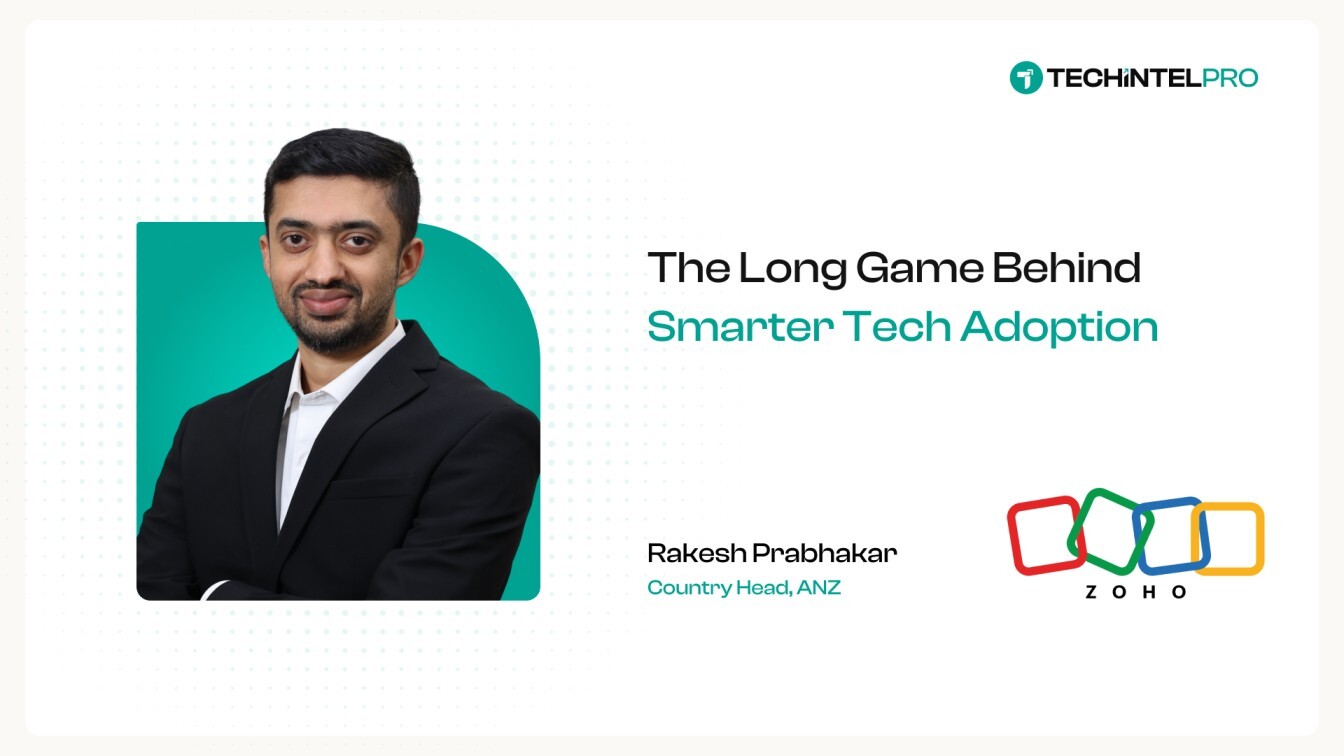
Rakesh Prabhakar, Head of Zoho ANZ, argues for a more deliberate path: understand the business problem first, then bring in technology that genuinely solves it. He discusses how that mindset applies to AI, software consolidation, data sovereignty and industry-specific solutions, while sharing why local presence and long-term investment are key to building a more resilient digital future.
I’ve spent 17 years with Zoho, joining when the company had around 500 employees globally. Today, the number is close to 20,000. Being part of that journey has shaped how I think about growth: it needs to be long-term, disciplined and grounded in what customers actually need.
My background in implementation and services has also been important. When you work closely with customers, you quickly learn that technology decisions are much more than software features. Trust, cost, privacy, business continuity and whether a solution can adapt to the realities of that organisation are equally important.
These principles have strongly influenced how we have built Zoho in ANZ. We didn't enter the market with a short-term mindset. We started slowly, listened carefully and built a local team that could understand the needs of local businesses. Our Adelaide story is a good example of that. We originally looked at Sydney, but during the Great Resignation, we saw an opportunity to build around strong technology talent in Adelaide that was being overlooked or moving interstate. That decision has become central to our regional strategy.
Businesses today are being asked to do more with less. Costs are increasing, customer expectations are rising, and there is constant pressure to adopt new technologies, especially AI. At the same time, privacy, regulatory compliance and data sovereignty are becoming more important considerations, as organisations look more closely at where their data sits and how it’s managed. Many organisations are also still running fragmented systems that make it difficult to move quickly or get a clear view of the customer.
In ANZ, we see many businesses looking for practical ways to simplify operations, reduce software costs and improve productivity without adding more complexity. They want tools that are easy to adopt, integrated across departments and flexible enough to support different levels of digital maturity.
There is also a growing need to separate hype from real value. AI is a good example. There is urgency in the market, and every technology company is looking closely at what AI can deliver. But businesses are also asking which applications genuinely improve productivity and which ones add little value to day-to-day operations.
Our view is that technology should solve real business problems, not simply follow the latest trend, which is why full-stack solution providers have become more important. Businesses need partners that can support the full technology foundation, from applications and infrastructure to privacy, security and scalability, rather than adding another disconnected tool.
The first step is staying close to customers and partners. A local presence matters because it allows us to hear directly from the market, understand how businesses are operating and respond in a way that is relevant to ANZ conditions.
That has been one of the reasons behind our investment in local offices, including Adelaide and Sydney. Having teams on the ground helps us translate global product capability into solutions that fit local needs.
Zoho is also the biggest user of its own software, so we build from practical experience. When we see a need in our own business, that often informs the way we develop products for customers. At the same time, we’re seeing demand for more industry-specific solutions. The future will not only be generic CRM or finance tools. Businesses increasingly want software that understands their sector, whether that is retail, healthcare, professional services or construction.
Our role locally is to make sure those customer realities are reflected back into the broader product vision.
Privacy and digital sovereignty are becoming central to technology decisions, particularly as businesses rely more heavily on cloud platforms and AI. For Zoho, these are a fundamental part of how we have built the company.
We don't run an advertising-based business model, and we don't monetise customer data through ads. That gives customers confidence that the relationship is based on delivering software.
We have also spent decades building our own technology stack, including our own data centres and infrastructure, rather than simply relying on hyperscalers. In Australia, we own our servers and infrastructure, with data hosted locally in Sydney and Melbourne commercial data centres. That gives us more control over cost, performance and data handling.
Another important point is legal and operational accountability. Our local entity conforms with Australian law, which matters as more organisations consider not only where their data is stored, but which country’s laws apply to their provider.
As AI adoption grows, these questions will become even more important. Businesses need to know that their technology partners have the right foundations in place before layering on new capabilities.
We try to balance breadth with practicality. Zoho offers a broad platform across areas such as CRM, finance, HR, collaboration, and analytics. That gives businesses the ability to bring multiple systems into one environment, reducing fragmentation and allowing them to scale over time.
But every customer is different. Some are early in their digital journey and need simple, accessible tools to replace manual processes. Others are more mature and want deeper automation, integration, analytics or industry-specific workflows.
That is where flexibility matters. We see a growing opportunity for more vertical and bespoke software. Rather than only offering a generic CRM, the market is moving toward solutions that can be adapted for specific sectors and use cases. Zoho’s model allows us to support that because we build much of our technology organically and have control across the stack.
In ANZ, that also means working closely with customers and partners to understand where practical challenges exist. Innovation is important, but it only matters if it helps businesses work better, serve customers more effectively and grow sustainably.
The principle I would suggest is disciplined adaptability.
Businesses need to be adaptable because technology, customer expectations and economic conditions are changing quickly. But adaptability should not mean chasing every new trend or adding more tools without a clear purpose. It should be disciplined, grounded in long-term thinking and focused on solving real problems.
That applies to AI, cloud, automation and digital transformation more broadly. Leaders should ask: does this improve productivity, reduce complexity, protect customer trust or create lasting capability for the organisation?
At Zoho, we have taken that approach in the way we grow. We are privately held, we have no outside funding, and we reinvest earnings into product development, infrastructure and local capability. That allows us to make long-term decisions, whether that is building our own infrastructure, investing in Adelaide or supporting customers with more accessible software.
For ANZ businesses, resilience will come from building strong foundations first, then adopting technology in a way that is purposeful, sustainable and aligned to customer needs.
Rakesh Prabhakar is the Head of Zoho Australia and New Zealand. Prabhakar has spent almost 17 years at Zoho, in roles such as Head Software Concierge and Regional Manager. In his current role, Prabhakar oversees the sales, marketing, technology and operations of one of the fastest-growing regions for Zoho, driving its mission to help businesses of all sizes and sectors leverage Zoho's innovative and integrated suite of products to streamline their workflows, enhance their productivity, and achieve their goals. With 55+ apps in nearly every major business category from sales, marketing and finance, to collaboration, customer support and back office operations, Zoho is the operating system for business.
More about Rakesh: 
Founded in 1996, Zoho Corporation is a privately-held global technology company headquartered in Chennai, India. It has several prominent brands, including Zoho, ManageEngine, Qntrl, and Trainer Central. More than 150 million users and over a million paying customers, ranging from SMB organizations to enterprises, rely on its solutions to run their business. The company owns and operates 20 data centres across the world, ensuring complete oversight of customer data, privacy, and security.
Learn more at zohocorp.com.
Tell others what you think of TechIntelPro.



 Rate us on G2