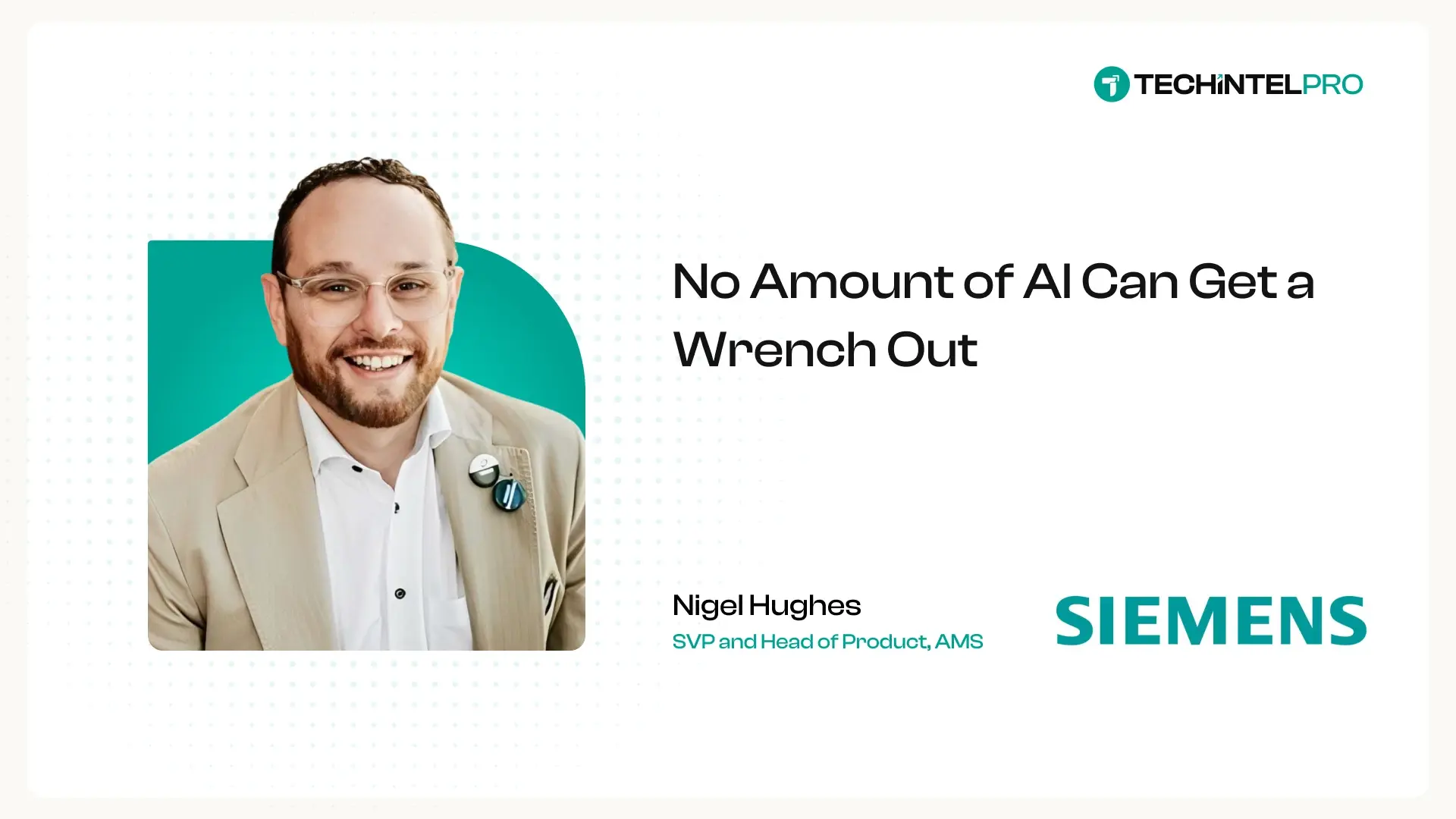
For all the talk of AI transforming asset management, Nigel Hughes keeps returning to something far less glamorous: a technician with a wrench. As SVP and Head of Product at Asset Management Software, Siemens, he argues that asset-intensive industries are still businesses where physical things must be maintained, repaired, and replaced, and that the real constraint is the time of the skilled people doing that work. With shrinking workforces, aging infrastructure, and tighter budgets all feeding one another, he says technology earns its place only if it gives those teams real operational leverage.
Hughes brings a long Siemens career to the question, from founding a business acquired by Mentor Graphics to establishing the Capital Platform after Siemens' 2017 acquisition, leading electrical engineering product teams, and moving to Siemens Smart Infrastructure in 2022. In this conversation, he explains the thinking behind the AI Flywheel, which connects data capture, enrichment, integration, and action, and why the industry needs an open, resilient ecosystem of best-in-class solutions rather than one platform trying to do everything. He also names the problem he believes AI still hasn't solved: judgment. AI can summarize, predict, and automate, he says, but it doesn't make the choices that define asset-intensive work, such as when to take an asset offline or when safety outranks uptime.
There is no magic formula. Our team starts with listening closely to customers and understanding the operational challenges they’re facing in the real world. In asset-intensive industries, those challenges are often complex and deeply connected to how work gets done. Customers are balancing aging infrastructure, fragmented systems, and leaner teams. Product innovation has to start with diving deep into the challenges our customers are trying to navigate.
From there, our team explores where new capabilities could drive value for customers. The advantage we bring is the combination of deep industry expertise and strong technical capabilities. Our team understands these long-standing challenges and our AI expertise allows us to look at them in new ways. Product innovation delivers the most value when it’s grounded in customer needs and shaped by industry expertise.
I don’t think there’s one single bottleneck – it’s a combination of all the factors and challenges. Shrinking workforces, aging infrastructure, and tighter budgets are all connected.
At the end of the day, asset-intensive industries are still businesses where physical things need to be maintained, repaired, and replaced. We’ll always need someone out in the field, fixing boilers, or maintaining HVAC systems. No amount of AI can get a wrench out and fix these things. That work depends on skilled technicians and field teams.
The bottleneck comes when those expert teams are being asked to cover more assets, manage more complexity, and do it all with fewer tools. Their time is becoming a hugely constrained resource in the business.
Technology must come in and create real operational leverage. The goal has always been to help teams get more value out of every minute in the day and dollar in the budget. That means making sure expertise is used where it matters most, including by giving teams better visibility into what needs attention, helping them prioritize, and reducing unnecessary tasks. This is what will truly help reduce the conglomeration of bottlenecks customers are facing every day.
Our focus is truly on helping asset-intensive industries move into the next stage of digitization. Over the last decade, the industry has made real progress. Organizations have invested heavily into operational workflows and they’re no longer starting from zero. Data clearly shows this progress: Year over year we’re seeing declines in reactive maintenance, more organizations using five-year capital plans, and the growth of AI utilization.
The issue is that much of the information organizations need still lives in different places. The AI flywheel is about bringing those pieces together. Data capture is only the first step. The data must now be enriched, connected with other sources, integrated into workflows, and then turned into action.
High-quality data is a major investment for organizations. Companies need to know that the data they collect can actually improve decisions, not just sit in another system never to be looked at. We want to help organizations continuously improve the quality and usefulness of their data so they can make better decisions about their long-term asset strategy.
When we look at the industry problem we’re trying to solve, what stands out is the gap between organizations having data and being able to act on it. The next phase of intelligent asset management will be rooted in having data that grows over time and continuously drives smarter, more confident decision making.
What separates the organizations that are truly operationalizing AI from those still stuck in experimentation is whether those companies have solved for time, money, and opportunity. Most organizations recognize the value of AI, but the hardest part is creating the conditions for those tools to move into everyday workflows.
The organizations making real progress have found ways to create space for innovation, fund it appropriately, and connect it to operational outcomes businesses care about. Once those three things are solved, organizations start to see the flywheel come to life.
We’re going to see AI become part of how teams capture data, improve it, and connect it to real business workflows. As people at the operational level see the benefits, adoption will continue to grow. That adoption then creates more data and a clear reason to continue AI investment.
AI’s use is naturally catapulted when companies can show tangible business impact, including better uptime, faster mean time to resolution, and improved customer satisfaction. When teams see those benefits within their own day-to-day work, AI can flourish as a trusted part of everyday workflows.
Connected ecosystems are going to be critical, but the industry needs to be thoughtful about what that actually means. Successful integration won't mean having one platform that tries to be everything to every business. I’ve seen companies get in over their head in an attempt to be all things to all people. That complexity can easily overwhelm the value they offer.
The stronger way to solve system fragmentation is with a connected ecosystem of best-in-class solutions. Intelligent asset management requires different parties to bring their strengths to the table, share data responsibly, and support process integration to create real value.
The key is making those integrations resilient. Systems need to be connected enough to create a more complete digital view of the asset but not so tightly coupled that one software update breaks the entire workflow. We can't replace every system with one monolithic platform; we have to build an ecosystem that is open, interoperable, and durable enough to support how assets are managed.
I don't view innovation as a trade off between customer pain points, long-term vision, and AI. The job is to connect those three things. The risk with AI is that it can make every ideal feel possible, but great products are defined as much by what you leave out as what you put in. So, the discipline is not simply building something because you can; it's prioritizing how we solve real customer problems that move us closer to our long-term vision while still creating value. We must strike a balance of moving quickly enough to take advantage of what AI makes possible while staying focused enough to build products that are useful and resilient to stand the test of time.
In many ways nothing has suddenly changed, we’ve been working towards this for four years. As we transition to Asset Management Software, Siemens, we’re ready to go and plug tools directly into building management systems through platforms like Building X and Desigo CC. It’s allowed us to truly enhance our proactivity, even having a technician on the ground making fixes before anyone knew there was a problem. We also have access to Siemens’ broader, global resources to help our teams’ capabilities grow to better meet today’s industry challenges.
One of the biggest operational challenges AI still has not solved for is judgment. Today's AI is very good at transforming inputs into likely outputs. It can summarize recommendations, make predictions, and automate. That's incredibly useful in asset intensive industries where teams are managing complex systems, including large volumes of data. But AI does not truly make choices. Asset intensive work is full of choices. Teams must decide when to take an asset offline, when to prioritize safety over uptime, and when to trust a recommendation.
This is where the next wave of innovation is headed. AI isn't replacing experts but it's helping them exercise better judgment. The opportunity is to give people more context, better recommendations, and clear trade-offs so they can make faster, smarter decisions while still keeping human accountability at the center.
Nigel Hughes is the SVP and Head of Product at Asset Management Software, Siemens, where he is responsible for advancing the company’s global portfolio. Nigel has a storied Siemens career that includes founding a business acquired by Mentor Graphics, where he remained to establish the new Capital Platform through Siemens’ acquisition of the company in 2017. He later led the product team focused on advancing engineering applications for electrical engineering, which was the fastest growing Siemens Digital Industries Software business at the time. In 2022, Nigel moved to Siemens Smart Infrastructure.
More about Nigel: 
Siemens Asset Management Software connects actionable data and insights across your entire asset lifecycle, improving maintenance, asset investment planning and operational intelligence.
Learn more at assetmanagement.siemens.com.
Tell others what you think of TechIntelPro.



 Rate us on G2