
AI may be transforming software development, but speed alone isn't solving the problems that matter most. Visibility, predictability, and better decisions are.
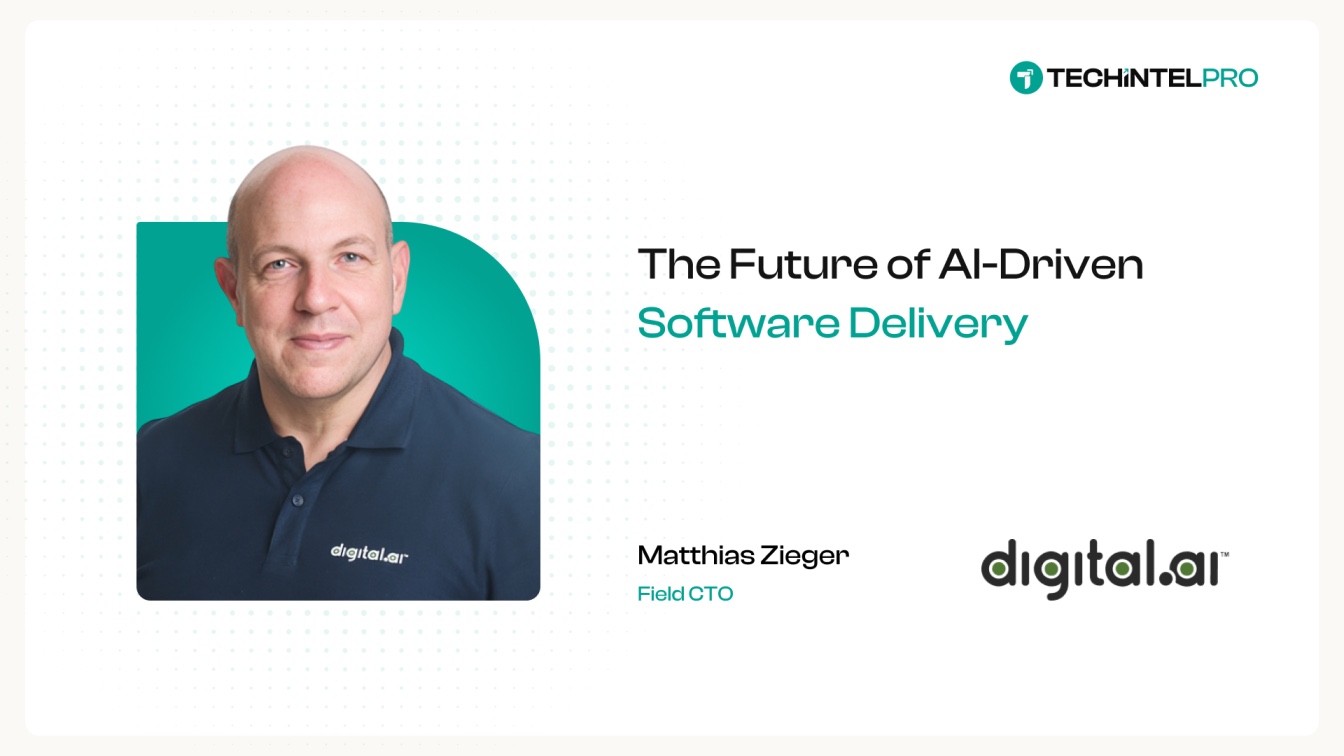
Drawing on years of working with enterprise teams across industries, Matthias Zieger, CTO of Digital.ai, explains why disconnected tools, fragmented data, and siloed processes continue to hold organizations back. He shares how connected SDLC intelligence, agentic AI, and a stronger focus on governance can help enterprises reduce uncertainty, identify risks earlier, and build software delivery processes that are both faster and far more predictable.
Field roles give you a front-row seat to what's really happening. Not the pitch deck, not the strategy, but the actual daily reality of customer teams trying to ship software under pressure.
Over the years, I've seen everything. Teams running on homegrown scripts held together by hope, enterprises with ten monitoring tools and no idea what's actually in production, a bank that had automated everything except the huge user acceptance test step that caused every single release to be delayed. Even release managed via Excel and Wikis.
What connects it all is missing pattern recognition or higher-level abstraction. After enough customer conversations across enough industries, you start seeing the same problems repeat.
Different tech stack, different company, and still the same root cause. The Field CTO role is where I get to help organizations see the pattern before it bites them.
Copilots made individual developers faster. While useful, this was also never the bottleneck in SDLC.
Agentic AI is a different conversation. When AI can coordinate tasks across a pipeline and act on its own, you're not just speeding up one person. You're changing how work moves through the whole organization.
In Europe, enterprises are interested and curious, but careful. And honestly, that's the right instinct. DORA, NIS2, the AI Act — you can't just deploy agents and see what happens. You need to know what they did, why they did it, and who was responsible. By doing so, they are building something that will actually hold up. If it's enough, the future will tell.
Usually, it’s not the tooling. I talk to teams with solid CI/CD, good test coverage, proper monitoring, and they still can't tell you when a feature will ship or why the last release failed.
The breakdown happens at the interfaces. Between planning and engineering. Between security, testing, and development. Between what the tools capture and what leadership actually sees. You can automate a lot and still have no real visibility into what's actually happening.
That combination is dangerous. You're moving fast but flying blind, and when you land hard, nobody saw it coming. Filtering the important signals from the noise is the fine art of DevOps engineering.
Start with the real question. Not "how do we automate testing" but "why do we keep shipping things that break in production?" Not "how do we shift security left" but "why do we keep finding critical issues in production?"
When you frame it as a decision problem, everything changes. The value of connecting planning, delivery, testing, and security isn't about having more features. It's that you finally have signals talking to each other. Release frequency, test gaps, security debt, planning accuracy: Only when that data is connected, do you see things you simply couldn't see before.
Three things I keep seeing, especially in EMEA, but also internationally.
First, governance. AI tools get picked up bottom-up — developers start using them, teams follow — but nobody at the top has thought through data handling, IP exposure, or what it means for compliance. That catches up fast. And then top-down governance kicks in and delays everything. This causes frustration because people see the potential, but also need to understand the risk.
Second, measurement. You can't show AI is delivering value if you weren't tracking the right things (Value, Risk, Cost) before you started. Most organizations don't even have that baseline.
Third, change resistance dressed up as technical skepticism. The real blocker usually isn't whether the AI works. Nobody wants to talk about the process and organizational changes that need to happen alongside it. That's the harder conversation and the more important one. This needs a proper change management system to accompany it.
Most teams plan based on gut feel or last year's estimates. That's where it breaks down. Most enterprises have a lot of historical data, but they don’t use it. How long did similar work actually take? Where did releases get stuck over the last 24 months? What patterns showed up before a delivery failed?
I've sat with customers who were surprised to find that their own data predicted a late release three weeks before anyone raised a hand. The signal was there the whole time. Nobody was looking at it.
That's the real shift. You stop relying on status updates in Excel or JIRA Tickets and opinions, and you start reading the patterns your delivery history is already telling you. A drop in team velocity combined with late security findings and reduced test coverage: if that combination has predicted trouble before, it will again and again. That's your own data talking.
Predictable delivery doesn't mean no surprises. It means the people who need to make decisions find out early enough to actually do something. Most organizations already have the data they need. It's sitting in their pipeline tools, their JIRA backlog, their test results. The problem is it's not connected, and nobody's acting on it until it's too late.
That speed is the only focus point. And my criticism of people looking only at the speed aspects, e.g., in DevOps, and now we see the same in Agentic AI in SDLC.
Everyone talks about developers shipping faster. And yes, throughput matters (a lot actually). But I've seen teams ship the wrong thing faster and wonder why nothing improved on the business side. Speed without direction is just expensive nonsense.
The organizations doing this well are using AI to make better-informed decisions, using 360-degree data holistically from the SDLC, not just quicker go/no-go decisions.
Where AI can help massively: Earlier visibility into risk. A clearer signal on where quality is slipping. Smarter choices about what to work on next. That's a quieter, less compelling story than "10x productivity." But it's the one that actually holds up many years later still.
Matthias is a Field CTO at Digital.ai, combining deep technological expertise with strategic foresight. With decades of experience in test automation, release orchestration, and hands-on software delivery governance, he supports organizations in building trust in their digital value streams. His focus lies on quality assurance, resilient system architectures, and the practical implementation of governance across the software lifecycle.
More about Matthias: 
Digital.ai enables the world’s most complex organizations to deliver trusted software at AI speed. By applying agentic AI across the critical stages of software delivery — from planning through security, testing, and delivery — Digital.ai helps enterprises remove bottlenecks, reduce risk, and improve the flow of software value to production. Its solutions integrate into existing environments, allowing organizations to transform to AI-first without disruption. Today, 53% of the Fortune 100 trust Digital.ai to make that happen.
Learn more at digital.ai
Tell others what you think of TechIntelPro.



 Rate us on G2