Businesses used to compete for talent. Now they're competing for adaptability.
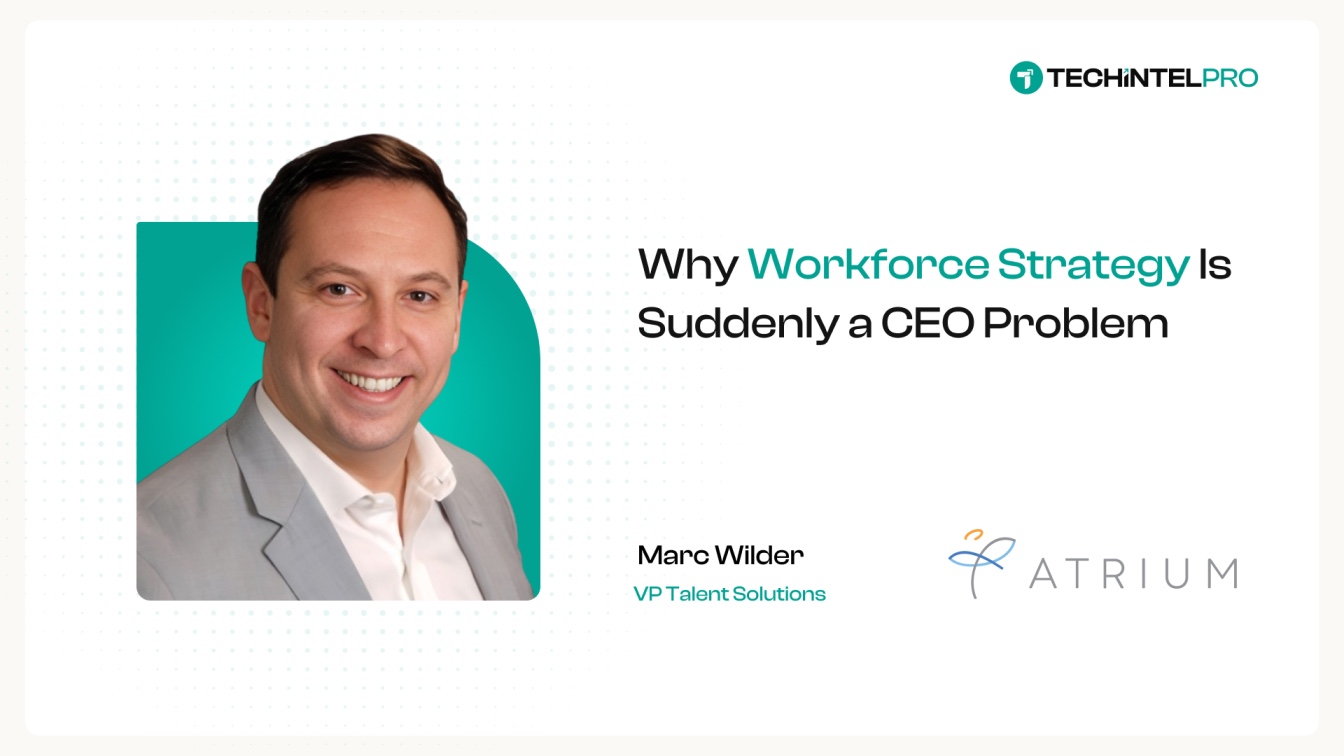
The challenge for leaders today is building a workforce that can evolve as quickly as the business does. Marc Wilder, VP Talent Solutions at Atrium, discusses why workforce agility has become a competitive advantage, how AI is changing the way organizations hire and manage talent, and why the most successful companies are rethinking traditional ideas about teams, roles, and workforce planning.
When people ask what Atrium does, the answer isn't "we fill roles." Strip any company down to its essentials, and what remains is people, organized to deliver something. Without them, there is no company. My job, alongside my team, is to build the workforce strategy that moves an organization forward.
And movement is the point. In business, change is the only constant, and organizations that thrive are the ones built to adapt.
Filling a role solves for today. A workforce built on flexibility solves for what comes next: scaling up when demand spikes, reshaping when priorities shift, and adjusting to new challenges or technology as they emerge.
Atrium's edge lies in pattern recognition. We see how companies across industries hire and where they get stuck. That vantage point lets us help clients build a workforce strategy that anticipates change rather than reacts to it.
Our Applicant-Centric™ philosophy is the principle Atrium was founded upon 30 years ago, and it remains at the center of how we work today. We hire from the candidate's viewpoint by getting to know people, listening to what motivates them, and placing them in work they love.
In this era defined by speed and automation, that's still our approach. Algorithms can filter resumes in seconds, but they can't understand what someone really wants and needs. The faster hiring gets, the rarer it becomes to feel heard, and candidates notice the difference.
By putting people first, we attract higher quality talent both internally and externally, make placements that last, and strengthen long-term client partnerships.
Companies that engage their extended workforce effectively take a multifaceted approach. They take advantage of the full spectrum of talent in the marketplace, including full-time, contract, project-based, and contingent roles – building this into a single collective workforce that is deliberately matched to what their business actually needs.
Companies with a strategic workforce strategy decide where it makes sense to maintain a permanent core and where flexibility serves them better. Contingent talent spans many different types of candidates, and a thoughtful approach can provide tremendous value. When used well, it gives businesses the speed to respond when demand shifts, access to specialized skills they don’t need full-time, and the ability to scale up or down without overcommitting.
In the talent solutions space, it is the agility, talent quality, and business outcomes that are often seen as a trade-off. If you move too fast, quality slips. If you hold out for quality, things happen too slowly. Yet, at Atrium, we don't see it that way because, when done right, all of these factors pull in the same direction.
Quality is what makes agility real. Place someone who genuinely fits, and they ramp faster and stay longer, so the client moves quickly without having to re-hire three months later.
By working with many of the world's largest brands, we’ve seen what works at scale, so we match from experience rather than by untested guesswork. For Atrium, none of it matters unless there are tangible business results behind our work. We start with what the client is trying to achieve and work backward to identify the talent that will help get them there.
First, hire for where a role is heading, not just where it sits today. AI is reshaping roles so quickly that what matters most is whether someone can grow as the work evolves. Adaptability is the real skill.
Second, titles and job descriptions are struggling to keep up. When you're hiring for skills that didn’t exist a year ago, rigid descriptions and titles can create more confusion than clarity. It helps to anchor on outcomes and real capability rather than the job specifications you used last time.
Third, there is no single way to combat the skills gap other than to continually encourage potential applicants to skill-build. The key is a multifaceted approach that includes upskilling your current staff, hiring core permanent talent with AI expertise, and supplementing with contingent resources where needed. Most importantly, work with a trusted workforce solutions partner that can help bring those strategies together.
The biggest opportunity is speed without the bottlenecks. AI can source, screen, and match at a scale no human can touch. It can scan thousands of profiles in seconds, surface people you'd never have found, and flag skills that are adjacent but not obvious. Done right, it filters out the noise so recruiters can spend their time speaking with people and building relationships rather than doing administrative work.
That said, there's a ceiling on what AI does well. It can't tell you who someone is or where they're going. And it can't build a relationship close enough to make someone comfortable revealing things about their job search they hadn't even realized themselves. AI helps us move more quickly. But for recruiting and workforce management to be fully effective, human judgment cannot be removed from the process.
One belief business leaders will need to rethink is that their strongest talent has to live on their permanent payroll. For decades, the goal was simple. Find the talent with the skills you need and keep them full-time for the long term.
Work is changing too quickly for that model to be enough. The companies that adapt best will be the ones that build flexibility into their workforce from the start, combining a strong core team with contract, temporary, and project talent they can bring in as priorities change and new needs emerge. Success depends less on the size of your workforce and more on your ability to access the talent you need at the right time.
Since 2008, Marc Wilder has helped companies hire top talent across multiple continents. He entered the New York City market in 2012, and since then, he and his teams have partnered with hundreds of companies to place thousands of candidates in both temporary and permanent roles. He has earned a reputation for building and scaling high-performing teams.
Marc serves as Vice President, Talent Solutions at Atrium, where he oversees the New York City temporary staffing teams, leading more than 30 recruiters and sales professionals who support clients across Technology, Finance & Accounting, Administrative Support, Creative, HR, and Fashion.
More about Marc: 
Founded in 1995, Atrium is a WBENC-certified leader in Extended Workforce Management and Talent Solutions that partners with the world's largest brands to reimagine how work gets done. By blending technology with human expertise, Atrium delivers high-impact talent and supports dynamic contingent workforce programs at scale.
Atrium services span four core divisions. Talent Solutions redefines staffing by rapidly connecting clients with exceptional talent. AtriumWORKS™ serves as the execution engine, designing and operating complex workforce programs, including Managed Service Provider solutions, Employer of Record and Agent of Record Payrolling, Direct Sourcing, Early Talent Administration, Independent Contractor (IC) Compliance, Statement of Work management, and Recruitment Process Outsourcing. HR Advisory Services delivers agile, customizable enterprise, project-based, and hourly people operations consulting. Atrium Innovation Research™ (AIR), an internal technology product incubator, transforms workforce challenges into scalable, market-ready solutions.
Learn more at atriumglobal.com
Tell others what you think of TechIntelPro.


 Rate us on G2