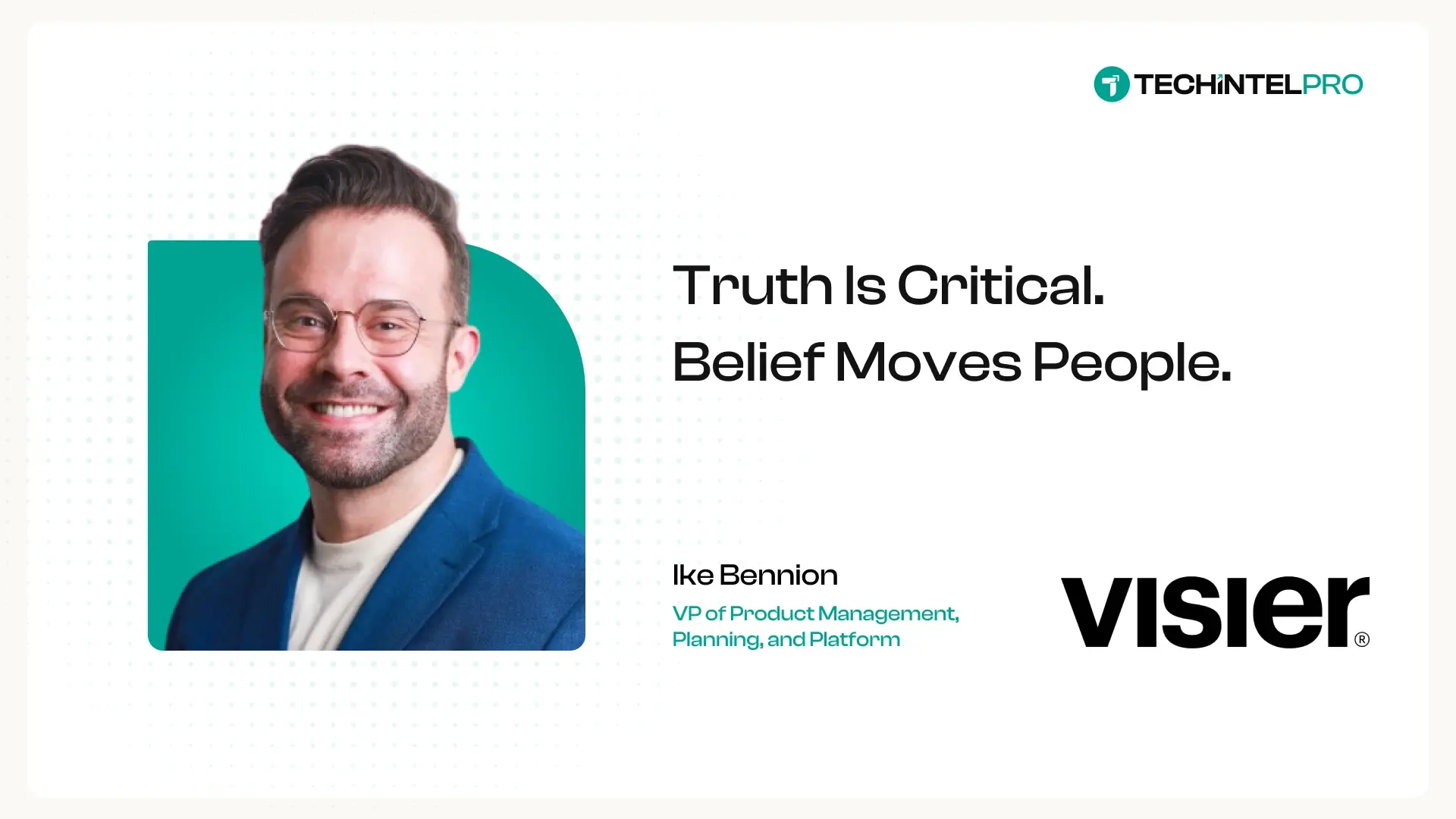
Ike Bennion has a name for a cost most companies don't even know they're paying: Logic Debt. As VP of Product Management, Planning, and Platform at Visier, he's watched the same pattern play out across enterprise after enterprise, HR calculates active headcount one way, Finance calculates it another, and reconciling that single metric eats time before any real analysis can even start. AI doesn't close that gap, Bennion says. It multiplies it, running the same query three different ways and surfacing a fracture that's been quietly accumulating for years.
That diagnosis runs through how Bennion thinks about nearly everything happening in enterprise AI right now, including a distinction he returns to often: “truth is what's critical, but belief is what moves people.” Anyone can vibe-code something that looks like an enterprise app, he says; whether it can actually be trusted with a decision about someone's job is a different question entirely. In this conversation, he explains how AI is “breaking” HR data by exposing context that's been scattered across the enterprise for years, why HR and IT are being forced into closer collaboration than ever without yet speaking the same language, and why he believes IT will increasingly hold the check book for HR technology, forcing HR leaders to defend not just what they can build, but why they should.
“To me, it’s about ‘following the money,’ and not necessarily just listening to what customers say they want. I look for signals like budget shifts and new functionality emerging from competitors or adjacent spaces. Another key signal is who is identifying a problem they want solved and how close that person is to the authority and budget to actually solve it. When that signal is coming from someone close to the decision-making process, it can be much stronger than what you might hear from a general admin or end-user population.
Ultimately, everyone has plenty of problems they’d like solved. But when you ask someone to pay to solve that problem, the list gets a lot shorter.”
“A lot of the critical context AI needs is scattered across the enterprise. A decision might be conveyed over email one day and captured in CRM notes another. People data is no exception, especially in a world where a manager might forget to mark an employee as terminated for weeks.
AI is amplifying and exposing critical gaps in the context around people and work, and those gaps can’t simply be solved by adding a new database. It’s about rounding out that context so the data becomes operable and, ultimately, the AI can be productive.”
“In our fast-moving AI world, there’s a murky but wide gap between belief and truth. As I often say, truth is what’s critical, but belief is what moves people. People believe they can do a lot with AI, including replicating entire enterprise SaaS solutions. Can I vibe code something that looks and behaves a lot like any app on the market today? Yes. Will it scale and be secure in the same way as an enterprise app? Maybe for some applications, but not for all. It’s going to take some time for all of us to reach a similar understanding of how AI actually applies to the reality of work.
I think the middle ground is creating tools that give users the speed, flexibility, and convenience of AI with the observability, scalability, and security of traditional enterprise SaaS. When a manager is making a decision about someone based on data, you want ironclad certainty that the decision is being made on a defensible basis. Given AI’s probabilistic nature, it can’t reliably provide that certainty on its own today.”
“Often, the teams that “own” these questions are approaching them from different vantage points. These decisions can also happen at different cadences and rely on different data pipelines. Even keeping up with the data and definitions across each of these areas is work, so it can make sense for teams to create definitions that are narrowly focused on the task at hand.
That said, there’s a real advantage to taking a more holistic approach. Having a comprehensive, consistent view of workforce metrics and insights means everyone is singing from the same hymn sheet and making decisions with richer context than they would have otherwise.”
“IT is increasingly tasked with owning agentic capabilities across the enterprise, which is bringing IT teams into much closer collaboration with many parts of the business, but especially HR.
The challenge is that HR and IT often don’t speak the same language. As their responsibilities become more intertwined through AI, that disconnect can make it harder to align on what the business actually needs and how technology can support it.
That gap is making HRIT an increasingly important role. HRIT can serve as the strategic layer between the two, balancing the compliance and sensitivity requirements of workforce data with the need to scale technology and drive impact across the organization.”
“This is where disrupting yourself with AI becomes critical. The only way to adapt to the speed of changing demands in the world of AI is to ride on the back of AI itself. Practically, that means using AI to become more iterative in how we learn, to accelerate software development, and to rethink how we deploy so we can reap the benefits of AI while mitigating the risks.
In terms of what we need to deliver today, we also have to make it easier for customers to create something new with their own LLMs using the products we’re building. It’s treating consumption as co-creation. Our customers are already doing some very cool things, building applications with Visier workflows and launching tools custom-built for their own users. It’s very cool to see, and it delivers customized, meaningful value that we wouldn’t be enabling without tools like our MCP server.”
“The biggest blind spot when it comes to people data is the cost of what I call “Logic Debt.” It’s one of those seemingly tiny costs that accumulates over time. It shows up in every project where Finance has one way of calculating active headcount and HR has another. There can be a lot of details to reconcile in that single metric before the work can even begin.
Now bring in AI, where it might use three different ways of calculating headcount across three different queries of the same data. Then add compounding macro changes that force you to step back and reconsider how you’re measuring the business in the first place. It’s the perfect storm for many organizations to spend a lot in quiet costs just maintaining the context of the enterprise.”
“IT will become the holder of the checkbook for HR technology purchases in many enterprises. That means HRIT roles will become even more strategic to the success of the department because, in many cases, they’re the “translator” of HR operations and strategy into data and technology.
The argument they’ll have to get really good at making is why building something on existing architecture isn’t enough. Especially now, you can build almost anything. The real question is whether you should build it.”
Ike Bennion, Vice President, Product Management, Platform at Visier, is a speaker, writer, and thought leader in the human resources space. He has a rich history in product strategy, development, implementation, consulting, and go-to-market for HR products. Ike has helped companies like Cornerstone OnDemand, HireVue, and Instructure navigate and meet the needs of the ever-changing world of work. He has a passion for using data to drive more equitable and intelligent decisions that, in turn, drive better people and business outcomes. He also likes dogs, hip hop, and weightlifting.
More about Ike: 
Visier Workforce AI gives leaders, business executives, and managers, the trusted insights and contextual guidance to make confident workforce decisions and lead workforce transformation at scale. The company’s award-winning technology expands beyond analytics, connecting insights to action during the workforce decision moments that matter most to an organization.
Our mission is to help businesses lead with insight at scale while continuously transforming in a rapidly changing workforce landscape.
Founded in 2010 by the pioneers of business intelligence, we have over 85,000 customers in 75 countries—including enterprises like Dick’s Sporting Goods, Domino’s Pizza, Experian, Amgen, eBay, and Ford Motor Company.
More information is available at www.visier.com
Tell others what you think of TechIntelPro.


 Rate us on G2