
AI's biggest impact on finance won't come from doing work faster. It will come from changing who, or what, does the work.
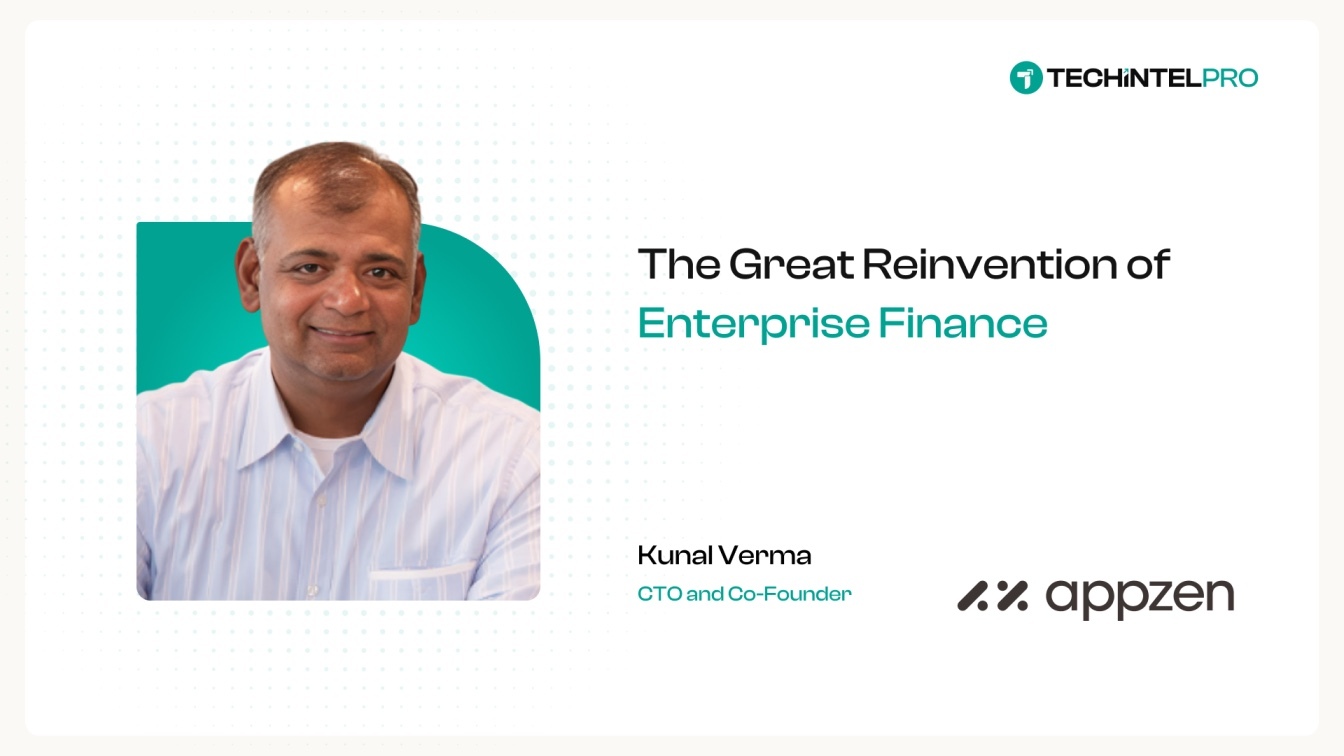
Kunal Verma, CTO of AppZen, explains how agentic AI is transforming finance from a people-intensive function into an AI-native operating model. He discusses the technologies, governance frameworks, and strategic mindset required to build autonomous, resilient finance organizations.
You were working on AI-powered solutions long before the technology became mainstream. What industry challenge inspired you to co-found AppZen, and what convinced you that finance was ready for AI-driven transformation?
My path into AI began in academia. I earned my Ph.D. in Computer Science from the University of Georgia, where my research focused on semantic technologies, a discipline that enables machines to interpret meaning within unstructured data. That academic grounding has informed the work I've done ever since.
Before AppZen, I led research teams at Accenture Technology Labs, where I built AI-based tools for Fortune 500 companies. That experience taught me something important: the highest-value AI applications within large enterprises are those that tackle unstructured, judgment-intensive work that humans had always assumed only humans could do.
When my co-founder and I started AppZen, the thesis was simple: finance and accounting back offices are the largest pool of structured judgment work inside any large company, and AI is the only technology capable of doing that work at scale with consistent quality. That conviction is what shaped the company, and it continues to shape my view today as we move from narrow AI tools into true agentic systems.
AppZen has been at the forefront of autonomous spend management for years. How has the nature of finance automation evolved since the company's inception, and what shifts have been most significant for enterprise customers?
A few years ago, our focus was on modeling the lower-level work that finance teams perform every day, like verifying receipts, matching purchase orders to invoices, and checking line items against policy. That represented a meaningful advance over rules-based systems, and it generated sufficient value that more than a third of the Fortune 500 adopted AppZen to run that work.
The greater opportunity, however, lies one layer above that, with autonomous processing through agentic AI. The bottleneck inside most finance organizations is not the extraction of data, but the judgment work that follows. That judgment work is governed by standard operating procedures (SOPs). In AppZen Expense Audit, this means encoding the SOPs that determine approval versus rejection. For accounts payable (AP) teams, AppZen Autonomous AP covers SOPs for complex extraction, PO matching, GL coding, and VAT treatment. The AI agent is no longer simply reading the document; it is reasoning through the company's playbook in the way an experienced auditor would, and then acting on it.
This is where the economics shift. Once SOPs are modeled and the agent can both decide and execute, entire workflows that previously required a human in the loop — expense reports approved or rejected, invoices coded and posted, exceptions resolved — begin to run end-to-end without one. The human role moves to governing the system and handling true edge cases, while the agent handles the volume.
The progression from extracting information to applying judgment to autonomous processing is why I believe AI will not simply improve back-office operations, but fundamentally re-architect them.
As organizations face increasing pressure to improve efficiency and control spend, where do you see the greatest opportunities for AI to create value across finance operations today?
In the near term, the most rule-bound, high-volume workflows will move closest to fully autonomous operation. Expense audit, invoice ingestion and matching, vendor email triage, GL coding, VAT review, and corporate card compliance fit that profile. These are processes where the SOP can be written down, the data is structured enough for an agent to act on, and the consequences of a single decision are bounded.
Cost per transaction is another area where AI creates value. AppZen customers have collectively realized over $2 billion in savings and reallocated up to two-thirds of manual work to higher-value activities. But CFOs who stop there are leaving most of the ROI on the table.
AP and T&E cycle time also compresses from days to hours, and that releases working capital. It includes coverage. AI reviews every transaction rather than a sample, which raises the floor on compliance and fraud detection across the entire business. It includes policy velocity, because changes that used to take months can ship in minutes, which matters in industries where regulation moves fast. And it includes the opportunity cost of analyst time. Those hours return to the business for close work, fraud investigations, and strategic analysis that a finance team couldn't staff before.
One more measure deserves attention. Cost predictability. Token-based AI pricing is dangerous in a finance context because spend scales with usage in ways the CFO can't forecast. Pricing models that tie cost to outcomes rather than consumption are far easier to underwrite.
With generative AI accelerating innovation across industries, what new possibilities do you see emerging for spend management, accounts payable, and broader finance workflow?
Four new technological developments have converged. First, foundation models have reached a quality threshold at which they can accurately process the unstructured content of finance operations, such as invoices, receipts, and supplier emails, at quality (and speed) levels that meet or exceed those of offshore reviewers. Second is deployment speed. A finance team can stand up a working Agent in days by uploading the same SOP they might have had to outsource, and they can refine it in plain English when the process changes. Third, agentic frameworks have matured to the point where AI can act directly within systems of record rather than simply read and summarize. Fourth is governance. Every action an Agent takes produces a decision trace explaining what it evaluated, what policy it applied, and why it acted. Finance teams have always struggled to deliver that consistency at scale. Together, these advances make autonomous processing a viable operating model rather than an aspiration.
The deeper structural change underneath all of this is the emergence of the hybrid finance workforce. Finance operations were built on the assumption that scaling judgment required scaling headcount. In a hybrid model, judgment is scaled by adding digital co-workers in the form of AI agents that execute the SOPs, operate continuously, do not turn over, and improve by learning, thereby evolving as the business evolves. Human teams shift from performing transactions to governing the system that performs them: handling exceptions, refining policies and SOPs, and monitoring agent performance.
AppZen's platform draws insights from thousands of data sources to make real-time decisions. How important is data intelligence in driving innovation, and how does it shape your product roadmap?
Data intelligence is foundational. Finance AI performs only as well as the data it sees, so the breadth and quality of the signals an agent can draw on directly determine the quality of its decisions. Our agents ground every decision in the company's own SOPs and the source evidence tied to each transaction, rather than free-form generation, and that grounding is what makes autonomous decisions defensible inside regulated finance environments.
This shapes our priorities in two ways. We invest in connecting and structuring the unstructured content of finance operations, such as invoices, receipts, and supplier emails, so agents can act on it directly. And we invest in the governance layer that captures the full reasoning trace behind every decision, because data intelligence is only valuable in finance if it is auditable. The direction of our roadmap follows from that principle: more sources an agent can reason over, more workflows it can execute end-to-end, and a decision trace behind all of it.
Looking ahead, what will distinguish truly AI-native finance organizations from the rest, and how do you see AppZen shaping that future?
Start with the SOPs you already have, not with the technology. If you can explain a process to a new hire, you can build an agent for it. The companies moving fastest are those where finance leaders treat existing policy documents as the foundation for AI.
The deeper structural change underneath all of this is the emergence of the hybrid finance workforce. Judgment is scaled by adding digital co-workers in the form of AI agents that execute the SOPs, operate continuously, do not turn over, and improve by learning, thereby evolving as the business evolves. Human teams shift from performing transactions to governing the system that performs them: handling exceptions, refining policies and SOPs, and monitoring agent performance. A team that previously required 100 offshore reviewers can now operate with a substantially smaller onshore team, supervising the agents that perform the volume of work.
The companies that wait until 2027 to start will be two years behind the ones piloting today, and that gap will be very hard to close.
Industry analysts expect 2026 to be the year agents move from pilots into core finance operations, and that matches what we see in the field. We've had a head start in this transition, with AI agents already operating in production and taking autonomous actions across finance workflows at global enterprises. At AppZen, we see our role as bringing that capability to global enterprises at the standards their audit, compliance, and risk functions demand. That includes decision traces an auditor can follow, change management that provides version-control for every SOP update, and simulation before any change to an agent reaches production. Our customers’ finance organizations are doing this now and returning thousands of hours to their teams, freeing their teams to do the more rewarding work that genuinely requires human judgment. That is the future we are building toward.
Kunal co-founded AppZen and developed its core artificial intelligence technology. He is passionate about developing AI-based solutions to solve real-world business problems. He is responsible for AppZen’s product vision, and oversees the company’s R&D, product and data science teams. Previously, he led research teams at Accenture Technology Labs that were responsible for developing AI-based tools for Fortune 500 companies. He earned his Ph.D. in Computer Science from the University of Georgia with a focus on semantic technologies. He is a published author with over 50 refereed papers and holds several granted patents. Kunal is a keen golfer and an avid follower of the Georgia BullDawgs and the Golden State Warriors.
AppZen’s autonomous spend and compliance management transforms enterprise finance operations with agentic AI that automates high-volume transactional work, expense audits, card audits, and invoice processing. Its AI-native technology was engineered specifically for T&E, corporate card, and accounts payable teams to detect fraud, ensure compliance, and automate manual review processes while improving accuracy and speed. Discover why Fortune 500 companies trust AppZen's AI to cut operating costs by up to 50 percent, accelerate processing time from days to minutes, and maintain audit-ready transparency at scale without adding headcount, at www.appzen.com.
Tell others what you think of TechIntelPro.



 Rate us on G2

