
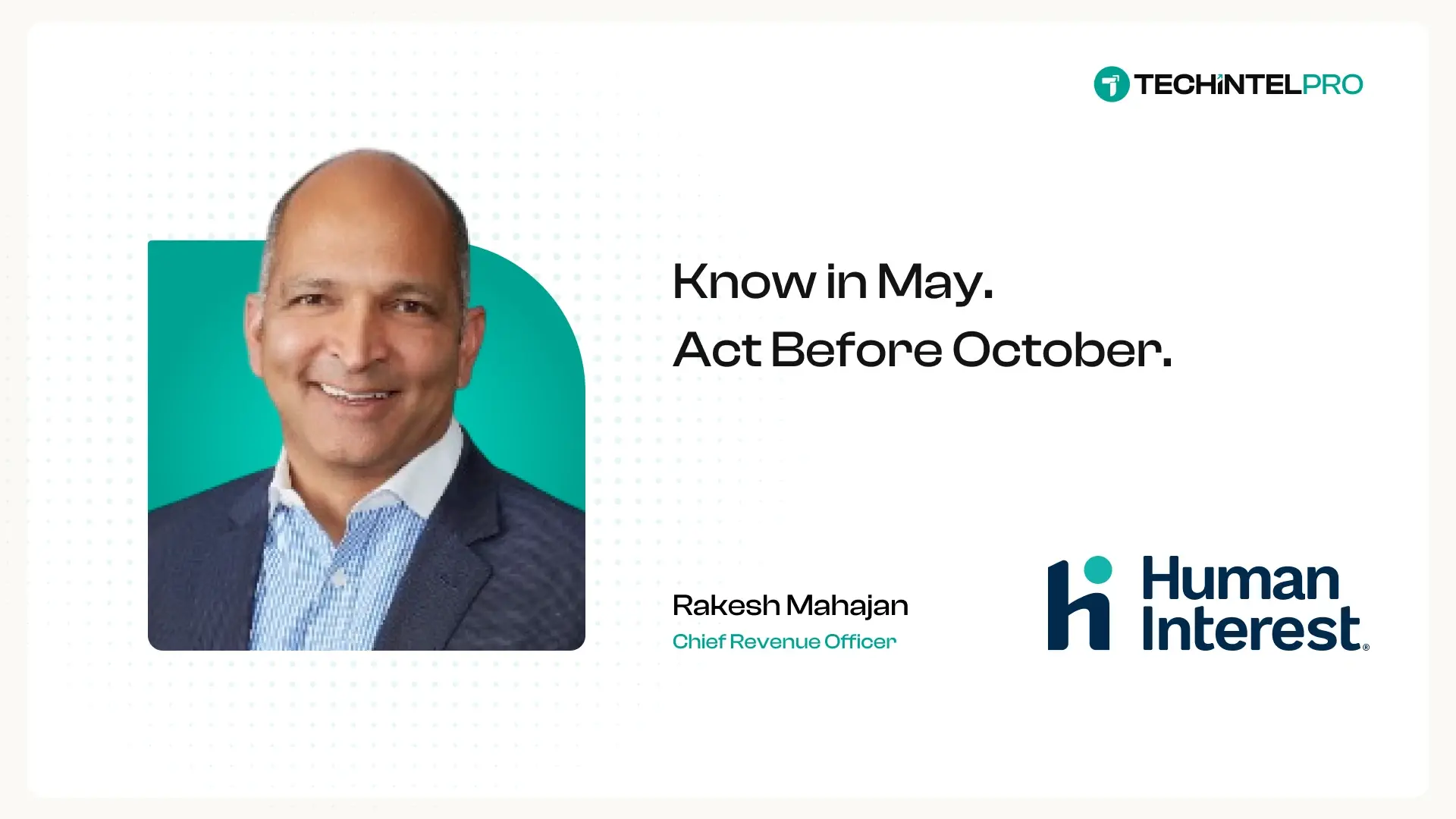
For decades, 401(k) compliance testing has worked the same way: wait until December 31, check whether the plan's balance holds, and if it doesn't, fix it with a corrective contribution or by handing money back. Rakesh Mahajan, Chief Revenue Officer at Human Interest, says that is no way to treat customers. Using data from more than 620 payroll integrations, plus AI and machine learning, Human Interest projects where a plan will land at year-end, so a sponsor can find out in May that the plan will be out of balance by October and act well before it becomes a problem. Legacy providers don't have bad intent, Mahajan says, but they do have bad strategies.
Mahajan brings more than 20 years of channel and partnership leadership across T-Mobile, Microsoft, British Telecom, and Smartsheet, and says his guiding rule is to put the partner's business first. In this conversation, he explains how auditors helped Human Interest rethink the annual plan audit through Audit Relief, why PartnerConnect was built to cut advisors' paperwork down to a click or two, and why the company is willing to back its Customer Experience Guarantee with compensation if it doesn't deliver. He also makes the case that technology is what makes serving small and mid-sized businesses sustainable, and predicts that AI will become far more pervasive in 401(k) plans than most of the industry expects.
I don’t think legacy providers have bad intent, but they do have bad strategies. To do compliance testing well, you need a very technology-forward approach, and that by itself is one issue because you’re not tech-forward if you’re using fax machines in 2026. The second is that you need timely, detailed payroll data going into the calculation, and that’s where our 620-plus payroll integrations come in.
The best example is top-heavy compliance testing. The government created a set of compliance tests to make sure the plan is fair and not advantageous to highly-compensated employees. One of the tests checks that the highly-compensated group doesn’t hold more than 60% of the total plan value.
That test has always been done only at the end of the year. On December 31, legacy providers test the plan to see whether the 60/40 balance holds. If it doesn’t, the way to resolve it is a corrective action, either an employer contribution or money handed back to the highly-compensated employees. That’s not a great customer experience.
What we do is take the data. We understand payroll, and we have a lot of information from our 620-plus payroll integrations. We use that, plus AI and machine learning, to project where the ratio will end up at year-end. We might know in May, with a high degree of certainty, that your plan is going to be out of balance by October. Because we know that in May, the plan sponsor can act way in advance instead of waiting for year-end. They can nudge employees to contribute, change the construct of the plan, or take other corrective actions before it ever becomes a problem.
We learned that auditors believe large plan audits are done far too manually. But that’s just how it’s always been done. That’s the mindset across every dimension of the 401(k) industry, and it’s existed for 40 years. Nobody had the interest or the ability to invest in technology and think about doing things differently.
We showed up and started asking what could be done differently if we looked at every process from a technology perspective. That means working with auditors to understand how they actually work, so we can make that process better. Some auditors pointed to one or two small things. The more tech-savvy ones pointed to many. When we aggregated all those ideas from all those auditors, we effectively rethought how an audit gets done. When I talk to auditors who aren’t in the program yet, they can’t believe it. Then you walk them through it, and it starts to make sense.
It took a lot of help from our audit partners, a lot of ideas, and a lot of technology. We integrate with 620 payroll companies, which means we already have much of the information auditors are looking for. We’re also willing to give it to them in the format they need, to simplify their lives. When you listen to how auditors put these audits together, it’s very, very manual, and it just doesn’t need to be this way.
I’ve worked with partners for the last 20 or 30 years. My whole career has been very partner-centric, very channel-centric. I’ve done it across many countries, continents, and companies, and the biggest thing I’ve learned is that it’s critical to put the partner’s business first.
I’m a believer in karma. If you do right by people and do right by your partners, it pays back in spades, and that’s our philosophy at Human Interest. Yes, we’re a for-profit business. We’re absolutely trying to change the country and make retirement accessible to tens of millions of American workers. But with partners, it starts with what they’re trying to achieve and how my team and I can help them get there.
That’s been the biggest shift in thinking. A lot of our peers and competitors focus on what the partner can do for them. We flipped it around: what can we do for the partner? That mindset is why the vast majority of our business comes from partners, at high volume, and why we’re the fastest-growing 401(k) provider in the country.
The overriding complaint was that it’s too manual. Some legacy providers still rely on paper forms, faxes, and emailed spreadsheets, and it doesn’t need to be this way.
I think of it like the early days of the mobile internet, when getting online took many, many clicks and steps. Then somebody said, “What if we just had one button? You tap your browser, and off you go.” That’s how we approached PartnerConnect. How do we rethink everything advisors have to do so it’s one or two clicks, instead of pulling out a quill pen and fountain ink and sending it off by carrier pigeon? That’s how this industry has been built, and it doesn’t need to be.
Everything starts with our product. It starts with the product being as automated as it can be, and finding the places where there’s friction and automating it away. The more simply customers can do things and the more simply we can explain them, the faster and easier it is for customers to do things on their own.
The other half is understanding what it takes on the customer service rep side to deliver a simple experience. The systems our reps use are equally automated and equally intentional about simplifying how quickly they can get things done. This isn’t about pushing my team to do more, faster. It’s about making things easier for customers and easier for our service team. Only by automating all of that could we look at the data and see how great the service we’re providing is.
Our J.D. Power recognition for customer service is one proof point. We earned that certification because we deliver great service. Customers asked, “Can you prove it? We can see the awards, and we can see you have hundreds of people in Utah serving us, but why wouldn’t you put your money where your mouth is?” So we did, and we challenge all of our competitors to do the same.
Based on our performance, it’s a very well thought-through risk, because we’re delivering on these promises. With the Customer Experience Guarantee, if we don’t deliver, we’ve promised compensation to our plan sponsors and our participants. We measure everything and use data to track our performance.
We read our reviews every day, not just the positive ones, because we put the customer first, just like we put partners first. So we have a good understanding of what customers want, expect, and need. The real risk is not guaranteeing it, because customers are telling us how much they value service. I don’t understand why other providers aren’t doing the same.
I think customers are going to start walking away from legacy providers that aren’t delivering great service. Everybody thinks a 401(k) is a 401(k), until they realize there’s a much better way.
We start with our north stars. Are we able to deliver a great customer experience and a great partner experience? What are the things causing the most friction in delivering those two? That’s where we focus our time.
It’s actually not a difficult decision. The most important thing is delivering for our customers and delivering for our partners.
In one of my earlier roles, I struck a partnership with a large tech company. We thought customers would want to bundle services across the mobile phone and that company’s technology. It all made sense on paper. It was logical and well researched, and customers said they’d definitely want it. But when it came time to buy, there wasn’t a logic to it. People buying a mobile phone didn’t think about adding technology to that purchase. I think we were ahead of our time. That was 10 years ago, and people didn’t yet think of their phone as their mobile office.
The lesson I took to Human Interest has two parts. First, we’re thoughtful about helping customers see beyond the immediate decision. For example, in the next 12 to 18 months you’re going to have to do a large plan audit if you have over 100 participants, so let’s have a more encompassing conversation and look at Audit Relief ® (our automated solution designed to simplify, streamline, and offset the cost of mandatory annual 401(k) audits for large plans). We encourage customers to think about the bigger picture.
Second, we’re careful not to work with distribution partners where buying decisions aren’t actually being made. We focus on the partners most adjacent to the 401(k), where retirement plans come up in conversation all the time. Those are the partners we like to work with.
We’re a technology company that has chosen to solve retirement. About 76 million workers - nearly 52% of working Americans ages 18 to 64 - lack access to an employer-provided retirement plan. Because we use technology, we can radically strip out so many of the costs of serving small and mid-sized businesses.
In fact, we’re the only independent 401(k) provider offering zero transaction fees, because technology delivers those transactions. We strip out the extra costs legacy providers charge, because technology makes things simpler, easier, and more automated. And it’s not just cost. It’s time, too. Small and mid-sized business owners and executives don’t have the time or interest to manage the day-to-day mechanics of a 401(k). They want it automated and they want it to just work, so they can get on with running their business. That’s what Human Interest provides. We make it simple and easy.
If you ask most people in the industry, they’d agree there might be some AI somewhere in retirement. But they’d probably say it’s too risky, and that our business is too complicated for AI to really help.
What we’ve shown, by launching an AI-powered feature alongside our Predictive Compliance Monitoring, is that it can deliver a great customer benefit without being overly complicated. AI is going to be far more pervasive in providing 401(k) plans to SMBs.
Rakesh Mahajan is the Chief Revenue Officer at Human Interest, a fast-growing, automated 401(k) and 403(b) provider that's committed to helping employers provide long-term financial security to their employees.
With over 20 years of global experience, across organizations of all sizes, including T-Mobile, Microsoft and British Telecom, Rakesh is dedicated to helping companies grow through hands-on leadership and igniting transformational growth by retaining the best workforce.
More about Rakesh : 
Human Interest is the highest-rated, fastest-growing 401(k) provider in America. Human Interest believes that employers deserve retirement benefits that run themselves, do not put unnecessary liability on the company, and have low and transparent fees. Human Interest has created the retirement platform that delivers these commitments, allowing millions of employees to access retirement benefits for the first time. Human Interest has set the new standard for 401(k), including: eliminating transaction fees, offering a cash-back incentive program for plan participants, and a customer experience guarantee. Founded in 2015 and headquartered in San Francisco, Human Interest has helped provide retirement benefits to employees at 50,000 companies and counting.
For more information, please visit humaninterest.com.
Tell others what you think of TechIntelPro.



 Rate us on G2

