
Annual planning made sense when business moved slower. Today, it often becomes outdated long before the quarter ends.
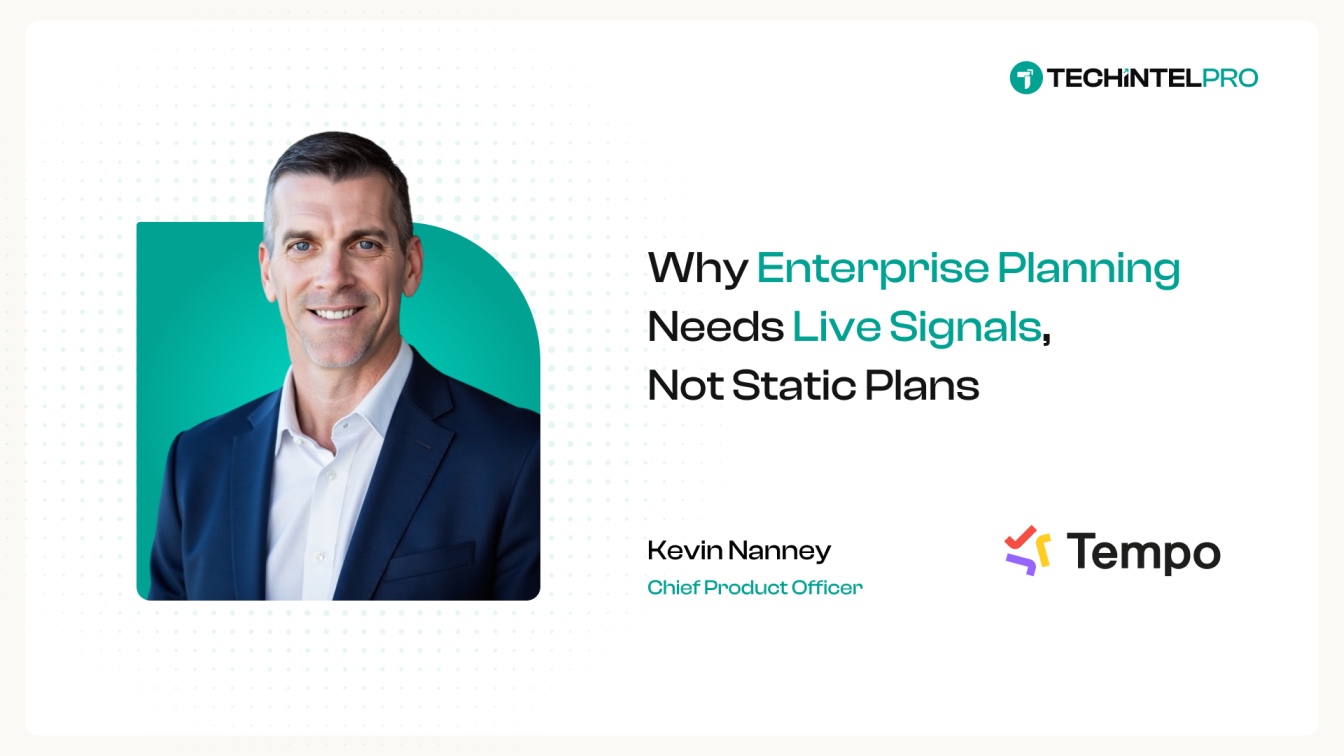
Kevin Nanney, Chief Product Officer at Tempo Software, explains why enterprise software needs to move beyond static plans toward continuous, adaptive planning. He discusses how organizations can use live signals from everyday work to improve alignment, rethink product decisions, balance immediate customer needs with long-term innovation, and replace rigid planning cycles with a system that evolves in real time.
Early in my career at PeopleSoft, and later while scaling Strategic Portfolio Management (SPM) at ServiceNow from zero to over $250M, the model was fairly linear: understand the business process, digitize it, ship a release, wait for adoption, then iterate on a fixed release later. The system of record was the finish line.
What's changed isn't just speed, but the definition of "done." At Tempo, we're not digitizing static processes anymore; we're building software that has to keep pace with how fast plans themselves change. My philosophy has shifted from "build the system that captures the plan" to "build the system that keeps the plan honest in real time." That means I spend a lot more energy today on signal — what's actually happening in the work — than I used to spend on structure. The interfaces and hierarchies still matter, but they're no longer the hard part. The hard part is closing the loop between strategy and execution continuously, not annually.
Most organizations built their planning stack to answer the first question and bolted on the second afterward. Roadmapping tools are great at capturing intent. They're much worse at reflecting reality: what people are actually spending their time on, whether that still maps to the goals leadership set six months ago, and where the drift started.
The other piece is organizational: alignment isn't a single meeting or a single document; it's a constantly decaying asset. The moment you publish a roadmap, it starts going stale because priorities shift, people move between teams, and dependencies change. Most companies treat alignment as an event, but it has to be treated as a live system. That’s exactly the gap Tempo is built to close.
It moves the conversation from "what did we say we'd do" to "what's actually true right now." When leaders are working off static roadmap decks or quarterly reviews, they're always making decisions on outdated information, sometimes weeks old. When planning is informed by a live execution signal, you get to catch misalignment while it's still fixable and before budget is wasted, not after a quarter's been lost.
It also changes the tone of leadership conversations. Instead of defending a plan that's already out of date, teams can spend that time on judgment calls — trade-offs, sequencing, and where to double down — because the system is doing the work of surfacing where reality has diverged from intent.
External feedback tells you what customers noticed. Being your own customer tells you what they haven't noticed yet. The friction has become so normalized inside their own workflow that they've stopped mentioning it. When our own R&D and product teams run their planning in Tempo, we feel every rough edge in real time, and it's much harder to rationalize shipping something mediocre when you know your own team will be stuck using it tomorrow.
It's also a forcing function for honesty about complexity. If a workflow takes our own team 10 clicks and three tabs to complete, that's not a hypothetical UX problem. — it’s slowing down our own roadmap. That kind of direct, immediate feedback loop catches things that a support ticket or a quarterly NPS survey never will.
I think about it as two different clocks running at once. One clock is the customer's current pain point; that's non-negotiable, and if you neglect it, chasing a future vision, you lose the trust and the relationship that let you build anything at all. The other clock is the shift happening in the market that customers can feel but haven't fully named yet. For Tempo, that's the move from static, seat-based portfolio tools to continuous, AI-native planning.
The discipline is making sure the first clock funds the second. We don't treat future-facing investment as a separate, protected bet insulated from today's business — it has to earn its way in by being genuinely useful now, even in an early form, while building toward where we know the category is heading.
The first filter is: Does this request describe a symptom or a root cause? A lot of feature requests are really workarounds for a deeper structural gap, and if you build the literal ask, you end up patching the symptom while the underlying problem festers and resurfaces in a different form six months later.
The second filter is durability: does this serve a specific customer’s configuration, or does it serve a pattern we're seeing across our broader customer base? Volume of requests can be a proxy for that, but it can also just mean one vocal account has a loud advocate. I'd rather build for the pattern than the volume. And the third filter, honestly, is whether it moves us toward the strategic bet we've made — in our case, continuous adaptive planning — or just adds surface area to a static model we're trying to move past.
The annual planning cycle itself. Not a tool, the cadence. Enterprise software has spent thirty years getting really good at capturing a plan at a single point in time and then defending that plan for the next twelve months, even as everything underneath it changes weekly. That's the artifact I'd fire first.
What replaces it isn't "more frequent planning meetings"; it's a system in which the plan is a continuously reconciled, living process rather than a static document you revisit on a schedule. That's not a small tooling change; it's a mindset change for how organizations think about commitment and adaptability. It's also, not coincidentally, the exact bet we're making with Tempo Loop.
Kevin Nanney is Chief Product Officer at Tempo, where he leads product strategy and innovation across Tempo’s portfolio, helping organizations plan, track, and deliver work more effectively at scale. A seasoned product and GTM executive, Kevin brings more than a decade of experience building and scaling enterprise SaaS products across work management, IT, and employee experience.
Prior to Tempo, Kevin served as Senior VP of Global Product Management, Solutions & Marketing at Iron Mountain, where he led global product strategy across digital and physical information management. He previously held senior product leadership roles at Workiva as SVP of Product and Solutions, and spent nearly eight years at ServiceNow, including as General Manager for ITBM/SPM and Employee Experience, driving platform growth and category expansion.
More about Kevin: 
Tempo Software is a leading provider of Strategic Portfolio Management (SPM) solutions. Its modular platform extends Jira with its #1 add-ons for time tracking, capacity management, financial oversight, and portfolio management – connecting strategy, investment, people, and delivery in a unified system. Trusted by 30,000+ customers and 350+ global solution partners, Tempo is a leading partner in the Atlassian ecosystem.
Discover more at Tempo.io.
Tell others what you think of TechIntelPro.



 Rate us on G2

