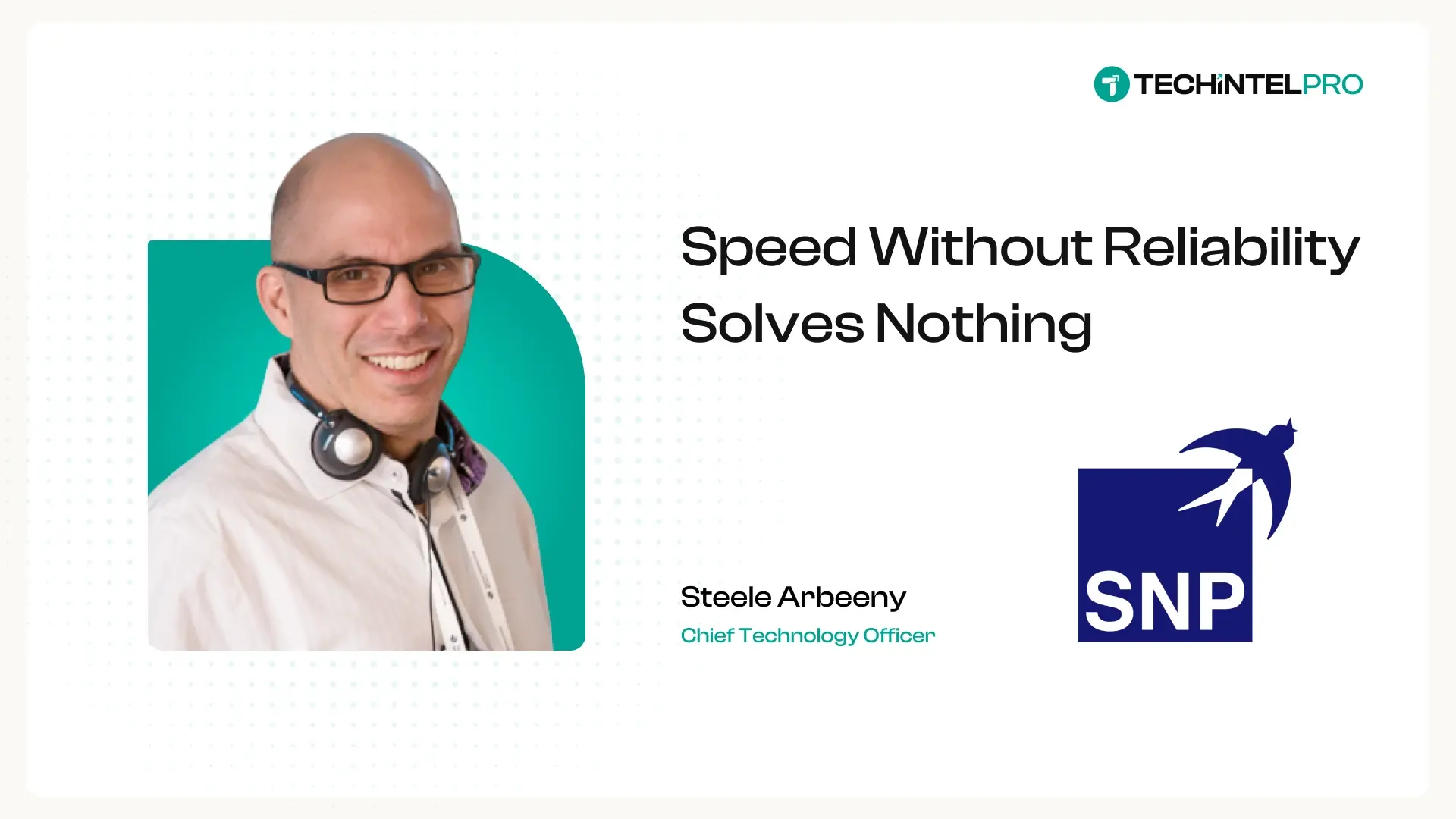
Enterprises rarely get to start a transformation with a clean slate. Dr. Steele Arbeeny, North American CTO of SNP Group, has spent his career architecting systems across organizations carrying decades of acquisitions, customizations, and historical data, some of it critical, much of it just weight. His approach to that mess is summed up in a line he returns to often: keep the best, and transform the rest, the philosophy behind SNP's Kyano and Bluefield methodology, which is built to selectively carry forward what still adds value rather than migrating everything by default.
As Kyano pushes further into AI, automation, and unstructured data, Arbeeny is trying to extend that same discipline to information that has always lived outside traditional business systems, in documents and loose files that hold real institutional knowledge but were never part of a formal migration plan. In this conversation, he explains why he believes speed without reliability creates more problems than it solves in business-critical systems, why he's designing SNP's platform to survive whatever eventually replaces today's LLMs, and why he expects enterprise transformation to stop being a discrete, multi-year project and become an ongoing capability instead.
Scale has a way of exposing technological weaknesses very quickly. The tools and technology that work well for a smaller or localized organization can behave entirely differently when applied across a large, global enterprise made up of thousands of data sources, deeply connected systems, and business processes that cannot pause while change happens. That experience has emphasized to me the importance of designing with complexity in mind from the start and making transformation as predictable and repeatable as possible. As CTO, this requires me to think simultaneously about the big picture and the fine technical details because the solution only works when both come together.
Large enterprises do not approach large scale transformations with a clean slate. Years of acquisitions, customization, and new tool investments can leave them with overlapping systems, outdated processes, and enormous volumes of historical data – and some of questionable value. That complexity can quickly become a limitation on growth and how quickly an organization evolves. The challenge is understanding what is there today, what still provides value, and what is holding back agility.
At their core, Kyano® and the selective migration “Bluefield” approach are structured around the flexibility of keeping what is needed and differentiates the organization, and eliminating what is not needed and may even be hampering agility. Instead of treating every system, customization, and historical knowledge the same way, organizations can determine what needs to be pulled forwards, what should change, and what should be removed.
This is especially important when dealing with data. For instance, regulatory, warranty, or record-keeping requirements may require certain information to be preserved, while the business may have little reason to keep all of it active in the new environment. That distinction can reduce complexity within an organization, and leave it in a better, more agile position to respond to whatever transformation comes next. As I’ve said before: keep the best, and transform the rest.
Our goal is to have an enterprise-wide holistic view of the data. We don’t want to just migrate SAP or even ERP data; we want to address everything the business needs. This includes structured, ERP, SAP, non-SAP and even unstructured data. To this day, a lot of enterprise transformation still depends heavily on specialized knowledge and manual work – but it doesn’t have to. Experienced teams spend significant time understanding complex environments, finding connections across systems and documentation, and identifying what actions to take for the problems that arise. It's now a reality to leverage AI to accelerate all those facets of data migration and transformation, and in every phase of the process from design and execution to verification and beyond.
The goal with Kyano® is to use AI and automation to help organizations accelerate secure SAP transformations and support our customers and partners throughout complex projects. This all leverages SNP’s decades of experience and best practices so that data migration projects can be compressed significantly. Unstructured data expands that opportunity because an immense amount of institutional knowledge lives outside traditional business systems in documents and loose files. This is what we are doing through Kyano® Oros: making it easier for our customers to automate and process that information more efficiently and effectively for transformation. Incorporating that information directly into the transformation process gives organizations visibility and a more complete picture of what they have, while also helping experienced professionals focus their time on decisions where human expertise adds the most value.
The speed of change is so rapid across the industry that predicting exactly what enterprises will need in a few months or years from now is nearly impossible, so the ultimate goal is to build for adaptability. Right now, LLMs are all the rage, and many solutions and platforms out there can leverage them. However, what will replace LLMs? While that answer is unclear now, we can be sure that something will. So our goal is to design our platforms, processes and use of AI to be flexible enough to adopt the next wave of technology. This allows us to help our customers and partners be flexible and adaptable to address whatever business challenge comes their way next. The technology is moving very fast, and this means investing in capabilities that make it easier to understand, move, and reshape data as the business evolves. The more adaptable the foundation is, the faster organizations can respond to change without every new initiative becoming another years-long process.
Absolutely. Speed is valuable, but in enterprise technology, speed without reliability can create more problems than it solves. When you are working with business-critical systems and data, a small error can have consequences across financial reporting, supply chains, customer operations, or regulatory compliance. That makes precision and predictability just as important as how quickly something can be done.
I think that is particularly relevant as organizations adopt AI and automation. The question should not simply be, “What can we automate?” It should be, “Where can automation deliver a better, faster outcome while maintaining the level of control and confidence the business requires?” AI can dramatically accelerate analysis, identify patterns that would be difficult to find manually, and help experienced teams make decisions faster. But those capabilities need to operate within an architecture that provides transparency, governance, and opportunities for human oversight where it matters.
Ultimately, the goal is not speed for its own sake. It is reducing the time and effort required for transformation while making the outcome more consistent and dependable.
Historically, enterprises have treated major technology transformations as discrete projects: spend years preparing, migrate to a new environment, stabilize it, and then begin planning for the next major change. I expect that model to become much less common. AI, automation, and better visibility into enterprise data will make it possible to understand an environment, model changes, and execute transformations much more continuously. Transformation will increasingly become an ongoing capability rather than a project organizations undertake every several years.
What I am less convinced by is the idea that AI will make deep technical and business expertise significantly less important. AI will continue to change how that expertise is applied, and it should remove a great deal of repetitive manual work. But enterprise environments are full of context, exceptions, dependencies, and business decisions that cannot simply be handed over to a model. AI can augment expertise, but it cannot replace the technical and business context that experienced people bring to complex transformations.
Three to five years from now, I suspect we will spend less time talking about AI itself and more time using it to make transformation faster, safer, and easier to repeat. That is ultimately the standard that matters.
Dr. Steele G. Arbeeny is the North American CTO of SNP Group and the architect of numerous mission-critical systems across multiple industries that are adopted by Fortune 500 companies globally. His primary focus at SNP is the architecture, design and AI-augmentation of SNP’s new and existing software products. Steele holds patents in digital speech processing and securities trading and is a member of the IEEE and ACM. He has keynoted worldwide and is an industry expert in SAP digital transformation. Steele earned his PhD in computer engineering from Rutgers University.
More about Steele: 
SNP (ticker: SHF.DE) is the global technology platform leader and trusted partner for companies seeking unparalleled data-enabled transformation capabilities and business agility. SNP’s Kyano® platform integrates all necessary capabilities and partner offerings to provide a comprehensive software-based experience in data migration and management. Combined with the Bluefield® approach, Kyano sets a comprehensive industry standard for restructuring and modernizing enterprise data faster and more securely while harnessing AI-driven innovations based on over 30 years of experience. The company works with more than 3,000 customers of all sizes and in all industries in over 80 countries, including numerous DAX 40 and Fortune 500 companies. The SNP Group has more than 1,700 employees worldwide at over 34 locations in 22 countries. The company is headquartered in Heidelberg, Germany, and generated revenues of around EUR 297 million in the 2025 fiscal year.
More information is available at www.snpgroup.com
Tell others what you think of TechIntelPro.



 Rate us on G2