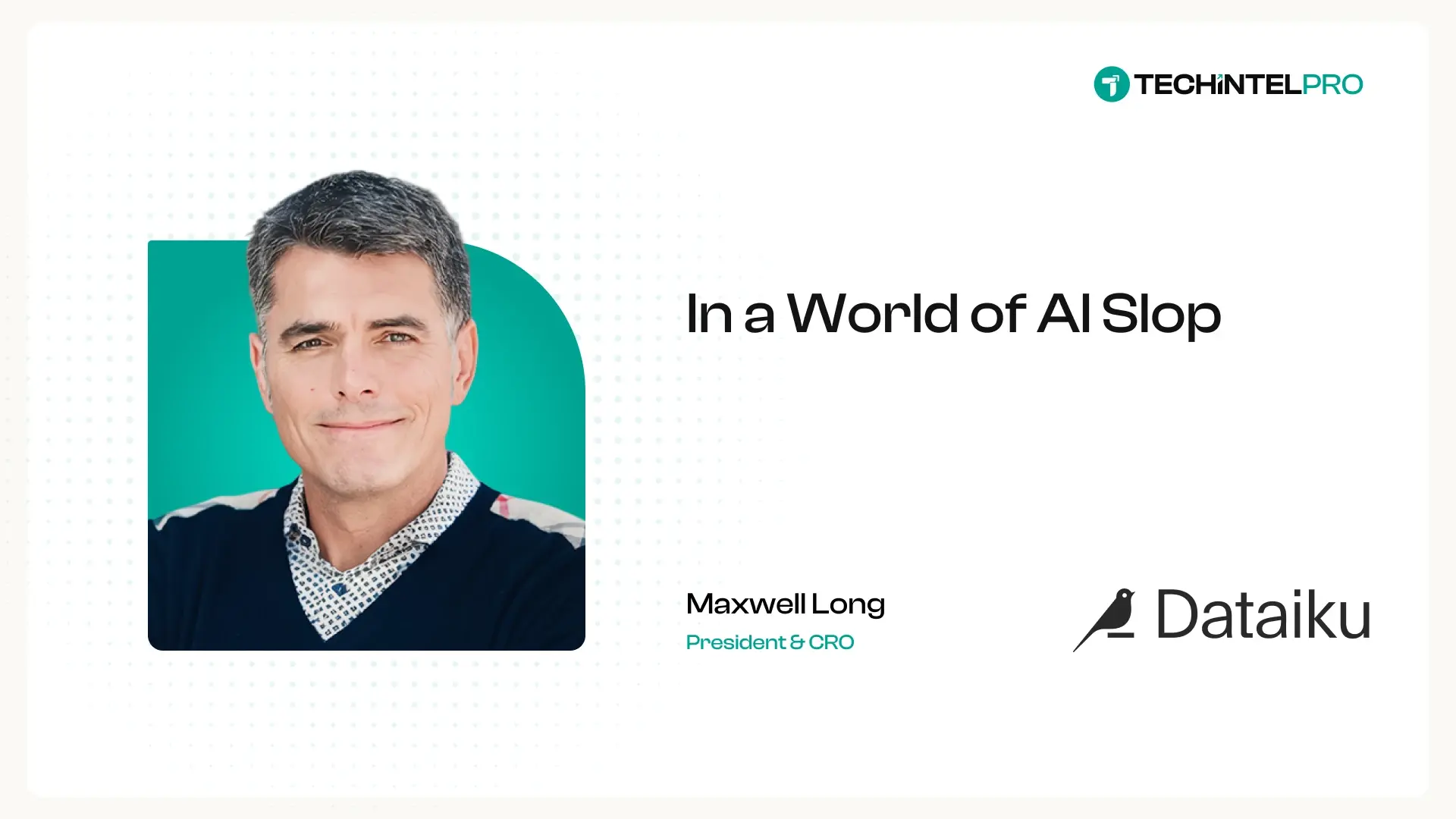
As President & CRO, Long has spent his first weeks doing what he calls a non-negotiable step regardless of how many companies he's run before: talking to customers, partners, employees, and the board, because he doesn't believe a standard playbook exists. In this conversation, he explains the tactical mindset he sees derail enterprise AI programs, plugging in an LLM and calling it a strategy, why there's no longer a clean line between pre-sale and post-sale in a consumption-based pricing world, and why he believes the only metric that actually separates a business-critical AI program from “AI slop” is whether it drives real, provable business value.
I wanted to join a company that was not just talking about AI but actually helping customers utilize it every day. Right now, the market is flooded with companies that bolted AI to their websites and marketing content. Dataiku stands apart from that. We've helped some of the biggest companies, including LVMH, Novartis, SLB, Michelin, and many others, scale and govern AI across their organizations. The company has grown enormously over the last couple of years, and I'm excited to help drive the next chapter of that growth.
I have spent the first few weeks talking with customers, partners, employees, and the board. I wanted to gain a deeper understanding of Dataiku's unique value proposition, the changing nature of the market space we operate in, the competitive landscape, and the talent on our team. Whilst I have operated in multiple companies before, I find that there’s no such thing as a standard playbook, as every company is unique.
Once the board mandates an AI strategy, there's often a rush to act. Too often, that means just plugging an LLM into the employees and calling it success. That's the tactical mindset, where companies spend big without a clear way to prove it's working, and executives end up struggling to justify the cost. We help close that gap by building agentic applications that overhaul legacy processes and deliver measurable financial impact, whether that's revenue growth or operational efficiency.
The typical enterprise company we are working with does not have the simplicity of working with one data source or one LLM. They want to move with agility and empower their teams to drive the company forward. But they also need to know where the data comes from, document their approach so it isn't locked in one person's head, and trust the answers they're getting. That's what keeps customers coming back to Dataiku. We enable enterprises to do all of this within a safe, governed environment.
What never changes is the need to know your customers' businesses well enough to sell to them and deliver value. In the same vein, it has always been clear to me throughout my career that people buy from people, so the importance of establishing strong relationships will never go away. That is earned by doing what you say you will do, being there during tough times, selling only solutions you know will add value, and being present for the customer. What has changed is the speed at which we need to operate and the ability to use AI to make what we do even more personal to the customer. We have to be AI-first ourselves before we can guide our customers to AI success.
In the era of legacy software licenses, our primary focus was maximizing sales efforts until the contract was finalized. SaaS came around and changed that — the sale meant nothing without adoption. And now, consumption-based pricing has changed it once again. There's no line between pre-sale and post-sale; it's one continuous job of finding and deploying use cases that drive real value and usage. That means CROs now have to work hand in hand with product teams, flagging what accelerates or blocks adoption so the customer journey stays simple.
Productivity improvements driven by AI are, of course, great, but the reality is that if the solution you are selling doesn't drive business value or ROI, then you aren't business-critical. In a world of AI slop, that's the metric that actually matters.
I expect people to say that Dataiku is at the forefront of helping enterprise companies deliver true agentic applications that changed the way they do business for the better. I also want them to say that we've continued to help them drive innovation at the intersection of people, governance, and orchestration. What I don't want them to say? That Dataiku became a legacy solution.
Max is the President & CRO of Dataiku, the Platform for AI Success. He brings over three decades of experience scaling teams at global software companies, including Microsoft, Adobe, and NetApp. Prior to Dataiku, he served as President of Go-to-Market at Smartsheet, where he helped lead the company through a major upmarket transformation as it grew from hundreds of millions in ARR to more than $1B. Max pairs analytical clarity with the experience to run a transformation end-to-end.
More about Maxwell : 
Dataiku is the Platform for AI Success, the enterprise orchestration layer for building, deploying, and governing AI. In a single environment, teams design and operate analytics, machine learning, and AI agents with the transparency, collaboration, and control enterprises require. Sitting above data platforms, cloud infrastructure, enterprise applications, and AI services, Dataiku connects the full enterprise AI stack, enabling organizations to run AI across multi-vendor environments with centralized governance and oversight.
Learn more at dataiku.com.
Tell others what you think of TechIntelPro.



 Rate us on G2