
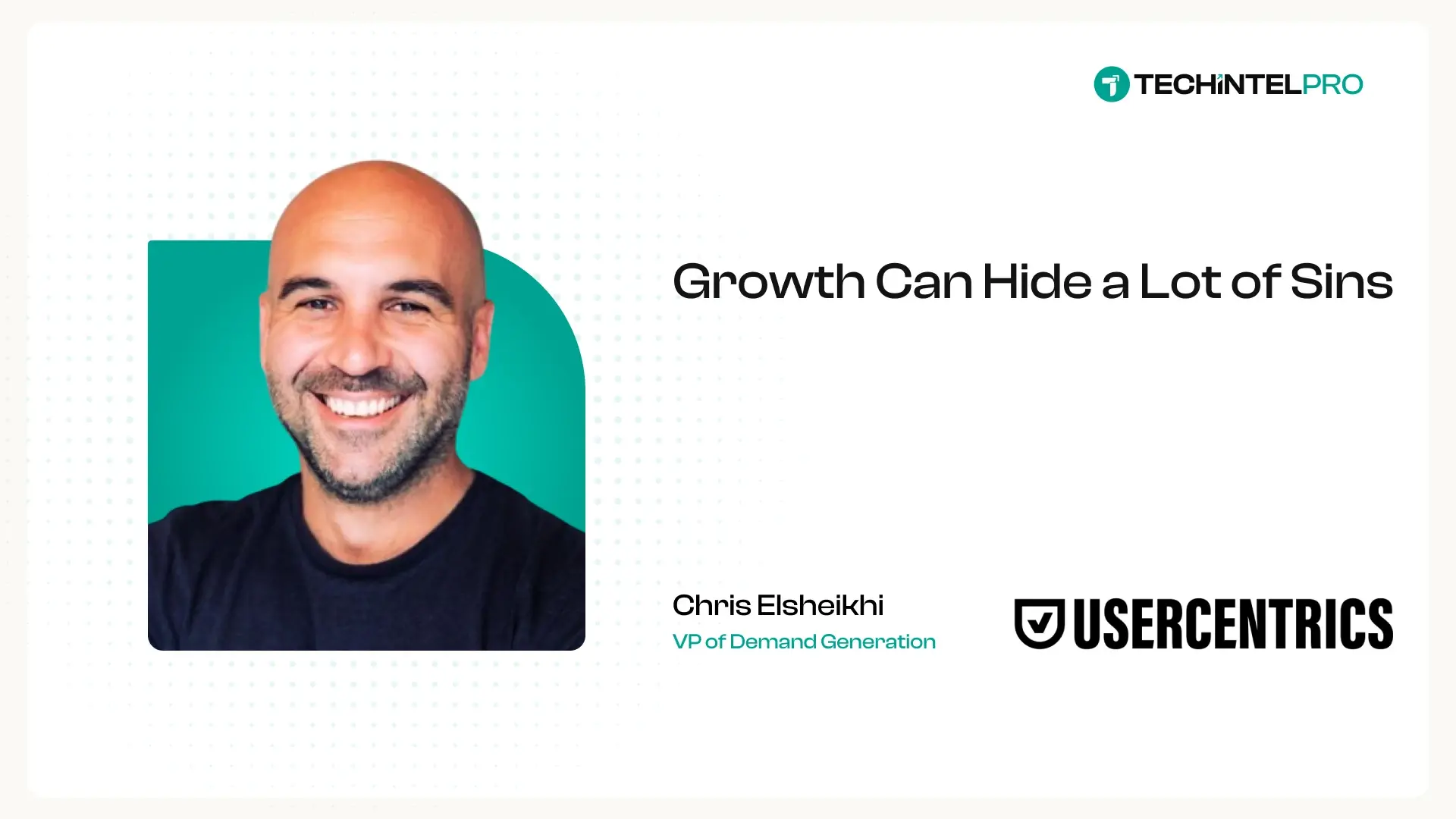
Chris Elsheikhi learned one of his most useful go-to-market lessons at Spring, where revenue kept climbing while nobody could say for certain what was driving it. Attribution was messy, pricing and retention were open questions, and different teams held different versions of the truth. Getting into the weeds, and tracing how customers were acquired, where money was made and where it leaked, helped unlock around $30 million in ARR. The takeaway he carried forward is blunt: scaling something you don't properly understand usually just scales the problems with it.
Now VP of Demand Generation at Usercentrics, Elsheikhi brings 15 years of experience across B2B SaaS, e-commerce, and emerging technology, along with a skeptic's eye for received wisdom. In this conversation, he explains how he builds a go-to-market playbook from scratch using a modified Blue Ocean approach, why a playbook is the output of repeated experiments rather than something written on day one, and why AI should be used to speed up experimentation without flooding the market with generic content. He also makes the case that skepticism from a stakeholder group is usually an incentive problem, not a communication problem, and explains why sending more email and publishing more content no longer creates more demand.
The absolute first thing to check is where the business is spending its time and money, and whether there's enough evidence to justify the spending. When a go-to-market strategy isn't working, the instinct is often to keep optimising or to double down on the same channels, rather than questioning whether they’re still the right ones. But, for a hyper-growth start-up you need to be willing to add more channels, offers and ICPs to open up more opportunities.
Interestingly, experimentation is a big part of how we’re approaching our growth and go-to-market at Usercentrics. We’re creating a broad area for testing our strategies, and AI means that we can do it at a pace that wasn't previously possible.
The most important thing to remember is that you don’t always need the experiment to work. You need enough of them running to start seeing where there is genuine demand, and where it’s worth more investment.
Quite often, that's where the next level of growth comes from.
“I actually teach a version of this framework in workshops with local accelerators ( shout out to Unicorn Factory in Lisbon) because one of my core beliefs is that people massively overcomplicate GTM.
When I’m starting from scratch, I begin with the market. I cast a really wide net on competitors — not just the obvious direct competitors, but adjacent businesses and alternative ways customers are solving the same problem.
Then I map what everyone is actually competing on: price, product, service, distribution, customer experience, whatever matters in that particular market. I score that out and visualise it. That’s the part inspired by Blue Ocean Strategy — you can very quickly see where everyone looks the same and, more importantly, where there might be white space.
Then I bring the customer into it. Who are the different personas? How do they buy? What do they actually value? What’s their willingness to pay? And does our assumed ICP actually stand up when you look at the evidence?
TempStars was a great example. They were the original dental temping platform and had built a strong business in Ontario, but they were struggling to replicate that traction elsewhere while competitors were growing across North America. So the question wasn’t simply, ‘How do we sell more TempStars?’ It was, ‘Where can TempStars compete differently, and which customers give us the best right to win?’
Once you have those hypotheses, you test them. I’m a big believer in limiting the number of objectives, running experiments quickly, measuring what gets traction and then doubling down.
And that’s really the key: a playbook isn’t something you write at the beginning. It’s the output of repeated learning.
Once something works consistently, then you codify the ICP, positioning, channels, sales motion and metrics so that it becomes repeatable. That’s when you actually have a GTM playbook.”
Spring taught me this more than anywhere.
We were growing fast, and when a company is growing fast, it’s very easy to assume the machine is working. Revenue is going up, so you keep pushing.
But when I got deeper into the business, I realised we didn’t have a clear enough picture of what was actually driving that growth. Attribution was messy, there were questions around pricing and retention, and different parts of the organisation had different versions of the truth.
So I had to get into the weeds. Not just looking at the top-line numbers, but understanding how customers were acquired, where we were making money, where we were leaking it, and which assumptions we’d been carrying because nobody had really challenged them.
That work eventually helped unlock around $30 million in ARR, but what stayed with me was something much simpler: growth can hide a lot of sins.
You really understand a business when you have to pull apart how it actually works, rather than how everyone thinks it works.
And that’s something I’ve carried with me ever since: scaling something you don’t properly understand usually just scales the problems with it.
The biggest mistake is assuming skepticism is a communication problem rather than an incentive problem.At Gett, particularly when we were expanding into Scotland, we were asking drivers to change behaviour and put trust in a platform they didn’t yet know, in a market where there was already a lot of noise and skepticism around ride-hailing.
You can give stakeholders the best presentation in the world, but if you haven’t understood what they’re worried about, what they stand to gain, and what could make them lose trust, you’re not going to get real buy-in.
So rather than trying to sell the strategy from the top down, we spent time understanding the drivers’ economics and concerns, getting close to the community, and creating early advocates who could validate the proposition with their peers.
That taught me that with a skeptical stakeholder group, you don’t start by asking, “How do I convince them?” You start by asking, “What needs to be true for this to work for them?”
Once you solve that, adoption becomes much easier because they’re no longer being asked to buy into your GTM strategy — they can see why participating is in their own interest.
I would say the instinct to get involved in everything.
In an early-stage business, being hands-on is often a strength. You’re close to the customer, making decisions quickly such as and if something needs doing, you do it.
But what works in the early stages can become a problem as the company grows. If every decision or problem still needs to go through one person, that person eventually becomes the bottleneck meaning that people start waiting for your view rather than trusting their own judgement. The leadership challenge is therefore to recognise when being hands-on is genuinely helping, and when I'm just inserting myself into something that someone else is perfectly capable of owning. That's quite a difficult adjustment for people who are used to building businesses from the ground up.
One of the most outdated best practices is the idea that doing more will automatically create more demand.
When every business now has access to the same automation tools and databases, it’s too easy to send another ten thousand emails or 20 pieces of content. The problem is that your audience is being hit with exactly the same thing from everyone else.
That’s why I’m increasingly interested in the relationship brands build with their audiences. Channels like Reddit and YouTube can all play an important role here as people go there to learn and exchange opinions. You can see the same thing in the creator economy, where smaller creators can often outperform much larger ones when it comes to monetization because they understand their audience better and have built a stronger connection with them. AI will amplify this problem even further by making it easier to produce huge amounts of content, meaning that generic content will become easier to ignore.
The opportunity is to use AI to increase the pace of experimentation while making sure the ideas, opinions and content that reach the market still feel original, human and worth remembering. The brands that stand out will be the ones that actually have something interesting to say and understand the people they're trying to reach.
Chris Elsheikhi is VP of Demand Generation at Usercentrics and a GTM leader with 15 years of experience driving hyper-growth and category creation for tech startups and scale-ups. With a background spanning B2B SaaS, e-commerce, and emerging technologies, he specializes in building demand engines that combine data-driven execution with category-defining narratives. Chris is now focused on scaling Usercentrics and shaping the future of privacy-led marketing.
More about Chris: 
Usercentrics is a Munich-based data privacy technology company founded in 2017 that specializes in consent management platforms and Cookiebot solutions. It helps businesses worldwide comply with regulations like GDPR and CCPA. Following its 2021 merger with Cybot and backing from investors including Google, the company powers privacy compliance for hundreds of thousands of websites and applications.
More information is available at www.usercentrics.com.
Tell others what you think of TechIntelPro.



 Rate us on G2