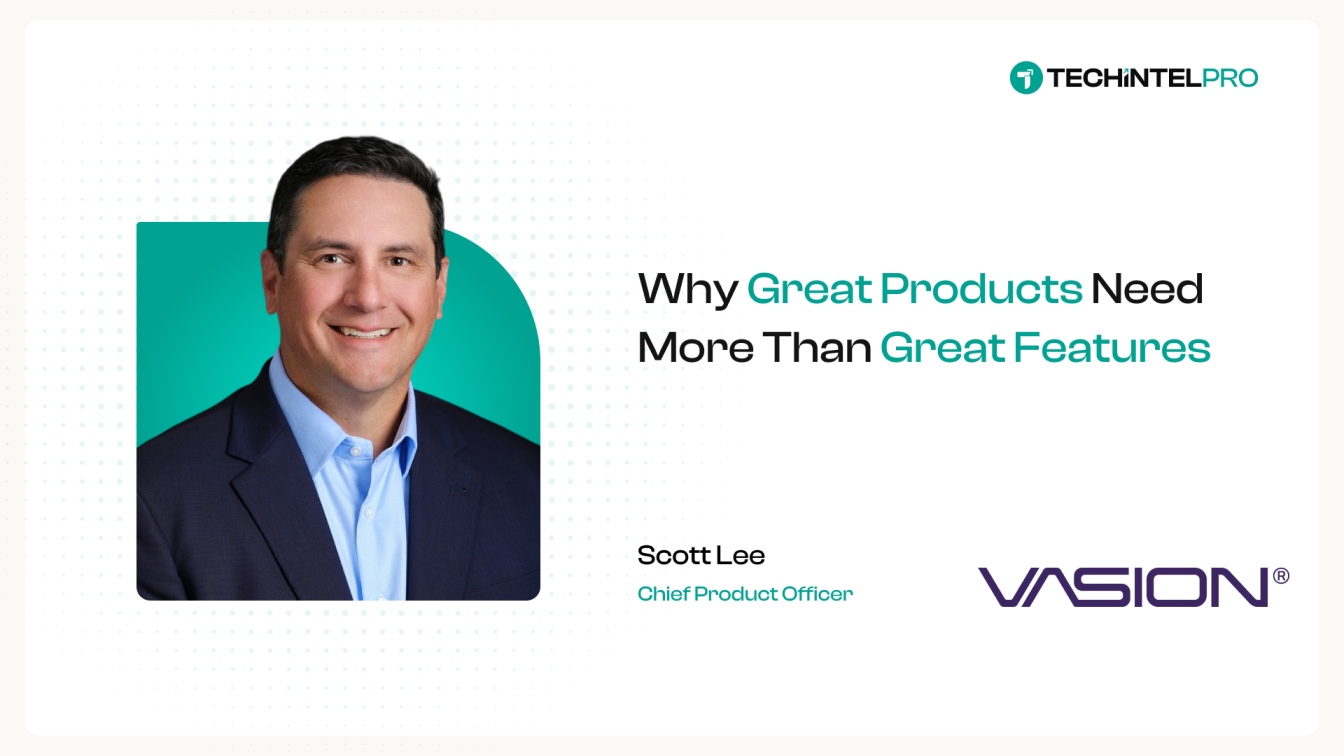
The toughest product decisions rarely involve choosing the next feature. They involve deciding what not to build.
That's a discipline Scott Lee, Chief Product Officer of Vasion, has refined across consumer, SMB, and enterprise software. In this interview, he discusses why product leaders should anchor every decision in customer jobs, not feature requests, how to keep long-term vision from getting buried under quarterly priorities, and why product, go-to-market, and business strategy must operate as a single system.
It's a great question. Each segment has taught me something I wouldn't have learned if I'd only lived in one of them. Consumer beats user obsession into you! My experience with Xbox really helped me understand this. If someone can't pick up and play immediately, have fun with what they're doing, they bolt. In B2B software, if the product isn't intuitive in the first few seconds, that user is gone. SMB taught me velocity and self-service. Often the buyer is the user and the admin, their budget is smaller, and the only way you win is if the product is intuitive, solves pain immediately, and sells itself. Enterprise is a totally different muscle where things like trust, durability, and usefulness help get adopted and you earn your way to "mission-critical." You're not just shipping features; you're underwriting somebody's career when they bet on you, as I learned at Adobe Workfront. People at our customer organizations got promoted because they bet on us and it paid off. So, in terms of product leadership, ultimately, I like to think our platform is "built for enterprise, designed for people."
I look at things across a few dimensions, beginning with a "jobs to be done" framework. This begins with a simple question: what job is someone trying to do independent of any tools or software? If you just look at what they're trying to accomplish, you get a clear picture of what will make them happy. For example, when you're building a treehouse and you must bolt posts together, you're not really buying lumber, a hammer, and nails; you're buying sturdy support for a place your kids can dream big, bond, etc. It's looking at the world through that lens to see what's really going on. So, in software, some of the signals I look for are:
Such an interesting and timely question. In my experience, most teams aren't undisciplined when it comes to producing. They have some sort of way they work. But the disconnect between what they're working on, and the actual product vision and strategy happens because that vision lives in someone's head, a deck, or a thousand docs, while the priorities live in a sprint and nobody translates between them. And then there are feature roadmaps and technical roadmaps (my record is seeing over 30 roadmaps when I walked in the door). My approach is straightforward. You must write the product vision and strategy down and align everyone on it: executive team, board, partners, teams. This is where we're going and why. You need an operating model so you can regularly discuss current priorities, tradeoffs, and what's coming next across features and tech – one roadmap. And you need to make sure every quarterly priority connects back to a multi-year bet. I also protect intentional time for the longer arc work, like adjustments to the strategy based on various inputs, because daily priorities always trump long-term thinking. Innovation doesn't die from one bad decision. It dies from a thousand reasonable ones that all favored the short term.
The biggest obstacle is the gap between the strategy and the org chart. So many times, you see leaders reorganize for every reason except the strategy. I don't do re-orgs until we have a vision and strategy and then ask if it's necessary. Conway's Law is real; your organization’s structure will ship itself. If we have a unified platform strategy and three independent product silos with three independent roadmaps, guess what we'll ship? Three products that don't fit well together. Another obstacle is what I call ‘metrics theater,’ or teams measuring activity instead of outcomes. Yes, everyone is working hard and that's valid. But of any team in the company, the product team must be clear on what we're building and why, how it helps and what customers are getting from it. I push hard to tie every product investment to a leading indicator that connects to revenue, retention, growth, or efficiency. If we can't draw that line, we're not ready. A third obstacle is heroism. Heroes are great for startups, but it's hard to scale a company on tribal knowledge and late nights. At some point you must build frameworks and systems that don't require the leader in the room. That transition is painful, and many times we underestimate as leaders how much of our job is making that shift possible. In the end, heroes don't scale.
I treat product and GTM as one team. Much of my career has been in product marketing, and I learned from those experiences that if you're selling to businesses, there are really a few roles that are critically linked: product management, product marketing, sales strategy & enablement, customer success, and sales engineering. Why? Because the product truth should answer the market problem for the job to be done, and the answer should be messaging, merchandizing, and demonstrated seamlessly to the customer. That's hard to do if PM and GTM aren't acting as one team. In practice this looks like marketing, sales, and customer success at the table when we're scoping the problem, discussing how we'd solve it, and designing and building it. By the time we're talking about features, the field has already shaped the why and how. Launches shouldn't surprise anybody and the messaging isn't reverse engineered from a feature list two weeks before GA. We run a joint launch readiness process with a hard bar: no launch without a clear ICP, clear story, use cases, sales enablement, pricing, and packaging. If any of those aren’t ready, we hold off. We also share metrics (engagement, time-to-value, expansion ARR, NPS, etc.) because if the product team celebrates a launch while sales misses the quota, we haven't actually won. This is why I coach product managers to think of their sales and CSM counterparts as our "storefront." I'm sure Apple product managers care a lot about a consumer's experience at the Apple Store; why would it be any different for a PM to care how a CSM or AE will tell that product's story?
When I joined Vasion, we had really powerful point solutions for end user print and output printing. But the vision for the past seven years, led by Ryan Wedig, our CEO, and architected and built by our R&D teams led by Corey Ercanbrack, our CTO, has been to bring these and other capabilities into one unified platform. So, in our spring release, we introduced Vasion Automate for workflow automation, and we are now bringing these into one platform with one identity layer, one workflow engine, and one document orchestration layer. That's the foundation. Here's how I think about it. Every enterprise, large or small, has a system of record for its customers (CRM), its money (ERP), its people (HCM), its patients (EHR), and its systems (ITSM). And they have document repositories, usually storage with a little bit of collaboration and maybe some workflow. But nobody has a system of record for the document, and documents are how all those systems actually talk to each other. They're the connective tissue. Today, that connective tissue is held together with paper, PDFs, email, and tribal knowledge. That's the gap I see Vasion closing. We become the system of record for the document lifecycle across capture, workflow, output, compliance trail and orchestrating across the systems the document touches. In terms of adoption, our Intelligent Print Automation platform enables digital transformation because the muscle memory of clicking File>Print is already there. Everyone knows how to do it. But now, they'll be able to click File > and send for signature, send to a workflow, at the printer, or scan to a workflow. We just defeated one of the major obstacles to digital transformation: user adoption of new tools. File>Print is something everyone can do now. And we have millions of devices already enabled for it; they just must turn it on. The play here is to take the boring, mission-critical document work (which has been largely ignored for a long time) and make it intelligent, compliant and strategic for our customers. Since we're building for regulated industries like healthcare, finance, government, and manufacturing, compliance isn't a feature. It's table stakes. So, for example, FedRAMP High Authorization means our platform passes over 420 controls the federal government requires to operate within their environment. Compliance is a design point of our platform. It's wired into how we think when we develop.
The opportunity is probably bigger than people are giving it credit for, and it's also different than what most demos are showing. I mean, everyone is racing to put a chatbot on top of their product or do voice or something. But I don't think that's the opportunity. The real opportunity is rethinking the workflow itself. What work do humans do, what work does the system do, and what does that new boundary look like? Even the job to be done, which is why the workflow exists in the first place, can be reimagined with AI. A lot of jobs that used to take a person reading, deciding, and routing can now happen automatically. Obviously, content generation accelerates. A lot of decisions that used to take days can collapse into seconds. That's just fundamentally a different product, not your old product with AI on top. And then there's durability and taste or product sense. A demo is easy and we're seeing a lot of cool demos. But a demo at 99.9% reliability, with auditability, compliance, and the user trusting it enough to take their hands off the wheel is hard to do. And in regulated industries, the bar cannot be, "it works 94% of the time." The bar is, "show me the audit trail." There are infinite places to apply AI. If you think about it, though, many of them are bad ideas. Take workflows. A deterministic workflow like processing an invoice compliantly must be done the same way every time. An agent can't freewheel that, so the job is to choose the use cases that require a consistent process and use deterministic workflow automation for those and use agentic capabilities where they may apply better. For example, even in a deterministic workflow, you might have an agent step to process, extract, and classify data in a sales contract you're routing for approval and signature. It's having the discipline to say no to the shiny stuff that won't move the business properly. That can be hard to do.
Well for one, the model is finally changing but maybe not how people think. For two decades, enterprise SaaS was about building bigger and bigger systems of record. Look at CRM, ERP, HCM, and so on. Most of those categories are spoken for now so replacing them isn't the game. But here's what I think people miss. Documents are the connective tissue between those systems. They flow into the ERP, out of the EMR, between CRM and finance, in and out of workflows, and nobody really owns that document lifecycle as a domain. Sure, there are repositories which have storage and some collaboration, but not in the way I'm describing. That's an opportunity that excites me. Another is the fact that most of these documents go “dark” (unstructured data) when printed. If a CIO is now tasked with creating AI capability in their own company, like training models on proprietary data, and Gartner says 80% of enterprise data is unstructured, then there's a big opportunity to keep documents intelligent throughout the journey. So, the future I'm betting on is two things at once. First, new systems of record for the domains that never had one. Documents are an obvious example, but they're not the only ones. Second, vertical-aware, AI-native solutions for this orchestration layer that power AI models and give people better understanding of what's going on in the critical work of their organizations, while saving time and money, improving quality of decisions, and speed. This is a great place to be building right now.
Scott Lee is a seasoned C-level product & growth executive with more than 20 years of experience building, scaling, and transforming enterprise SaaS companies. He is passionate about serving customers, developing high-performing teams, and helping growth-stage organizations achieve durable results through product innovation, operational excellence, and disciplined execution.
As Chief Product Officer at Vasion, Scott leads product management, product design, and product operations. His focus is on building strong product foundations, aligning teams around a clear product vision, and ensuring consistent delivery of customer value as the company scales.
More about Scott: 
Vasion is an Intelligent Print Automation company making digital transformation attainable for all by eliminating print servers, consolidating print environments, digitizing and automating workflows. We're redefining modern output management with one of the world's most advanced and secure cloud-native platforms, turning what's been IT's longest-standing headache, print, into a strategic advantage. More than 13,500 global customers, including hundreds of the world's leading enterprises, trust PrinterLogic, PrinterLogic Output, and Vasion Automate to modernize, secure, and unlock AI-ready environments. With Vasion, digital transformation works for everyone.
Learn more at www.vasion.com.
Tell others what you think of TechIntelPro.



 Rate us on G2