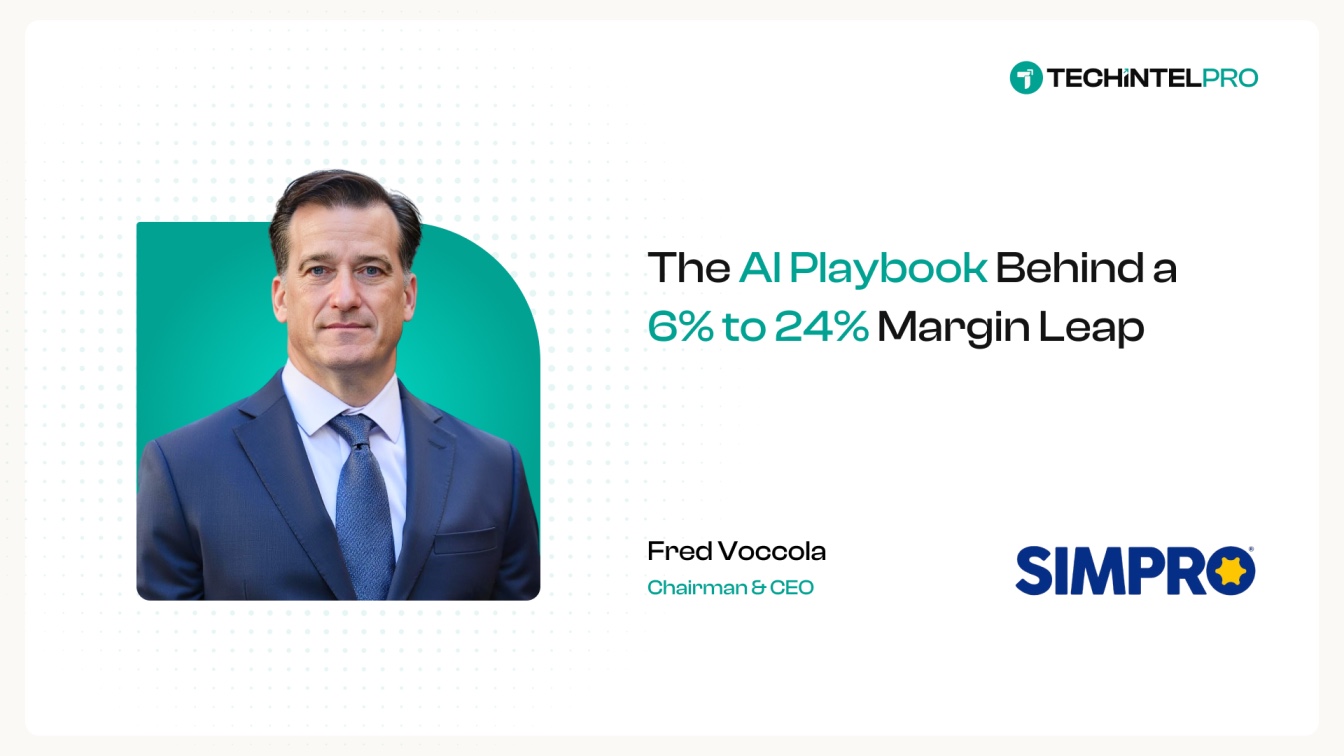
For decades, businesses have accepted operational gaps as the cost of staying lean. Fred Voccola thinks that excuse has expired.
Fred, Chairman & CEO of Simpro Software, argues that AI is fundamentally changing what's possible, not by replacing people, but by giving businesses capabilities they could never afford before. He shares why AI-first starts inside the company before it reaches customers, how digital workers can transform day-to-day execution, and why companies chasing trends instead of solving real problems will inevitably fall behind.
I think it’s unquestionably true that AI is the single biggest productivity shift in human history. Bigger than the internet, bigger than electricity. I don’t say that lightly; over my career, I’ve said, “no, this is hype” a lot more often than I’ve said, “this is the next big thing.”
I’ve been through the internet, mobile, cloud, cybersecurity. Every one of those had the same thing happen. A wave of companies raising money and building stuff because it was hot, not because anybody needed it. My father taught me the opposite of that a long time ago. Find a real need in a big market and solve it.
AI is a technology, not a business. It’s raw potential. On its own, it doesn’t fix anybody’s P&L. It has to be given shape and pointed at a specific problem in a specific industry before it does a single useful thing. Every big technology has been like this. The internet, software, databases. They’re only worth something when a company transforms them into something a real business can actually use. That’s the job of Simpro Group. We take the raw productivity of AI and turn it into a usable platform for the field service trades, aimed straight at their biggest problem, which is brutal inefficiency and low profit.
And the beautiful part for the business owner is there’s no new infrastructure to build. You don’t have to stand up a data center. If you’ve got a laptop and a phone, you’re ready. What you need is somebody to transform that potential into something built for you. That’s the gap Simpro Group fills.
The other lesson people underestimate is speed. Not recklessness. Speed with intent. Whoever moves fastest in a real wave wins, because the technology compounds. A company that goes AI-first this year and a company that waits look identical today. Twelve months from now one of them is running double the margin and the other one is quietly dying. It’s not close.
That’s why I’m here. The field service trades, the plumbers, the electricians, the HVAC and fire guys, the second responders who keep civilization running, sort of got skipped by every one of those prior waves. AI is the first shot they’ve ever had at the kind of efficiency boost white-collar industries take for granted. That’s a $6 trillion market and a genuinely good thing to do with your life. Both of those matter to me.
The shift isn’t just operational; it’s psychological. And it’s the hardest one there is, because you’re asking people to stop believing something they’ve believed their whole life.
Here’s the reality. The average trade business runs at about 6% net margin. The best ones run at 24%. People assume the difference is effort or being better at the actual trade. It isn’t. The difference is execution capacity. There are roughly 27 things you have to do well to run a genuinely profitable trade business. Marketing, purchasing, dispatch, collections, compliance, fleet, safety, all of it. Most trade businesses can only afford to do about 7 of them well, because the other 20 are jobs you’d have to hire for, and at 6% margins you can’t. So, they just don’t get done or get done inefficiently.
For decades that was the ceiling, and everybody accepted it. The mindset shift is refusing to accept it anymore. Stop running your business like a pile of individual jobs you’re personally holding together with willpower and start running it like a system with a brain. That’s what a digital workforce actually is. It’s not software you log into. It’s the 20 employees you could never afford, showing up for work every day, doing the functions you’ve been skipping for years.
The second part of the shift is trust. And this is the uncomfortable one for a lot of great operators. When the intelligence tells you a different route saves your crew two hours, or that you’re quietly losing money on residential and making a fortune on commercial, you have to be willing to act on it even when your gut says otherwise. I’m not telling anybody to throw out 30 years of experience. Experience is priceless in this business. But experience plus intelligence beats experience alone every single time, and the owners who figure that out first are going to eat everybody else’s lunch.
And the reason it matters so much is what it unlocks on the other side. It’s not just money, although the money is life changing when you go from 6% to 24%. It’s optionality. Some of these owners want to grow, buy more trucks, take more territory. Some of them just want to stop working 70 hour weeks and see their kids. A business with a brain gives you both. You get to choose. Right now, most of them don’t get to choose, and that’s the thing we’re actually changing.
Let me define it by what it is not. AI-first does not mean AI-assisted. It does not mean you took your existing software and bolted a chatbot onto the corner of it. That’s window-dressing, and most of what’s being sold as AI in this market right now is exactly that. A search box that can talk back.
The first thing people get wrong is thinking AI-first is only about the product you ship. It’s not. For us, it starts inside our own walls. It’s how we write code, how we run support, how we make decisions, how we operate as a company day to day. If you’re going to sell AI-first to the trades, you’d better be living it yourself.
On the product itself, AI-first means the intelligence is the center of the platform, not a feature on the side of it. The way I explain it to owners: your FSM system, whether that’s Simpro, AroFlo, or BigChange, is often the heart of your business. It pumps the blood. It runs the jobs, the quotes, the scheduling, the invoicing. What it’s never had is a brain sitting on top of it, thinking on the business’ behalf. That’s what we built, and we call the brain, Cooper. Cooper isn’t an add-on bolted to the top. Cooper is the intelligence layer the entire platform runs through. Always on, always learning, always working the business while the owner sleeps.
What that looks like in practice: an owner opens JustAsk and talks to their entire business in plain English. Which customers haven’t paid me in 60 days? Which crew is most profitable on commercial work? What jobs are at risk this week? No report builder, no analyst, no spreadsheet. Their whole data lake answering questions in a sentence. On top of that, we ship AI agents, a digital workforce, that do full-time jobs no trade business could ever afford to staff. One makes sure the tech shows up to the job ready, with the right parts and certifications. One makes sure the job itself is set up to actually make money. One writes up the work, so nothing falls through the cracks on billing or compliance. These aren’t features. They’re roles. They’re the employees you could never hire at 6% margin.
The test for whether any of this is real is simple. If your so-called AI is doing things your people could easily do without it, that’s a gimmick. AI-first means it’s doing work your business could never afford to hire for, at a scale no human team could match.
And the measurable part is the whole point, because outcomes are what matter. Fewer drive miles. More billable hours in the same day. Faster quote to cash, so the money’s in your account instead of somebody else’s. Cleaner compliance, so you pass the audit without a missed form. Every one of those drops straight to the bottom line, and they compound. That’s the difference between AI you talk about and AI that shows up on your P&L.
To be honest, I don’t spend much time positioning against competitors, and I think that’s a mistake most companies make. If you’re building features because a competitor shipped them, you’ve already lost. You’re playing their game, one step behind, forever. I position against the actual enemy, which is how badly this entire industry has been ignored.
The field service trades are a $6 trillion global market that technology seemingly forgot for 40 years. Everybody built for white-collar. Nobody built for the trades. When the opportunity is that big and that underserved, you don’t win by “out-featuring” the other guy. You win by solving the customer’s real problem better than anybody else, and the market is so large that any company genuinely doing that builds something enormous.
To stay grounded, there’s a line they always attribute to Henry Ford. Whether he actually said it or not, it’s true. “If I’d asked customers what they wanted, they’d have said a faster horse.” That’s the real key to staying grounded in customer need. You have to listen to customers religiously, we do, but then you have to do the harder part, which is to interpret what you’re hearing back to the root need. Somebody asks for a faster horse, the need isn’t a horse. It’s getting somewhere faster; miss that and you build the wrong thing every time.
It happens constantly in software. A customer conversation about a feature gets three minutes in and everybody’s arguing about where the button goes, when the real question was whether there should be a button at all. Our job is to get past the feature request and down to the need underneath it, then build from there. And we still adapt to the specific feedback, because the details matter too. Our last major release delivered 247 improvements, and every one of them traced back to something a customer actually asked for. We listen to the letter of what they say, but build to the spirit of what they mean.
You avoid falling into trends by starting with the need: field service trade businesses run at 6% margin because they can’t afford the people to run all the functions of a real business. Start there, then you can ask “what AI could do about that specific problem?”
First, let me say what I think culture is not. It’s not a poster in the break room. It’s not values painted on a wall. It’s not a ping pong table. Most of what companies call culture is decoration, and it falls apart the second things get hard. Real culture is how people behave when nobody’s watching and the pressure’s on. Mine comes down to three things, and yes, they map to what you just said, but let me tell you what they actually mean in practice.
Accountability. Everyone knows exactly what they own and exactly what success looks like. And when somebody doesn’t deliver, we don’t schedule a meeting about it, we don’t form a committee, we don’t write a memo. We have a direct conversation. That’s it. The thing that kills companies as they scale is the layer of people who survive by managing the process instead of creating value.
Bureaucracy. Politics. Hiding behind meetings. I have zero tolerance for it, because it destroys the two things I care about most, which are speed and trust. AI is going to wipe that layer out of every company on earth, by the way, because it rewards output and it doesn’t leave room for anything else.
Speed. We make decisions with imperfect information, we move, and we fix as we go. Waiting for perfect information is just slow dressed up as careful. The market doesn’t wait, AI is not slowing down, so neither do we.
Customer trust at scale, and this is the one that ties it together. Trust doesn’t come from your customer-facing teams being nice. It comes from every single person in the company feeling personally accountable to the customer, including the people who never talk to one. Everybody here should be able to answer one question. How does what I did today make a customer more successful?
Put those together and culture stops being soft.
I can tell you exactly what winning looks like.
Winning is a plumbing company running 20 trucks in Atlanta making a 22% net margin instead of 6%. Same owner, same trucks, same trade. But now they’re paying their techs more, competing with companies three times their size, and they’ve built something a bigger player will eventually want to buy. That owner has options they never had. That’s winning.
Winning is a commercial electrical contractor in the UK running 15% fewer miles per job because the intelligence is routing them, so the crews show up on time, with the right parts, to the right job, and they’re not burning their day in traffic and their margin on fuel. The field team stops being frustrated by garbage dispatching. That’s winning.
Winning is a small mechanical contractor in Sydney who used to drown in compliance paperwork every night, now finishing safety records automatically off a phone, passing their last audit without a single missed form. That’s hours of their life back and a whole category of risk gone. That’s winning.
None of those are hypothetical, and none of them are about us. They’re about them. I talk about the trades as the second responders of society, and I mean it literally. After the first responders, the fire, police, and healthcare workers, it’s the tradespeople who keep the world actually functioning. The water runs, the power stays on, the building stays safe, because of them. And for decades they’ve been running on 6% margins, holding it all together with willpower, because nobody ever built them the tools everyone else takes for granted.
So, in five years, winning is that we changed that. Hundreds of thousands of these businesses are healthier, more profitable, more predictable, and the people who own them get to choose whether they grow or just finally breathe. The scale will have happened, but the scale was never the point. The impact is the point.
Fred Voccola is a globally recognized technology entrepreneur, transformational CEO and philanthropist with a two-decade record of building category-defining software companies and creating tens of billions of dollars in enterprise value. He currently serves as Chairman and CEO of Simpro Group, a multi-billion dollar, AI- powered software platform for the trades.
Prior to Simpro, Fred co-founded and served as CEO of Kaseya, scaling it into a global leader in AI-powered cybersecurity and IT management software with more than $1.5 billion in annual revenue and over 5,000 employees worldwide, becoming one of the most valuable, privately held software companies in the world.
More about Fred: 
Simpro is the leading AI-first operating platform for residential and commercial trades. Our mission is simple: double contractor profitability. Built for the heroes who keep the world running, Simpro transforms how trades businesses operate—eliminating complexity, unlocking clarity, and turning hard work into lasting success. The platform integrates scheduling, dispatch, compliance, safety, invoicing, and cash flow into one clear path to profitability. Today, more than 250,000 users worldwide rely on Simpro to scale with confidence, supported by offices in the U.S., Australia, and the UK. Simpro is part of Simpro Group, alongside BigChange, AroFlo, and ClockShark.
Learn more at simprogroup.com.
Tell others what you think of TechIntelPro.


 Rate us on G2