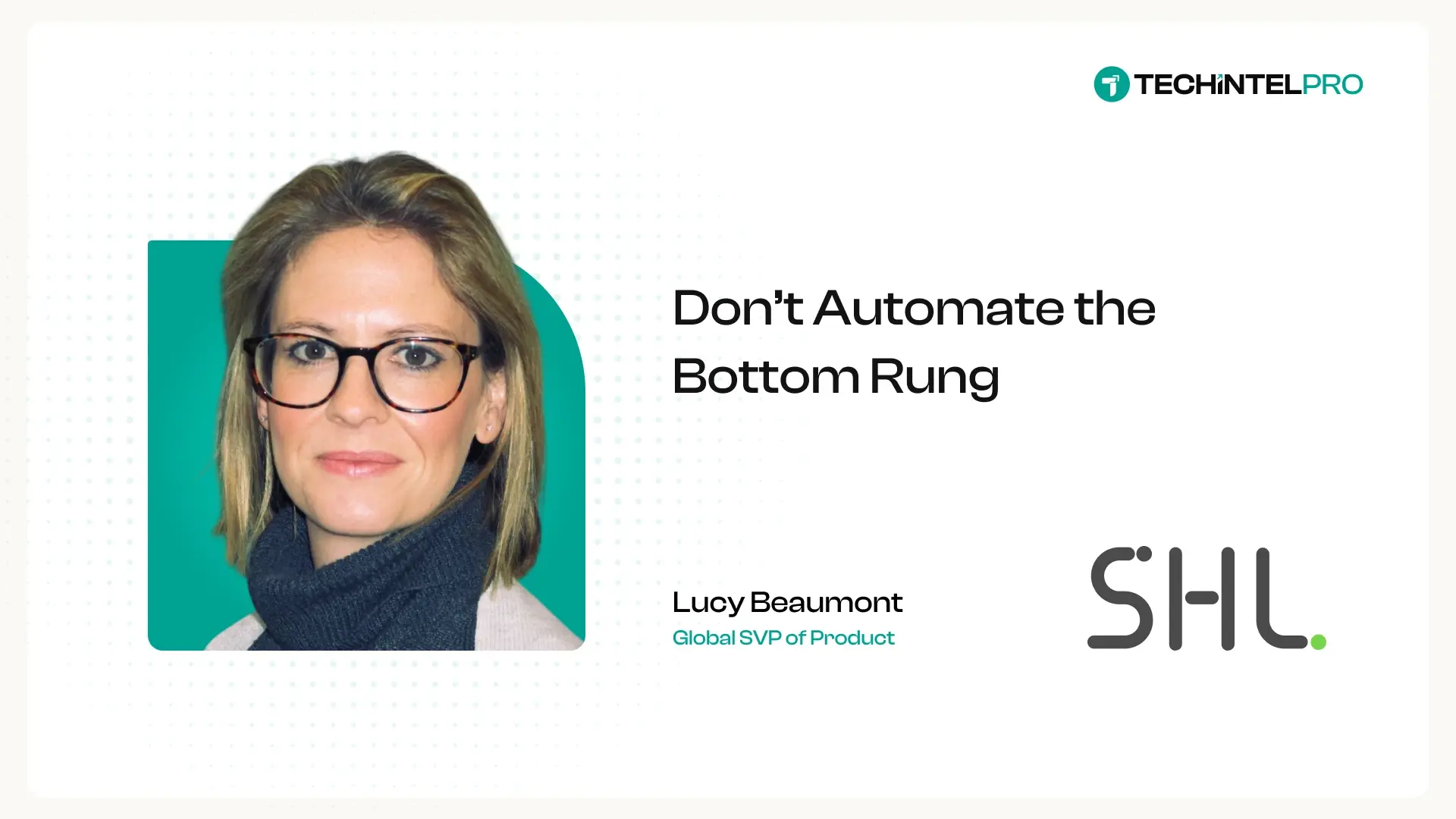
Lucy Beaumont, Global SVP of Product at SHL, is a psychologist by background and says product leadership in talent assessment is different from other software because its output informs decisions about people’s careers. A rough edge in most software is an annoyance, she explains, but here it can affect someone’s opportunities, so trust has to be designed in from the start. Her team is now using data from trusted assessments to build talent intelligence that helps people see their next role and how to reskill, and helps organisations see where their biggest gaps will be.
In this TechIntelPro conversation, Beaumont explains why workers’ willingness to be assessed has gone untapped, how SHL’s AI readiness assessment measures human behaviours that outlast any tool, and why she believes organisations that automate entry-level work will run short of future leaders. She sets out where AI should and shouldn’t operate inside a talent product, why “human in the loop” only works if the person stays skilled, and her prediction that within two to three years the best organisations will manage their workforce through skills data instead of job titles and CVs.
“I’m a psychologist by background, so assessment felt like a natural fit. What drew me in is that it’s one of the few places where you can use science to help people understand what they can do, and where they could go next. I’ve been at SHL for about five years, and SHL is known for providing trusted assessment data.
Product leadership here is different from other software because the output informs decisions about people’s careers. It has to be valid, fair, and explainable, and above all people have to trust it. In most software, a rough edge is an annoyance. Here, it can affect someone’s opportunities, so trust has to be designed in from the start.
SHL is a trusted science provider, and what’s exciting now is that technology lets us apply that same scientific rigour and governance in really innovative ways. So I lead a team that works out what’s coming in the workforce and designs trusted assessments around it. Right now the focus is using the data from those assessments to build talent intelligence: helping people see what their next role could be and how to reskill or upskill, and helping organisations see where their biggest gaps will be and plan around them.”
Running is my switch off. Putting on my trainers is how I get away from work, the kids, and everything else. Some of my best ideas, and my best ways of seeing a problem differently, come when I’m out running and not trying to solve anything. Stepping away from the screen and giving yourself room to think is a big part of how I approach product work, especially when the problem is new and the answer isn’t obvious.
The habit that’s shaped how I build products is going back to the why. In simple terms: what are we actually trying to solve? Why is that difficult? How could we answer it? It’s easy to jump to features, especially with AI making it so quick to build things, but the clearer the problem, the better the product.
“The overwhelming majority of workers say they’d welcome a fair assessment of their strengths, and they want to know what else they could do inside their organisation. This isn’t a hard sell to employees.
The willingness has gone untapped because organisations make decisions on job titles and descriptions. Only 42% of workers say their manager fully understands their skills beyond their job title, so the skills that matter most are the least visible: judgment, problem-solving, the ability to calm a difficult customer. A lot of what organisations think they know about their people is inferred, and inferred data is going to come undone.
What a product needs to offer is objective data you can trust. Opinion, self-report, and guesswork from a job title don’t hold up when you’re making decisions about people’s careers. People are willing to be assessed when they believe the result is fair, and organisations will only act on it when they believe it’s accurate. A good product earns both: it measures what matters consistently, and it gives people and organisations a result they can rely on to make better decisions.
Things are shifting so fast that people need to build skills in real time. What our AI readiness assessment measures is the behavioural, human skills that let someone interact effectively with AI, not knowledge of any particular tool. That’s how we deal with a technology that changes every few months. It looks at how someone interrogates AI outputs and applies their own judgement to them, and how they embrace the technology and keep upskilling on it. Tools will change, but those behaviours stay important. People also need to adapt, show empathy, and be flexible. These are all human skills.
“Our AI readiness research suggests younger workers are often comfortable with the tools but less practised in using them well. That is a skill built through experience and mentoring. Entry-level work is where people build judgment and learn how the business really operates. Take that away and you create a gap in the middle of your future leadership pipeline. Organisations are starting to redesign what early careers look like. Even if you join as a graduate, you might be taking on an account or speaking to customers, things organisations wouldn’t have let you do for two years before, and they’re now trying to supersize that to get people into high-value work quicker. If you automate the bottom rung of the career ladder, you can’t be surprised when you run short of people to climb it.
Seasoned professionals are almost the mirror image. They bring strong contextual judgment, a feel for what good looks like and what will work in their organisation, but they can find it harder to reimagine a solution from scratch. For them, it’s about creating the space and permission to experiment, and pairing them with people who are fresh to the tools, so experience and new thinking feed each other.
For the products we design, it means not treating the workforce as one group. People start from different places, so an assessment should show where each person’s strengths are, whether that’s using AI well, applying judgment, or reimagining how work gets done, and point to what to build next.”
“Trust works both ways. If I’m going to invest in myself and build a new set of skills, I need to know why I’m doing it, that it will be seen, and that there’s an opportunity at the end of it. Our earlier U.S. research found that only 27% of workers fully trust their employer to use AI responsibly. If you want to reclaim that trust, focus on how you develop your people.
It starts with how you communicate. Tell employees why they’re being assessed and what’s in it for them before they sit it. Then follow through on that promise. Give people a clear view of their strengths and gaps, and show them where they can grow their skills, in line with the skills the organisation needs. Connect it to real opportunity too: new roles, internal mobility, promotion. That’s what makes an assessment feel like the start of a development plan, not a performance filter.
That’s the thinking behind our Talent Mobility solution. It lets people see their own skills, compare them with the skills needed for any role in the organisation, and build a plan around the gap. The use a digital coach that uses that information to guide and develop employees in real time, so the plan becomes something they act on every day, not a document that sits in a folder.”
“We start with governance and the standards that apply to any assessment. Our position is that AI assessment is still assessment. It needs documented evidence of reliability and validity, it has to be demonstrably job-related, and it has to be fair, transparent, and explainable, with no black box algorithms. We build to recognised professional and legal standards, and no AI assessment should make decisions about people without human oversight. AI is there to strengthen the science, not to bypass it.
That’s also why I’d push on ‘human in the loop.’ Oversight is essential, but it only works if the person is still skilled enough to use it. If your job shrinks to checking what the AI produces, and it keeps giving you the same kind of answer, you lose the ability to interrogate it, spot problems, and take responsibility for the outcome. People start to say: that’s not my work, that’s the AI’s work. So in 2027 we need to ask how you design the role so the person brings their knowledge, wisdom, and experience to tell you something over and above the AI.
So the line is that AI can support decisions about people, but it doesn’t make them unchecked, and the people involved stay skilled and accountable. In our own products, we use proctoring to protect the integrity of assessments, so you can trust the result and check it.”
“My prediction is that within two to three years, the organisations that do best will be the ones that understand their workforce through skills data, not job titles and CVs. That means knowing the capability and potential of the people they already have, and managing it continuously, not once at the point of hire.
In practice, it means three things. Skills data becomes the foundation for workforce decisions, so organisations can see where their gaps are going to be and plan around them. Internal mobility becomes a core way of filling roles, because you can see who could do what next. And upskilling and reskilling become constant, built around the skills the organisation needs and not an annual training plan.
Many HR leaders would disagree, because most organisations are still built around job titles, job descriptions, and external hiring. AI is already weakening the CV, since anyone can produce a polished one in minutes, but the bigger shift is what replaces it: trusted, objective data on what people can do and could do next.
And success will be measured differently. People will stop judging AI by the hours it saves and start asking what it lets their people do: more innovation, more creativity, and new ways of reimagining the work.”

Lucy Beaumont is Global SVP of Product at SHL, where she leads product and strategy at the intersection of talent, data and business performance. She oversees SHL’s Talent Intelligence portfolio, which spans assessment, mobility and workforce decisioning, with a focus on helping organizations use connected talent data to make better, faster and more predictive decisions across the employee lifecycle.
Lucy’s background combines occupational psychology with product and commercial leadership. Over the past decade, she has worked across talent acquisition, development and mobility, building solutions that deliver continuous, outcome-driven decision support. She has led global teams and large-scale product portfolios, and works closely with executive stakeholders to turn market opportunities into scalable solutions.
More about Lucy Beaumont: 
SHL, the global leader in Talent Insight, transforms businesses by leveraging the power of people, science, and technology. Our unrivalled, scientifically backed workforce data and highly validated talent solutions provide organizations with the insights needed to optimally leverage their people’s potential and maximize business outcomes. We equip recruiters and leaders with people insights at an organization, team, and individual level, accelerating growth, decision-making, and talent mobility and inspiring an inclusive culture that supports game-changing agility.
For more information, visit shl.com.
Tell others what you think of TechIntelPro.

 Rate us on G2