
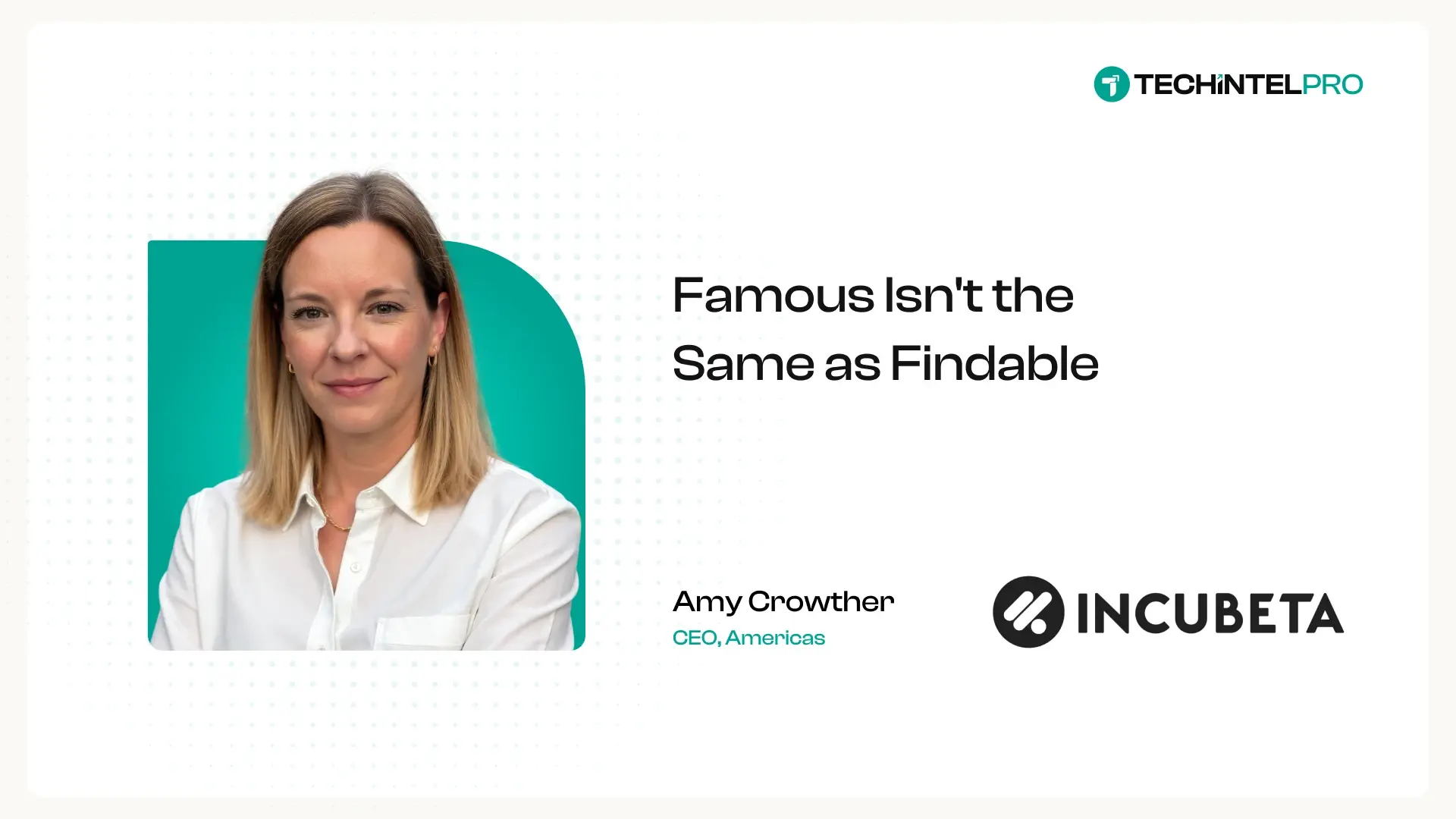
Ask an AI to recommend the top brand for each type of tissue paper, and Kleenex is not its top answer. Incubeta's technical team ran that test, and for Amy Crowther it captures the shift now facing marketers: being famous is not enough when buyers, and soon the AI agents buying on their behalf, are asking chatbots deep, contextual questions. The new measure, she says, is share of answer: when a customer asks about your category, are you recommended, mentioned or ignored?
Crowther is CEO of Incubeta Americas, and she argues that the agency model itself needs to change. In this conversation, she explains why media, creative and data can no longer live in separate rooms, why clients should move from procuring deliverables to partnering on outcomes, and why B2B buyers often settle on a shortlist before the first email goes out. She also describes how Incubeta guards against activity masquerading as results by combining attribution, incrementality testing and marketing mix modeling, including the work that helped Taxfix cut inflated channel metrics by 54%, and what behavioral science looks like once the sale is made.
The issue with the modern agency is its fragmented structure. The traditional agency model made sense when data was less available and less necessary. Now the disconnect between those who measure the data and those who act on it is costing agencies and their clients. Media, creative and data cannot live in separate rooms anymore.
The model also undersells the relationship. Too many partnerships are judged on whether the to-do list got done. That tells you the relationship is functioning. It does not tell you it is valuable. Part of what clients pay for is an outside perspective, and if nobody asks for it, they are paying for expertise and using it as execution capacity. Agencies own part of that. They must show-up asking better questions, challenging the brief and protecting the outcome rather than the scope.
I've never really subscribed to the idea that B2B and B2C require fundamentally different approaches to marketing. We're still influencing human behavior, building trust and helping people make decisions. What changes is the complexity, value and time involved in making those decisions. I think that's why we're seeing B2B marketers lean harder into behavioral science and more structured frameworks.
At Incubeta, we're seeing greater appetite to test and activate models like StoryVesting and our Bow-Tie Funnel, which connect the motivations behind a decision with the entire customer lifecycle. What's often overlooked is what happens beyond the initial conversion. It's not enough to understand what makes someone buy. We need to understand what makes them stay, grow and ultimately become more valuable to the business. That's where behavioral science becomes much more powerful, connecting how people make decisions to customer acquisition cost, lifetime value and real commercial outcomes.
I think the biggest misconception is that an agency should be bought on what it delivers, rather than what it helps a business achieve. So much of what agencies traditionally sold has become commoditized. Buying media, accessing inventory and technology, defining audiences, producing reports. These are all things an agency should be able to do, but they shouldn't be the checklist that defines the relationship or its value.
We need to move from procuring deliverables to partnering on outcomes. That's harder to do because success looks different for every business, depending on its stage of growth, commercial priorities and how it's structured. It requires both sides to agree on what they're trying to achieve, how they'll measure progress and where accountability sits. An agency can't own every lever of a client's business, but it should absolutely share responsibility for the marketing outcomes it's there to influence. For me, that's the difference between buying a service and building a partnership that moves the business forward.
When a firm buys something, it involves much more internal deliberation than a consumer purchase. A B2C marketer is usually trying to reach one person, maybe two. A business has many more decision makers, and each of them needs the choice to be defensible. The shortlist also forms early. Around 90% of B2B buyers purchase from the list they started with, and half of software buyers now start that research in a chatbot. If you are not on the list before the first email goes out, you are fighting for a decision that has already been made.
Consumers move faster, but they are no more forgiving. You used to be able to get away with a clunky website or a bad app. Today, tolerance for a bad digital experience is effectively zero. If I ask an AI to find five hotels in Italy that meet my exact criteria, any brand not structured to appear in that answer is eliminated before I even know it exists.
Our strategy is to have as little fragmentation between media and measurement as possible. Keeping a laser focus on real results is the best antidote to busywork. That means condensing platforms into as few as possible, so brands have full access to the metrics that matter. Activity wins by default because clicks are immediate and contribution margin is not. And when every dashboard is green, nobody questions the model behind it. Our research found that 92% of marketing leaders believe their measurement is precise, yet 41.6?mit measurement limitations lead to wasted budget.
We never rely on one lens. Attribution gives us the speed to optimize. Incrementality testing tells us what caused the result. Marketing mix modeling guides where the budget should go next. And we report profit on ad spend and contribution margin right next to ROAS and CPA. When Taxfix took this approach, it cut inflated channel metrics by 54% and doubled its upper-funnel investment with confidence. Therein is the difference between reporting activity and deciding.
AI and agentic search will have transformed how marketers reach their audiences. Once-supreme metrics like web traffic will become just another barometer for how marketers measure their operations. We spent two decades learning to type like robots. Now we are speaking like humans again, asking AI deep, contextual questions. The new measure is share of answer. When a customer asks about your category, are you recommended, mentioned or ignored?
Being famous is not enough. Our technical team asked an LLM to recommend the top brand for each type of tissue paper, and Kleenex was not its top answer. Dominating human conversation does not mean you dominate machine discovery. Over the next two years, AI agents will also start comparing and buying on the customer's behalf. Your product data, pricing and inventory must be as readable to machines as your marketing is compelling to people. If the AI cannot parse you, your brand does not exist in the new discovery ecosystem.
Amy Crowther is CEO, Americas at Incubeta, where she leads strategy, operations, client growth and expansion across the region. She is based in New York. She stepped into the role in July 2026, completing a planned leadership transition. Before that she served as President, Americas, and as Chief Client Officer, where she strengthened client relationships and scaled operations across the region.
Amy brings more than 15 years of global marketing and strategy experience across three continents. She began her career in market research in the UK. In Australia, she was Strategy Lead at Dentsu, managing major APAC accounts. As Global Strategy Lead at IPG Mediabrands’ Reprise, she led multi-regional teams for global brands. Before joining Incubeta in 2023, she built and led the Brand and Media Strategy practice at Jellyfish.Her work draws on behavioral science and marketing effectiveness, rooted in a long-held curiosity about how human behavior shapes brand influence. Today she is focused on helping clients turn the promise of AI into measurable business outcomes.
More about Amy: 
Incubeta is a global marketing agency that helps ambitious brands turn marketing into a driver of sustainable growth. Founded in 2001, the company brings together creative, media, data and technology through its Seamless Approach, delivering integrated strategies that improve performance and profitability. Its solutions span OutCreate, OutMeasure and OutSmart. Backed by majority investor The Carlyle Group since 2022, Incubeta has expanded its AI-powered capabilities through acquisitions including RocketSource, Shout Bravo and Persuasion Technologies. With 21 offices across the Americas, the UK, Europe, Africa & the Middle East, and Asia Pacific, Incubeta combines global reach with local expertise for brands including adidas, Heineken, L’Oréal and P&G.
Learn more at incubeta.com.
Tell others what you think of TechIntelPro.



 Rate us on G2