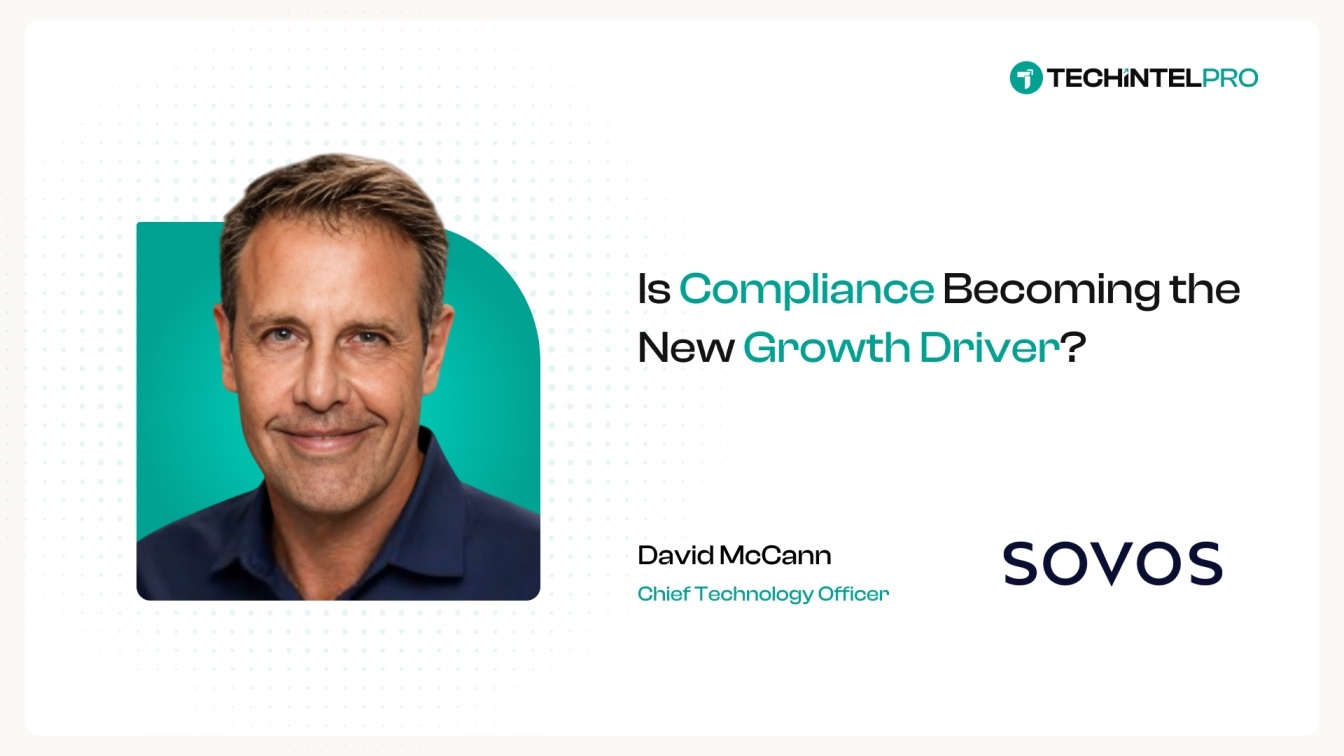
Global compliance is becoming more complex by the day. The answer isn't more manual effort; it's a smarter operating model.
David McCann, CTO at Sovos, discusses how enterprises can combine AI, automation, and cross-functional leadership to manage regulatory complexity at scale. He also explores the role of engineering excellence, intelligent compliance platforms, and real-time decision-making in building organizations that are both resilient and growth-ready.
You’ve led technology transformations across fintech, SaaS, and regulated industries for over two decades. What leadership lessons have had the biggest impact on your ability to scale teams, platforms, and business outcomes simultaneously?
The biggest lesson has been this: define success with your teams, not for them. Across fintech, SaaS, and regulated industries, the transformations that scaled successfully all shared a common thread — teams that were invited into the framework-building phase, not just handed the execution plan. When people contribute to the objective-setting process, they show up differently. Alignment becomes self-reinforcing rather than something you have to police. The discipline I've applied consistently is simplifying complex business objectives into clear, actionable outcomes, and then creating space for cross-functional teams to co-own the path to execution. That investment in the build phase pays compounding returns at scale.
As regulatory requirements become increasingly complex and digitized, what are the biggest compliance challenges organizations face today, and why are traditional approaches falling short?
Global tax compliance has hit a critical inflection point driven by intense data complexity, varying tax regulations across jurisdictions and the need for real-time processing.
Traditional methods lack the AI-powered intelligence and cross-platform integration required to safely manage the intense data complexity of modern global commerce. These approaches fall short because they rely on manual reporting at a time when governments across the world are now demanding real-time transaction visibility directly within core business systems. This leads to human-led data reconfigurations and file reviews whenever tax regulations or product lines shift, which are highly susceptible to error.
Our AI-powered platform was built on 40 years of Sovos expertise. Sovos employs over 100 global regulatory specialists and provides tax compliance coverage across 150+ countries, allowing companies to keep up with the pace of regulatory change without conducting strenuous tax research, which could take hours or days.
Sovos serves businesses of every size across more than 70 countries. How does the platform help customers simplify compliance while reducing the operational burden of managing constantly changing regulations?
The Sovos Tax Compliance Cloud simplifies operations by integrating seamlessly with a customer's business applications to automatically identify, determine and report tax obligations across more than 150 countries.
To further reduce operational burdens, our Sovi AI platform contains features such as Ask Sovi and Proactive Issue Detection, allowing customers to get answers to complex regulatory questions and automatically catch compliance errors within the everyday workflow. This combined approach ensures scalable compliance while removing the manual friction of handling billions of global transactions and reporting requirements.
At Sovos, you've brought product, engineering, architecture, and design together under a shared operating model. What changes when these teams are measured against common outcomes rather than individual functions?
The most immediate change is that the conversation shifts from what did my team deliver to what did we move together. When product, engineering, architecture, and design are measured against shared outcomes, the organizational seams that normally create friction — handoffs, prioritization disputes, competing roadmaps — start to dissolve, because everyone's incentive is pointed at the same result.
At Sovos, bringing those functions under a shared operating model meant redefining what accountability looked like. One of the most effective structural changes was establishing a tight two-in-a-box model between product and engineering leaders at every functional level — not just at the top. When that pairing exists from senior leadership down through mid-level and team leads, decisions get made closer to the work, context doesn't get lost in translation, and neither function can optimize in isolation. It creates a kind of distributed accountability that scales in a way that top-down alignment simply can't.
What also changes is the quality of planning. When teams know they'll be evaluated together, they invest in each other's context earlier. Engineers are in discovery conversations. Architects are in roadmap reviews. Designers are asking questions about system constraints. The two-in-a-box structure accelerates that fluency — because it's not just a cultural ask, it's built into how the work is organized and how leaders are held accountable. That cross-functional coherence is ultimately what allows you to scale platforms and teams simultaneously without losing speed or quality.
AI is influencing everything from software development to customer experiences. Where do you see the highest impact opportunities for AI within Sovos today, both internally and across the solutions you deliver?
The greatest opportunities lie in embedding agentic AI directly into core product, engineering and compliance workflows to help enterprises navigate dynamic markets at scale.
Sovos recently expanded its Sovi AI platform to introduce purpose-built capabilities for tax guidance, intelligent automation and compliance insight. This allows the platform to safely automate high-friction and manual tasks like product tax code classification and data mapping while giving humans the final decision.
You've spoken about building a metrics-driven engineering culture. What indicators do you pay closest attention to when assessing whether a tech organization is truly performing at its highest potential?
When I'm assessing whether a tech organization is truly performing at its highest potential, I resist the temptation to over-index on vanity metrics. What I've found most useful is a simplified framework built around three core indicators: quality, consistency, and velocity.
Those three dimensions aren't abstract — they manifest directly in the product development lifecycle through DORA-based metrics. Deployment frequency tells you about velocity and team confidence. Lead time for changes tells you about consistency and process discipline. Change failure rate tells you about quality and how well the team is managing risk. Mean time to recovery tells you about resilience and how seriously the organization treats operational health.
What I pay closest attention to is not any single metric in isolation, but the relationship between them. A team posting high deployment frequency with a deteriorating change failure rate isn't performing — it's accelerating toward technical debt. A team with low failure rates but sluggish lead times may be over-engineering their quality gates. The signal is in the balance.
The other thing I watch is whether the teams themselves are using these metrics or just reporting them. When engineers are genuinely oriented around DORA outcomes — when the metrics are driving daily decisions, not just quarterly reviews — that's when you know the culture has shifted.
That's the difference between a metrics-aware organization and a truly metrics-driven one.
As AI and digital regulatory frameworks continue to converge, how do you see the role of compliance evolving, and what position does Sovos want to occupy in that future?
With global tax authorities shifting to real-time reporting, compliance must now be fully in order before a transaction occurs; it cannot be reconciled after the fact. Companies risk severe penalties and fines for noncompliance.
For this reason, compliance is rapidly evolving from a regulatory burden into a strategic growth opportunity. AI capabilities that are carefully embedded within standard business applications along with trusted agentic AI functions can help organizations drive ROI while staying in good standing with governing bodies. Sovos is positioning itself as the foundational backbone of this future, seamlessly integrating into existing finance operations to reduce costs and permanently lift the operational burden of global tax compliance from enterprise teams.
As chief technology officer of Sovos, McCann leads the company’s global technology organization, focused on advancing its compliance platform, scaling innovation in data and AI, and strengthening the technical foundation required to support increasingly complex regulatory environments worldwide. With more than two decades of experience leading engineering, product, and platform transformation across high-growth and private equity–backed software companies, David brings a proven ability to align technology strategy with business performance and drive measurable outcomes at scale.
Most recently, McCann served as chief technology officer at Self Financial, where he built a reputation for delivering scalable architecture, operational rigor, and disciplined execution in complex, regulated environments. His career has been defined by a consistent focus on modernizing platforms, accelerating product velocity, and improving engineering efficiency, all while leading global teams through transformational change.
Throughout his career, David has championed data-driven decision-making, shared accountability across product and engineering, and the adoption of cloud-native and AI-enabled architectures. His leadership approach centers on building high-performing, cross-functional teams and establishing execution frameworks that balance innovation with reliability and compliance.
McCann brings deep expertise in SaaS platforms, fintech infrastructure, and enterprise software operating models. This experience directly supports Sovos’ mission to enable global tax compliance through a singular platform solution.
More about Anirban: 
Tell others what you think of TechIntelPro.


 Rate us on G2