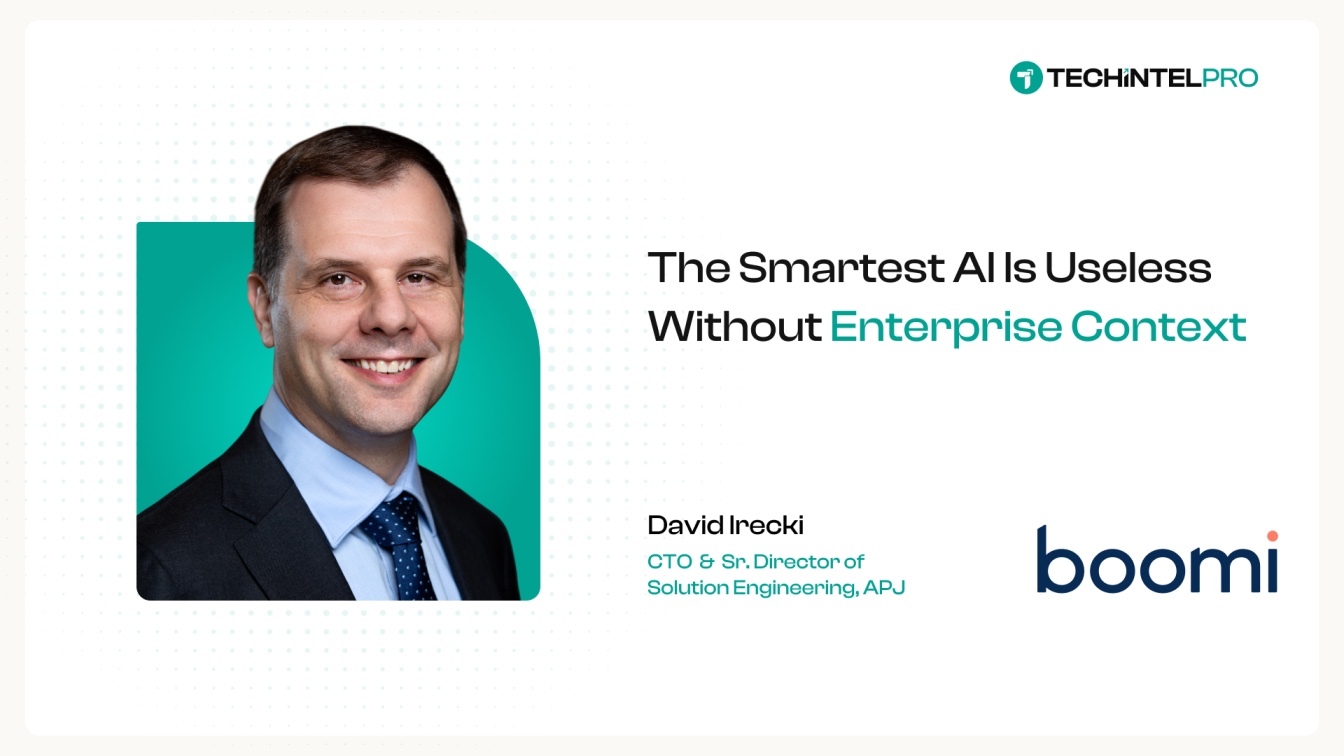
The smartest AI in the world can't answer a question your enterprise can't.
When systems disagree, data can't be trusted, and governance is missing, AI simply scales the confusion. David Irecki, CTO of Boomi, discusses why connected enterprise data has become the foundation of successful AI, how organisations should rethink integration for the age of AI agents, and what separates enterprises experimenting with AI from those creating lasting competitive advantage.
One of the advantages of working in enterprise technology for more than two decades is that you begin to see patterns. Every major technology wave – cloud, mobile, APIs, digital transformation, and now AI – has promised to transform how organisations operate. Yet the underlying challenge has remained remarkably consistent: connecting people, systems, and data so the business can actually use technology effectively.
Earlier in my career, integration was largely viewed as an IT problem. The goal was simply to connect applications so information could move from one system to another. Today, integration has become a strategic business capability because AI doesn't just analyse data – it acts on it, makes decisions on it and automates work. That means the quality, governance, and accessibility of enterprise data now directly influence business performance.
That's why Boomi has evolved into the Data Activation company for AI. We believe organisations already possess enormous amounts of valuable data. The challenge is making that data discoverable, trusted, governed, and usable in real time across business processes and AI systems.
What excites me most about this stage of my career is that we're no longer talking about connecting systems for efficiency alone. We're helping organisations build the trusted digital foundation that turns AI into measurable business outcomes.
The biggest misconception is that organisations are struggling with AI. In reality, they're struggling with the data and operational foundations that AI depends on.
Our recent Omdia research found that 74% of organisations across APAC already have AI initiatives underway, so adoption is clearly no longer the issue. The challenge is operationalisation.
We also found that 81% of organisations say unmanaged or "shadow" integrations are already affecting data quality, visibility, and trust. At the same time, fewer than half have adopted a platform-led integration approach. That creates fragmented data, inconsistent business definitions, and multiple versions of the truth.
AI doesn't eliminate poor data. It amplifies it. If customer records, inventory levels or financial data differ across systems, AI agents don't know which version is correct. The result is unreliable recommendations, inconsistent automation, and stalled AI initiatives.
This is why I often say that AI doesn't fail because the models are weak. AI rarely fails because of the model. It fails because organisations haven't activated, governed, and connected the data underneath it.
The next phase of AI success will be determined not by which model an organisation chooses, but by how effectively it activates trusted enterprise data.
Integration remains fundamental, but it's no longer the end goal.
As organisations begin deploying AI agents, they need much more than connectivity. They need a platform that can connect systems, automate processes, manage data, govern APIs, and increasingly manage AI agents themselves.
That's why we talk about five foundational capabilities for building the agentic enterprise:
Together these capabilities enable Data Activation. Instead of data sitting passively in systems or dashboards, it becomes available in real time for applications, workflows, employees, and AI agents.
Ultimately, organisations don't create value simply by connecting systems. They create value when connected systems activate data, automate work, and enable better business decisions.
One thing that has become very clear over the past year is that our customers don't have an AI ambition problem. They have an AI execution problem.
Across APAC we're seeing enormous enthusiasm for AI, but organisations are also recognising that scaling AI requires modernising the foundations underneath it.
Our Omdia research found that while only around 46% of organisations currently have a platform-led integration approach, around 90% want to move toward a unified AI-ready platform. That tells me the market understands where it needs to go. The challenge is getting there while continuing to operate mission-critical systems.
Those conversations directly influence our strategy. Customers consistently tell us they want fewer disconnected tools, better governance, simpler architectures, and greater visibility across increasingly complex AI environments.
That's why we're investing heavily in capabilities that simplify integration, activate enterprise data, improve API governance, and help organisations manage AI agents responsibly at scale.
Technology strategy should always begin with the customer reality rather than vendor aspiration.
I've always believed customers don't buy technology. They invest in business outcomes.
One of the principles I reinforce with our Solution Engineering team is that our job isn't to deliver the best demonstration. Our job is to understand the business problem better than anyone else.
That means asking questions about customer experience, operational efficiency, governance, compliance, employee productivity, and commercial outcomes before we ever discuss features.
Increasingly, our conversations begin with questions like:
Only after we understand those answers do we start discussing technology. Technology should always support strategy, never replace it.
That mindset has become even more important as AI enters the enterprise. Organisations don't need more demonstrations of what AI can do. They need practical guidance on how to operationalise AI responsibly, securely and in ways that deliver measurable business outcomes.
I think we're entering a new phase where governance is becoming just as important as the intelligence itself.
Historically, organisations governed AI models. They asked questions like, “Was the output accurate?” Today, we need to govern actions. What systems can an AI agent access? What decisions can it make? What business processes can it trigger?
Recent Forrester research commissioned by Boomi found that while 86% of organisations have moved beyond AI agent pilots, only 34% actually trust the actions their AI agents are taking. That gap is significant because trust ultimately determines whether AI scales.
Architecturally, organisations need three things.
First, trusted and activated data. AI agents need trusted, contextual, real-time information.
Second, a unified integration and API layer that becomes the control plane for how agents interact with enterprise systems.
Third, comprehensive governance including observability, auditability, policy enforcement, and human oversight.
Human-in-the-loop remains a critical design principle. AI should elevate human judgement, not replace accountability. Autonomy without orchestration creates risk. Autonomy with orchestration and governance creates competitive advantage.
I don't believe the next competitive advantage will come from building bigger AI models. The largest models are rapidly becoming available to everyone.
What will differentiate organisations is how effectively they connect their enterprise data, applications, people, and AI systems into a single operating environment.
In the AI era, context is becoming more valuable than the model itself.
The organisations that win won't necessarily have the smartest models. They'll have the most contextually intelligent organisations because their AI can understand customers, products, operations, regulations, and business processes in real time.
That requires a mindset shift.
Technology leaders need to stop asking, “Which AI model should we buy?” and start asking, “How do we activate our trusted enterprise data so any AI system can create value?”
For me, that's the future of enterprise AI.
The next competitive advantage won't belong to organisations with the biggest AI models. It will belong to those that build the best-connected organisations, activate their data, govern AI responsibly, and consistently turn AI into measurable business outcomes.
David Irecki is the CTO for Asia Pacific & Japan (APJ) and leads Boomi’s technology vision and thought leadership across the region, helping organizations build the foundations for agentic transformation through data activation, integration and automation, API management, data and AI agent governance.
David leads a team of pre-sales professionals across the region. Under his leadership, the team partners with customers to solve complex integration and data management challenges that drive business transformation.
With over 20 years of experience in enterprise integration and embedded computing, David is a seasoned IT leader. He joined Boomi in 2015 as the first Solutions Consultant in APJ. Prior to that, he led the APJ Solutions Consulting team at MuleSoft.
More about David: 
Boomi, the data activation company for AI, powers the agentic enterprise by bringing data to life across the business. The Boomi Enterprise Platform is the active data foundation that delivers essential agentic infrastructure to drive agentic transformation. By unifying agent design and governance, API and MCP management, integration and automation, and data management into a single platform, Boomi enables organizations to harness the power of AI with secure, scalable connectivity. Trusted by over 30,000 customers and supported by a network of 800+ partners, Boomi helps organizations of all sizes achieve agility, efficiency, and innovation at scale.
Learn more at boomi.com.
Tell others what you think of TechIntelPro.



 Rate us on G2