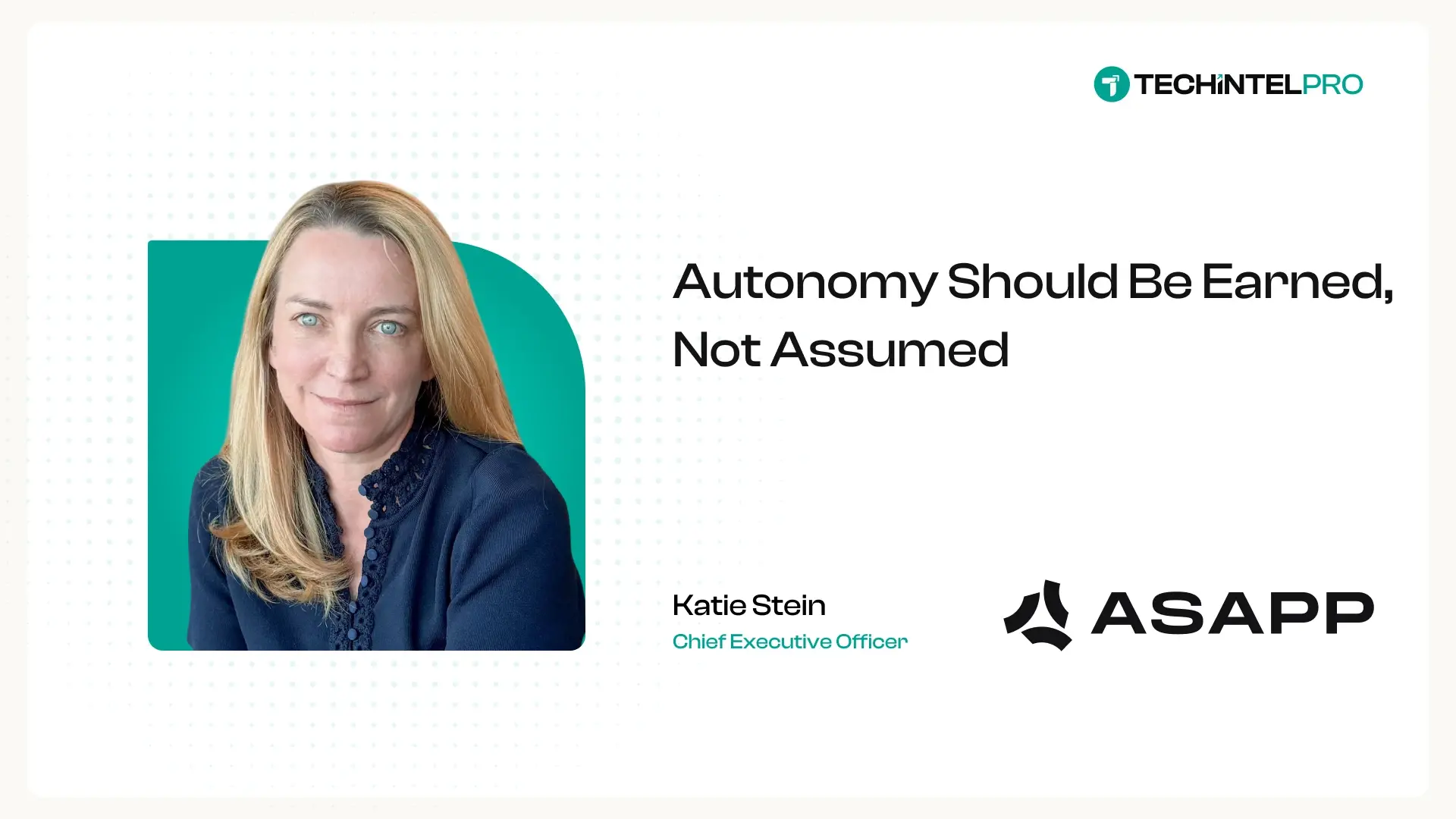
Katie Stein has a problem with one of customer experience's favourite metrics. Containment, whether a conversation stays inside an automated system instead of escalating to a human, gets reported across the industry as a win. Stein, who became CEO of ASAPP after leading Atain through its own period of transformation, argues it's often measuring the wrong thing entirely: a contained conversation can still mean an unresolved problem, or a customer who simply gave up and left.
That instinct for finding the metric or assumption hiding in plain sight runs through how Stein thinks about AI autonomy more broadly. Having spent eight years as Chief Strategy Officer at Genpact and earlier time at BCG and Mercer, she's watched plenty of transformations that looked successful on paper change nothing about how an organization actually operated, because talent, incentives, and decision rights never moved together. In this conversation, she explains why she believes the hesitation around agentic AI is fundamentally a trust problem rather than a technology one, why ASAPP designs human judgment directly into its automation instead of treating a person as a fallback for failure, and why she believes AI autonomy in a customer-facing environment should be earned through evidence, not assumed because a demo looked impressive.
Three things mattered enormously at Atain, and they apply directly to ASAPP. First, you need the right talent with real accountability. Second, you have to listen deeply enough to customers to understand their most important problems, not just respond to the loudest request. And third, you need absolute clarity about where you’ll compete and what you can be uniquely great at. There’s a tremendous amount of noise in AI right now. At this stage of ASAPP’s growth, focus is what turns a strong product and early customer success into a repeatable business.
I don’t think it’s either-or. It’s a trust problem rooted in how the technology is deployed. Enterprises see the potential of agentic AI, but they need confidence that they can understand what it’s doing, control the actions it takes, and bring in human judgment when required, especially in regulated environments. That takes more than a capable model. It means establishing clear boundaries, continuously monitoring performance, and making decisions auditable. Trust shouldn’t be something leaders are asked to assume. The system should give them the visibility and control to verify it.
The difference is whether human involvement ends the automation or extends what it can safely accomplish. When a person is only the fallback, the AI reaches its limit and transfers the entire interaction. The customer waits, repeats themselves, or both. When human judgment is designed into the system, the AI can request a specific decision or approval behind the scenes, then continue managing the interaction. That allows enterprises to automate more complex, higher-stakes work while preserving human accountability. The goal isn’t to remove people from the process. It’s to apply their judgment precisely where it creates the most value.
It requires making deliberate choices about where you’ll compete and how you’ll win. Early-stage growth often comes through strong relationships, individual customer opportunities, and a team willing to build whatever it takes. That can produce tremendous early wins, but it isn’t yet a repeatable growth model. As the market matures, leadership has to align product, go-to-market, talent, and investment around the opportunities where the company is best positioned to win. The hard part is saying no. Scale comes from focus and repeatability, not simply pursuing more opportunities.
At Genpact, we worked to bring more data and AI expertise into the go-to-market motion. We made meaningful progress, but the broader organization was still structured, measured, and rewarded around large BPO deals. We had changed part of the selling model without changing enough of the operating model around it. That experience reinforced something I’ve seen repeatedly: transformation doesn’t happen because you add new capabilities or announce a new strategy. It requires changing talent, incentives, decision rights, and investment priorities together. If the organization still rewards the old behavior, the old model usually wins.
The biggest blind spot is underestimating how strongly an organization can resist a logically sound answer. A strategy may be right on paper, but companies are made up of people, incentives, processes, and power structures that don’t change just because the analysis is compelling. The operator’s job is to mobilize the organization, make tradeoffs, and keep moving while the imperfections reveal themselves. You rarely get to design the ideal transformation and execute it exactly as planned. You set the direction, learn from what happens in practice, and continually adjust without losing the goal.
Autonomy isn’t a single setting, and more isn’t always better. The right level depends on the action, the consequence if the AI gets it wrong, and whether that action can be reversed. A great demo usually shows the happy path. Production introduces ambiguity, exceptions, and real accountability. We start by defining what the AI can do independently, what requires a rule-based process, and where human judgment or approval is necessary. Autonomy can then expand based on evidence: system performance, exception handling, and the enterprise’s ability to monitor and audit its decisions. Autonomy should be earned, not assumed.
Containment is useful, but it’s often treated as the outcome when it’s really just an intermediate metric. A conversation can be contained without the customer’s issue being resolved, or because the customer simply gave up. Optimizing for containment alone can reward exactly the wrong behavior. The better question is: did the customer accomplish what they came to do, at the right level of quality and without creating downstream work? That’s why we focus on verified resolution. Cost savings matter, but they’re durable only when the interaction is genuinely resolved and the customer doesn’t have to come back.
Katie Stein is the Chief Executive Officer of ASAPP, where she leads the company's work helping the world's largest enterprises transform how they serve their customers — earning the trust of leading brands across financial services, insurance, travel, and communications who depend on ASAPP for mission-critical operations at scale. Before ASAPP, Katie was CEO of Atain and spent eight years at Genpact as Chief Strategy Officer and Global Business Leader for Enterprise Services and Analytics. She holds an MBA from Columbia Business School.
More about Katie: 
ASAPP is the agentic Customer Experience Platform (CXP) purpose-built for enterprise customer service. CXP orchestrates AI agents, human expertise, and enterprise systems to resolve customer issues faster and more accurately across voice and digital channels.
More information is available at www.asapp.com
Tell others what you think of TechIntelPro.



 Rate us on G2