More automation hasn't necessarily made healthcare operations simpler. In many cases, it has made fragmentation harder to see.
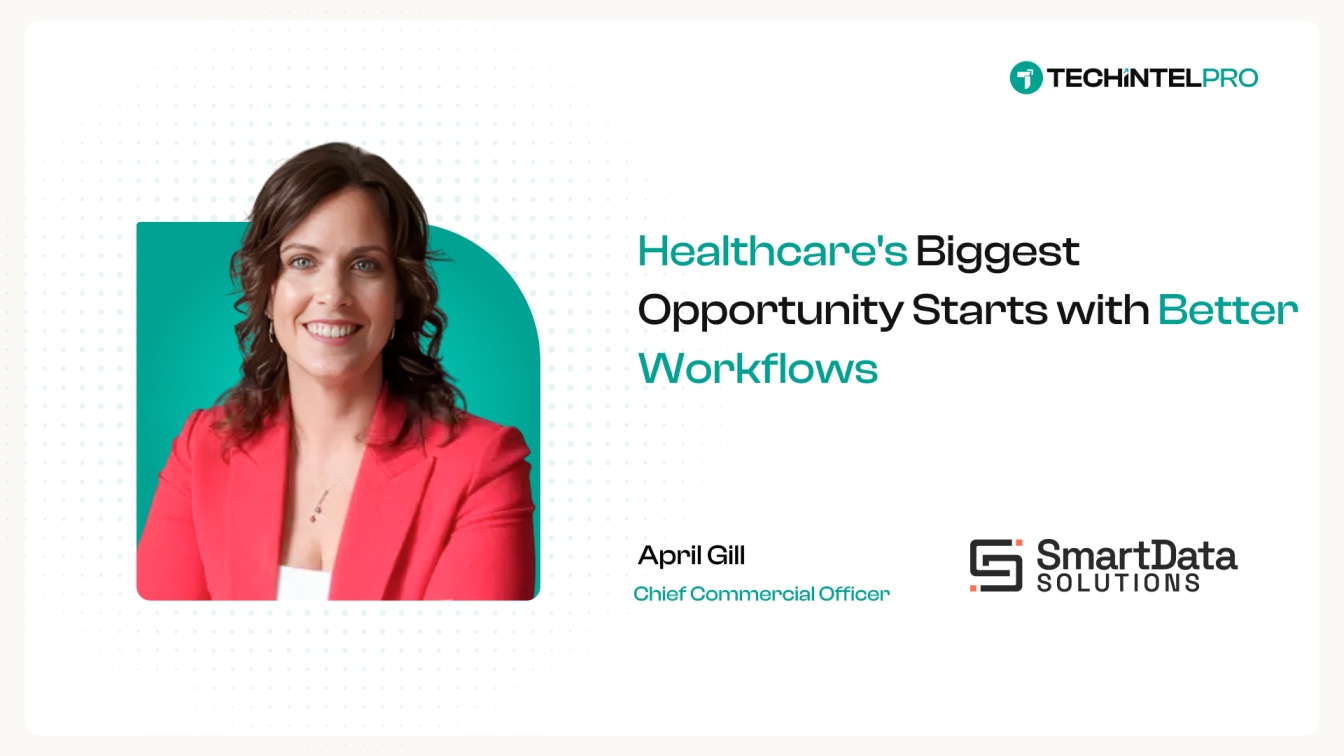
April Gill, Chief Commercial Officer at Smart Data Solutions, shares why healthcare organizations need to rethink operations as an interconnected system. From prior authorization and claims processing to document intelligence and workflow orchestration, she explains how connected operations can improve accuracy, reduce rework, strengthen compliance readiness, and create better experiences for both providers and members.
The recognition reflects two strategic decisions that have shaped how Smart Data Solutions supports payer operations.
The first was to approach payer operations as one connected operating model rather than a set of disconnected functions. Health plans are operating in an increasingly complex environment, particularly during peak periods such as Q4 when AEP activity, Marketplace Open Enrollment, year-end compliance work, eligibility changes, claims volume fluctuations, provider inquiries, and documentation-heavy workflows converge. At the same time, CMS requirements around prior authorization, interoperability, transparency, and program integrity are increasing expectations for accuracy, data quality, auditability, and operational speed.
That environment shaped our investment in a unified, AI-native workflow automation platform. Our goal was not to simply digitize manual work, but to connect intake, data intelligence, validation, routing, and orchestration before information reaches downstream systems. This helps payers reduce rework, strengthen data integrity, manage volume, and improve operational consistency.
Second, we stayed deeply healthcare-specific. Claims, EDI, prior authorization, medical records, attachments, eligibility, and clearinghouse operations – all come with unique rules, formats, exceptions, and compliance requirements. Generic automation can address individual tasks, but payers need technology built for the complexity of healthcare.
Everest Group’s recognition validates that strategy and underscores the need for purpose-built, technology-led operations that help payers perform with greater confidence during their most demanding periods.
These capabilities are most powerful when they operate as part of a connected model, not as stand-alone services.
In payer operations, a claim rarely moves through a simple linear path. It may depend on eligibility data, provider information, attachments, medical records, prior authorization history, routing rules, or documentation that arrives through a completely different channel. When those inputs are managed in separate workflows, health plans often end up managing exceptions instead of managing outcomes.
Smart Data Solutions brings these capabilities together through three layers: intake, intelligence, and orchestration. At the intake layer, we help payers capture information from any channel, including EDI, paper, fax, portals, API, email, and document-heavy submissions. The intelligence layer structures, validates, enriches, and classifies that information. The orchestration layer then routes the work to the right system, team, or workflow with the context needed to act.
That connected approach is during high-volume operating periods such as AEP, Marketplace Open Enrollment, year-end claims activities, compliance reporting, and operational planning for the next benefit year. In those moments, even a small intake issue or routing gap can create larger downstream challenges.
By connecting claims, clearinghouse, document intelligence, intelligent connectivity, and prior authorization, we help payers move away from fragmented operations and toward a more controlled, visible, and scalable operating model.
The biggest bottlenecks are occurring where volume, complexity, and fragmented data converge.
Payers are managing more transactions, more documentation, more regulatory oversight, and higher expectations from members and providers. Marketplace enrollment is a good example of that scale: CMS reported that during the 2026 Open Enrollment Period, 23.1 million consumers selected or were automatically re-enrolled in coverage through Healthcare.gov and State-Based. That level of activity creates significant pressure on eligibility, enrollment validation, member communications, routing, and downstream administrative workflows.
At the same time, program integrity expectations continue to rise. CMS has finalized additional safeguards to protect consumers from improper enrollments and unauthorized changes to coverage, while strengthening the integrity of ACA Exchanges. For payers, that makes accuracy at the point of intake even more important. When data is incomplete, inconsistent, or incorrect at the front end, the impact often appears later as rework, appeals, provider abrasion, member disruption, or compliance exposure.
We see four major bottlenecks for payers.
For payers, the challenge is no longer simply “How do we automate more?” The more important question is, “How do we create greater operational control before the work breaks down?” That is where connected intake, cleaner data, and intelligent orchestration become essential.
The difference is whether AI is transforming the workflow or simply accelerating a task within the workflow.
Conventional automation often takes a repetitive step and makes it faster. That can be valuable, but it does not always address the underlying operational problem. If the data is incomplete, the process is fragmented, or the workflow still depends on manual follow-up, the organization may simply be accelerating an inefficient process.
True AI-native workflow transformation starts earlier and goes deeper. It looks at how information enters the enterprise, how that information is interpreted and validated, how decisions are supported, and how work moves across systems, teams, and vendors. In healthcare, that distinction matters because the work is not just high volume; it is highly variable, highly regulated, and deeply dependent on data quality.
That is especially important as CMS requirements move the industry toward greater transparency, tighter prior authorization decision timeframes, and more interoperable data exchange. Under CMS’s Interoperability and Prior Authorization Final Rule, certain operational provisions generally begin in 2026, including prior authorization decision timeframes and public reporting, while major API requirements generally begin in 2027.
In that environment, AI cannot be a surface-level feature. It needs to support healthcare-specific accuracy, auditability, documentation readiness, exception handling, and workflow orchestration.
For Smart Data Solutions, AI-native means the platform is designed to make the work more intelligent from the point of intake through completion. It helps structure unstructured information, identify gaps, validate data, route work, reduce rework, and create a more reliable operating model.
The real measure of AI is not whether it appears in the workflow. The real measure is whether it improves speed, accuracy, transparency, compliance readiness, and the experience for members, providers, and payer teams.
The areas most ready for breakthrough innovation are the workflows where documentation, decisioning, and data movement still slow everything down.
Prior authorization is one of the clearest examples. A KFF analysis of CMS-reported data found that nearly 53 million prior authorization requests were submitted to Medicare Advantage insurers in 2024. While only a small share of denied requests were appealed, more than 80% of those appeals were partially or fully overturned. That points to a broader issue: the challenge is not simply whether a request is approved or denied, but whether the right information is complete, understandable, validated, and routed correctly the first time.
Claims processing is another area ready for meaningful innovation. A claim may look like a transaction, but it often depends on provider data, eligibility, attachments, clinical documentation, authorization history, benefit logic, and payment rules. If any of those inputs are incomplete, inconsistent, or disconnected, the work slows down and creates downstream rework.
Document-heavy workflows are equally important because so much valuable information still enters payer operations in formats that are difficult to use quickly: medical records, attachments, appeal letters, grievance documentation, paper claims, and provider-submitted files. These documents often contain the information needed to make decisions, but that information is not always structured, validated, or available at the right point in the workflow.
The breakthrough is not simply extracting data from documents. The real breakthrough is turning that information into validated, workflow-ready intelligence that can support the next best action.
For payers, this is where AI and automation can create the most value: reducing avoidable rework, improving documentation quality, supporting faster and more consistent decisions, and giving teams better visibility into what is happening across the workflow.
We want to lead the conversation on replacing fragmentation with intelligent, connected operations.
Healthcare has made progress in automation, but the next stage is about connection, resilience, and operational intelligence. The 2025 CAQH Index found that electronic transactions and improved data exchange helped the industry avoid an estimated $258 billion in administrative costs in 2024. That progress shows how much the industry now depends on reliable, automated infrastructure, and how much opportunity remains to make that infrastructure more connected and effective.
At the same time, the 2024 cyber-attack underscored that operational resilience is no longer optional. When a major healthcare transaction network is disrupted, the impact can reach claims, payments, pharmacy services, prior authorization, provider cash flow, and patient access. It reinforced the importance of redundancy, data integrity, secure exchange, and business continuity across the healthcare ecosystem.
Over the next few years, we believe payer leaders will be focused on several core questions: How do we make operations more resilient? How do we reduce administrative burden without losing control? How do we prepare for CMS interoperability and prior authorization requirements? How do we make AI practical, auditable, and useful in real workflows? And how do we create a better experience for providers and members while continuing to manage cost, quality, and compliance?
That is where Smart Data Solutions wants to lead.
We want to help payers modernize the operational backbone of healthcare: intake, data digitization, clearinghouse operations, claims, prior authorization, medical records, intelligent connectivity, and workflow orchestration. These functions cannot be treated as disconnected pieces. They need to work together as part of a more intelligent, transparent, and resilient operating model.
The future is not about adding more isolated tools. It is about building connected operations where data moves with context, work moves with purpose, and payer teams can operate with greater speed, accuracy, confidence, and control.
April is Chief Commercial Officer (CCO) at Smart Data Solutions, leading an integrated commercial organization across sales, solutions, marketing, client success, and commercialization to strengthen GTM strategy, drive revenue growth, and enhance the client experience.
Across her 25+ year career, April has focused on using technology, innovation, and operational discipline to improve healthcare efficiency, access, and outcomes while driving accelerated growth at scale.
More about April: 
Smart Data Solutions is a healthcare technology company delivering intelligent workflow automation through a unified, AI?native platform. For more than 26 years, Smart Data Solutions has partnered with healthcare organizations to support complex operations at scale, serving over 600 clients nationwide.
Powered by an AI?native platform, Smart Data Solutions delivers a modern portfolio of solutions—including Digital Mailroom, Document Intelligence, Clearinghouse, Intelligent Connectivity, and Operational Support & RPA, enabling healthcare organizations to reduce cost, increase efficiency, and operate with confidence.
Learn more at sdata.us
Tell others what you think of TechIntelPro.


 Rate us on G2