
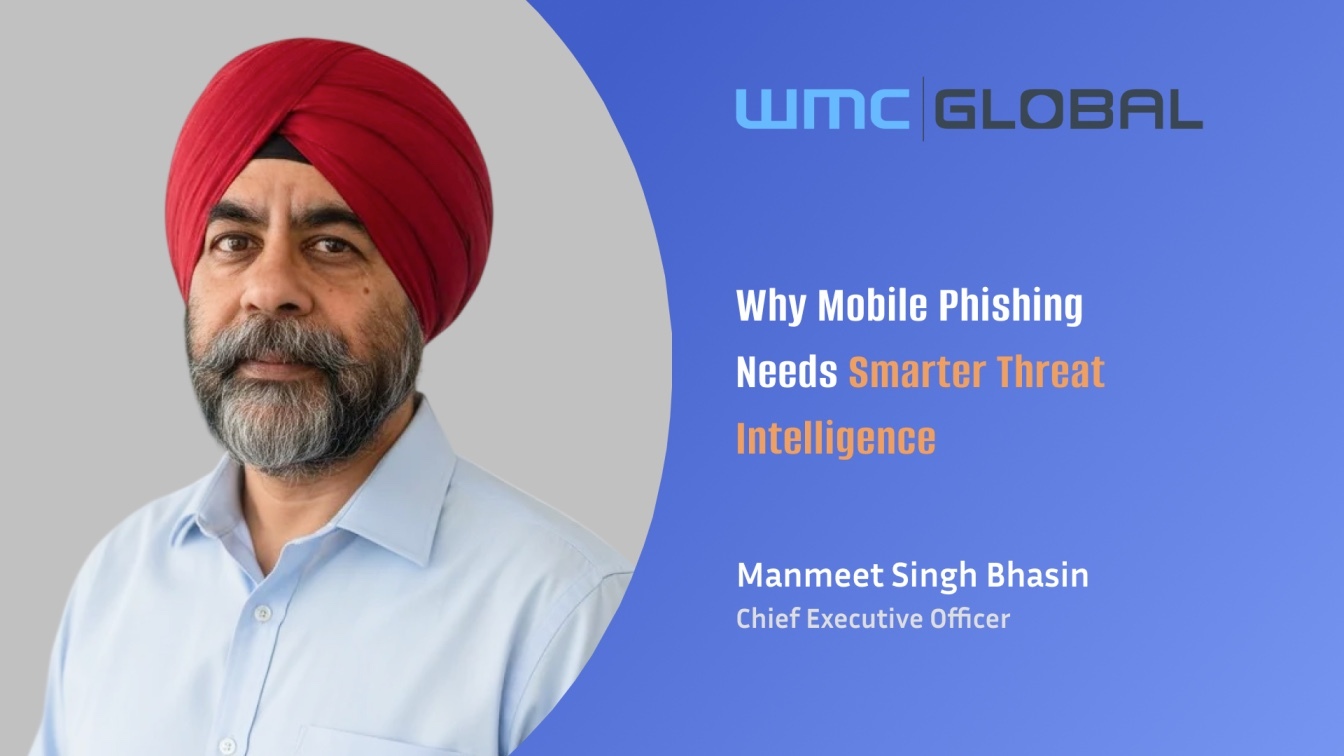
Smishing attacks are getting smarter. Is your intelligence?
As attackers exploit mobile channels with greater speed and coordination, legacy threat intelligence models are falling behind. Manmeet Bhasin, CEO of WMC Global, unpacks how leveraging agentic AI can identify patterns across campaigns and enable faster, more precise threat disruption.
Since stepping in as CEO, my focus has been on accelerating WMC Global’s transition from a services-led model to a product-led, AI-driven platform. A key priority has been shifting from reactive threat detection to proactive disruption, targeting adversary infrastructure and behavior before attacks impact customers.
We’ve invested heavily in building our agentic AI platform, enabling continuous, automated threat detection, analysis, and response at scale. This allows us to move from human-driven workflows to an always-on model where AI augments our teams and our customers.
In parallel, we’ve unified our capabilities into a single platform with a strong user experience, giving both operators and executives real-time visibility and actionable intelligence. The goal is simple: reduce operational friction, increase speed, and empower organizations to stay ahead of increasingly sophisticated threats (including AI-based threats).
With WMC Insight+, we’re addressing a fundamental gap in traditional threat intelligence; most platforms are still reactive, siloed, and heavily dependent on human analysis. Humans can only process so much data and are limited in their ability to correlate large-scale patterns across campaigns, phone numbers, URLs, and evolving adversary infrastructure in real time.
Insight+ changes that by leveraging agentic AI and advanced models to continuously analyze and connect these signals at scale. This allows us to identify coordinated threat campaigns earlier and with far greater precision than manual or rule-based systems. More importantly, we’re not just surfacing intelligence, we’re enabling action. Customers can now directly engage with the platform to investigate, ask questions, generate insights, and initiate threat resolution workflows on their own.
We’re effectively putting high-fidelity cyber threat intelligence in the hands of our customers at a depth that hasn’t been possible before, particularly in the mobile ecosystem where threats like phishing, smishing, and spoofing are rapidly evolving. As one of our large banking CISOs put it, the need is to proactively model and stop attackers targeting vulnerable customer segments, especially senior users who are often the most at risk. Insight+ is built to do exactly that: anticipate, correlate, and disrupt these threats before they scale.
With the rise of RCS and OTT platforms like WhatsApp and iMessage, phishing and smishing attacks are becoming more targeted, interactive, and harder to detect. These channels are particularly challenging because they are end-to-end encrypted and operate outside traditional telecom controls, limiting visibility.
There’s also a misconception that encryption equals security; it protects the transport, not the user, from social engineering. This is where intelligence-led platforms like WMC act as an early warning system, identifying threat patterns and infrastructure before attacks scale. Greater collaboration with these platforms is essential to stop threats before they reach users.
We’re aligning product, talent, and capital around a clear shift to an AI-driven, product-led platform. Having built and scaled Dataguise, I’ve seen the importance of disciplined execution, moving fast, but with focus.
We’re investing in agentic AI to automate detection and disruption at scale, while bringing in leaders who can translate innovation into real enterprise outcomes. It’s about building efficiently, staying close to customers, and scaling what works.
Even with AI adoption, the industry still underestimates how fast threat actors adapt. As we innovate, so do they, without scruples or guardrails. They only need to succeed once; we must succeed every time.
The real gap isn’t just more tools; it’s speed, behavioral understanding, and collaboration. Attackers operate collectively, sharing infrastructure and tactics, while defenders remain siloed.
Enterprises will need to make hard trade-offs: move faster, rely more on automation and behavior-based models, and be more open to sharing intelligence across ecosystems. The future of defense isn’t isolated, but collective, intelligence-led, and always on.
Manmeet Singh Bhasin is CEO of WMC Global, where he is redefining how enterprises defend against digital threats in the age of AI. With over two decades of experience across cybersecurity, data privacy, and enterprise technology, he focuses on building autonomous, AI-driven systems for mobile threat detection, phishing defense, and fraud prevention at scale. He previously founded Dataguise, a data security leader acquired for over $100M, and actively invests in next-generation AI and blockchain startups.
More about Manmeet: 
WMC Global is a cybersecurity market leader in digital threat intelligence with specific expertise in mobile, having partnered with Tier 1 mobile carriers for the past two decades and launched the United States’ first mobile market compliance program.
The WMC Global portfolio is at the forefront of fighting malicious text messages, eradicating phishing and smishing attacks, and stopping cyber criminals from targeting large brands, financial institutions, and governments. WMC Global helps security teams scale in response to mobile threats by providing its partners with proprietary data feeds of phishing attacks (including intelligence from active phishing kits), mobile investigation and disruption services, threat response and takedown services, automated partner due diligence, and customer experience monitoring.
Learn more at wmcglobal.com
Tell others what you think of TechIntelPro.



 Rate us on G2

