
Observability tells you what your AI agent did. It doesn't tell you whether it actually helped. As enterprises race to deploy AI agents, that distinction is becoming impossible to ignore.
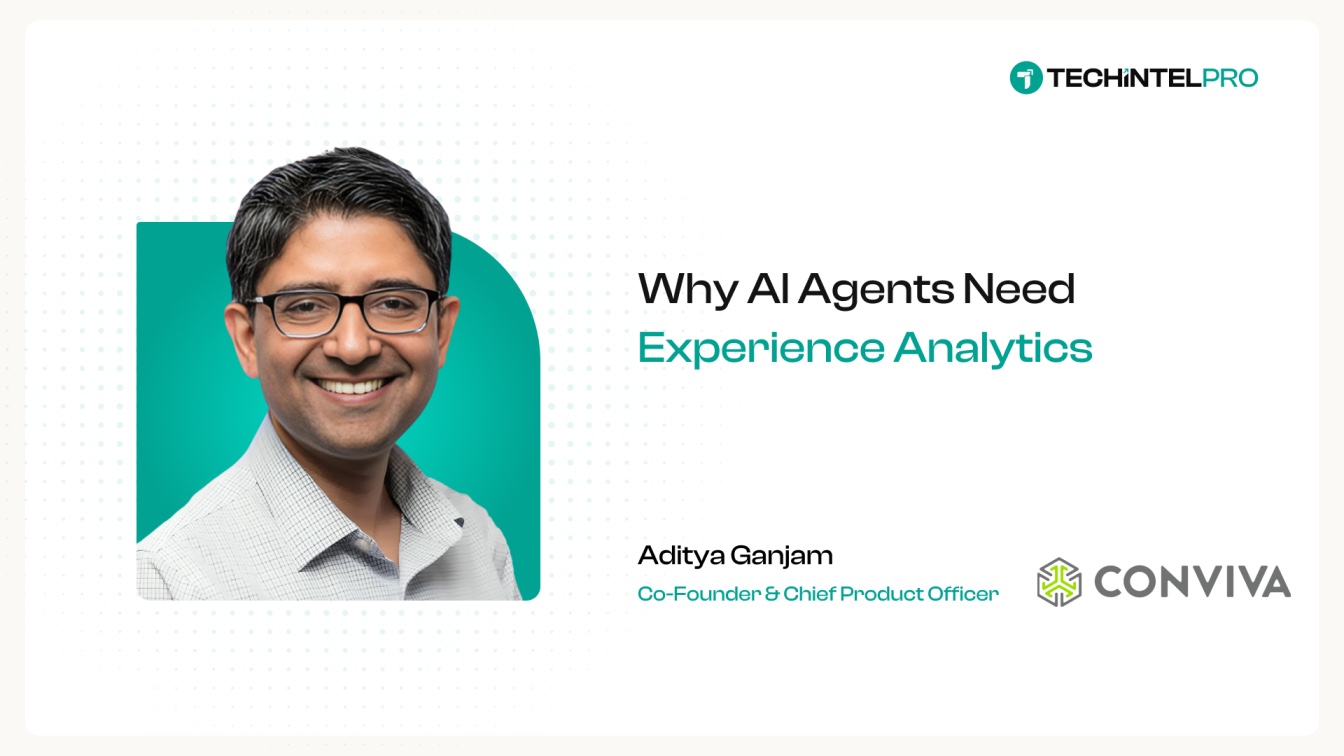
Aditya Ganjam, Chief Product Officer of Conviva, explains why the industry needs to move beyond traces and technical metrics toward experience analytics that captures intent, behavior, and business outcomes. He also shares how this shift can help organizations uncover hidden failures, improve customer journeys, and confidently scale AI agents that create real value.
The core lesson from streaming is that you must measure experience from the end user’s perspective. With AI agents, the same principle applies: you can see every trace and use LLM-as-a-judge to tell you if the response was on-brand, but what matters is whether the agent actually helped the user accomplish their goal. The measurement framework we built for video — tracking sequences of behavior rather than isolated events, at full census, in real time — turns out to be exactly what agent analytics requires.
The biggest underestimation is how much harder it is to verify quality when the interface is a conversation rather than a fixed UI — no two interactions are alike, and failures often hide in the long tail of production. Organizations are also underestimating the context problem: agents operating without knowledge of what the user has already done, seen, or said outside of the current agent conversation will keep re-establishing ground that was already covered. Consumers have very little patience for that. The gap between "the agent responded" and "the agent helped" is where most production deployments fail.
Agent observability tools give you traces and spans — a record of what the system did — but they don't tell you what the user actually experienced or whether the outcome was good. Conviva connects agent behavior to user behavior, mapping intent, sentiment, and outcome as trajectories across the full interaction, not just within the chat window. That correlation between what the agent did and what the consumer ultimately did is the only reliable signal for understanding whether a decision was actually correct.
Conventional product analytics assumes that customers travel through a fixed funnel (which Conviva data actually shows isn’t true 67% of the time), but agent interactions are dynamic and personalized by design — the same user asking the same question in a different context should get a different response, which makes funnel-based measurement meaningless. Agent analytics answers questions like: which agent behaviors actually drive conversion versus which ones look helpful but cause drop-off? Where in the conversation does intent shift, and is the agent tracking it? Which user segments are being systematically underserved? These are questions that require stateful, population-scale trajectory analysis, not isolated event counts.
Conviva found that roughly 30% of failed sessions trace back to misread intent, where the agent completed a task that wasn't what the user actually wanted. Conviva surfaces these failure patterns by correlating agent responses with downstream user behavior — what the user did after the agent responded is often the clearest signal that something went wrong.
The signal we obsess over is where our customers' customers are abandoning — not because the agent had a technical failure, but because it “worked” but didn’t help. That gap between technically functional and genuinely useful is where the next category of tooling needs to be built. I also pay close attention to where evaluation workflows are breaking down: when engineering teams can't tell whether a prompt change made things better or worse at the outcome level, that's a product gap we can close.
The leaders will be the ones who close the loop between agent behavior and customer experience in real time — not analyzing last week's logs, but adjusting this session before the user is lost. That requires a fundamentally different data architecture than most companies have today: one that treats trajectories, not events, as the unit of measurement, and that connects what happens in the agent conversation to everything that happens before and after it. The laggards will be running analysis after the fact while their customers quietly churn.
Aditya Ganjam is Co-Founder & CPO of Conviva, where he is leading the company’s expansion from video experience analytics into agent experience analytics. He drives Conviva’s product strategy with a focus on how AI agents behave in production — and how their decisions, efficiency, and failure modes translate into real customer outcomes.
Aditya helped create the Video QoE Analytics category, building the technology that powers streaming experiences for the world’s largest media companies, including Fox and Peacock. Under his leadership, Conviva became the industry standard for measuring video quality, engagement, and system performance across hundreds of top brands and millions of consumers. At the core of that work is Conviva’s Time-State Data Platform, which uses explainable AI to capture, connect, and explain behavior across highly dynamic systems.
More about Aditya: 
Conviva transforms every digital interaction, across apps, websites, and AI agents, into outcome-based intelligence that reveals how experiences truly perform and drive results. Powered by full-census client-side telemetry and a patented stateful analytics engine, Conviva continuously analyzes every session and conversation to expose behavioral patterns, connect them to outcomes, and surface opportunities for growth and improvement in real time. The result is a single, objective view of the digital experience from the consumer’s perspective, empowering product, marketing, and engineering teams to build more adaptive, measurable, and outcome-driven businesses in the Agentic era.
Learn more at conviva.ai.
Tell others what you think of TechIntelPro.



 Rate us on G2

