
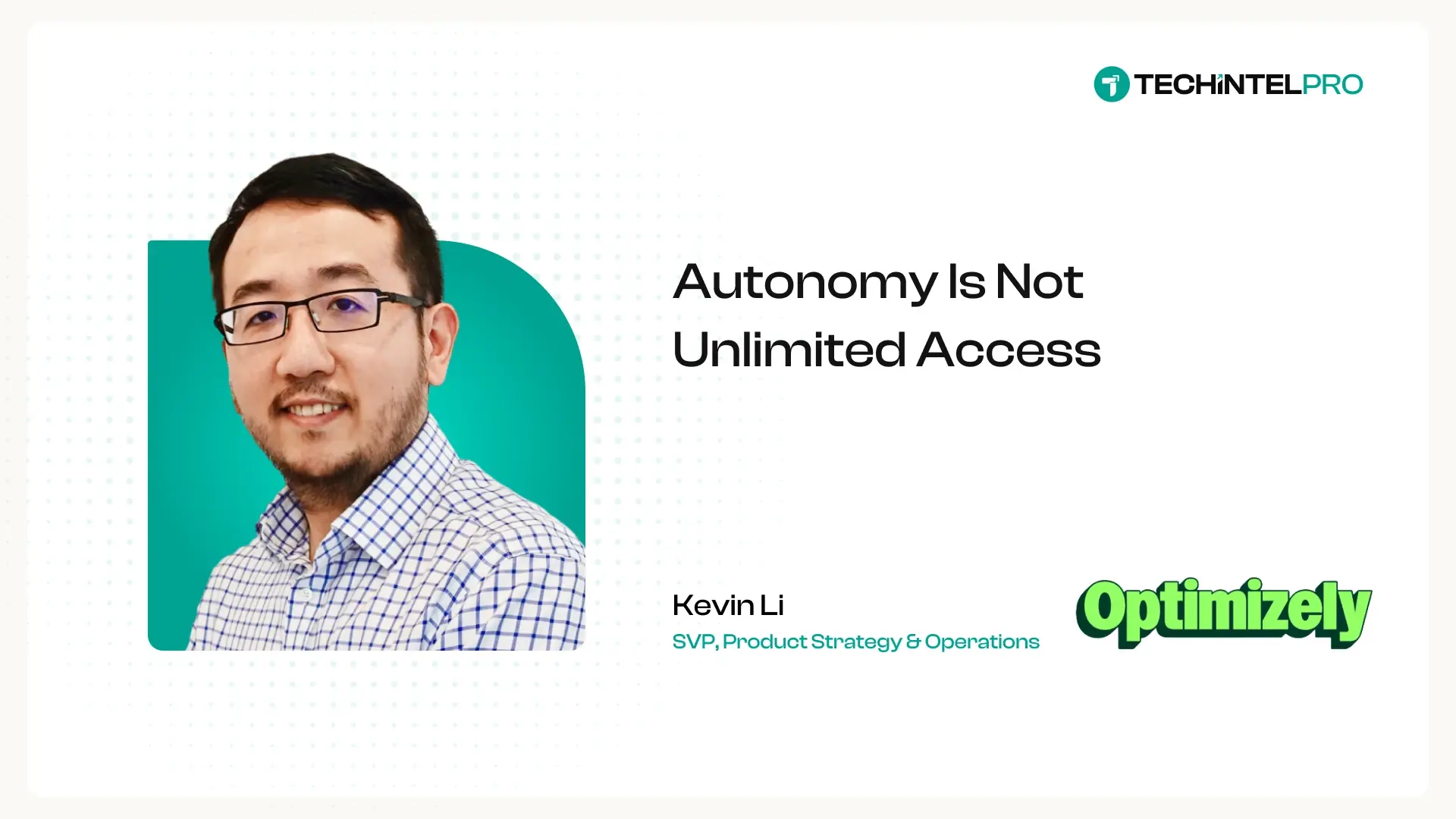
Most AI agents today act on behalf of whoever starts them, quietly inheriting that person's access. Kevin Li thinks that is the wrong foundation for an autonomous workforce. As SVP of Product Strategy & Operations at Optimizely, he oversees the product strategy behind Virtual Teammates, AI colleagues with a name, a personality, and, critically, their own employee ID, permissions, and activity history. The name and personality make collaboration more intuitive, Li says. The identity underneath is what makes it governable, because an organization can control what each teammate can touch and trace every action back to it.
Li brings a strategy-first view shaped by his time as Chief Strategy Officer at Idio, which was acquired by Episerver and later became Optimizely, and earlier roles at ThinkVine and The Nielsen Company. In this conversation, he explains how a Virtual Teammate differs from a copilot that waits to be prompted, why least-privilege access should apply to AI the same way it does to a new hire, and what it means for IT, security, and compliance teams when identity and access management can no longer be designed only around human users. He also describes what success looks like a year from now: not just adoption or output, but marketers who trust a teammate's work enough to stop double-checking it.
The identity is much more than humanizing the technology. Virtual Teammates are meant to encapsulate real, interrelated work, not a single task. It’s the same reason why you wouldn't hire one person to interview an exec, another to draft a blog, and another to spell-check. You hire someone to own the whole job. Most AI assistants today are reactive: you prompt them, they complete a task, and the interaction ends. Virtual Teammates are designed to be persistent and proactive. They have defined responsibilities, retain context, and can reach out or continue working without waiting for someone to initiate every task. Once you have something behaving more like an ongoing colleague, giving it a recognizable identity makes the interaction much more natural.
There’s also a very practical reason for that identity: most agents today act on behalf of whoever starts them, inheriting that person's access. We wanted a true autonomous workforce, where each Virtual Teammate has its own permissions and activity history, so organizations can control what it has access to and trace its actions back to the teammate specifically.
The name and personality make collaboration more intuitive. The identity underneath makes that collaboration governable.
The biggest difference is that a copilot typically waits for you. A Virtual Teammate keeps working. You can give it an ongoing responsibility like preparing a weekly briefing, monitoring search visibility or analyzing campaign performance, and it can run that work on a schedule or in response to a trigger without needing the same prompt every time. It's also built for multiple people and multiple Virtual Teammates to collaborate on the same work at once, sharing context and even a single work product, rather than each person working from their own isolated instance.
It also retains context from previous work and can collaborate with multiple people and other Virtual Teammates in shared workflows, and it improves the more it works with your team. That moves AI from something an individual opens when they need help to something the broader team can actually work alongside.
We give teams control over how their Virtual Teammates are configured because every organization works differently. Even two people hiring a Chief of Staff may have completely different expectations for how that person communicates, what they prioritize, and what they own.
That configuration is the starting point, not necessarily the end state. A Virtual Teammate can learn from its interactions with the people it works with and recognize preferences over time. If you consistently want a report structured a certain way, for example, it can pick up on that pattern and adapt. Think of a real executive assistant who knows how you take your coffee. They don't ask you every morning. A Virtual Teammate works the same way: once it notices a pattern, it can proactively confirm whether to keep doing it that way going forward, rather than asking from scratch each time.
The goal isn't personality for personality's sake. It's for the teammate to become more useful as it learns how your team actually works.
Memory shouldn't be treated the way human memory works, where every past event good or bad lingers indefinitely. It's about preserving a record of what good looks like, so the teammate keeps producing to that standard. That way marketers don't have to continually re-explain their organization, priorities, and ways of working. Teams can define the knowledge, systems, and workstreams that matter and continue updating that context as things change. Human oversight remains important here because the harder problem isn't simply giving AI more memory; it's making sure the context it carries forward stays relevant and useful.
That feedback should be part of the normal working relationship. If a teammate produces something you don't like, you can correct it through the interaction rather than having to rebuild an entire workflow or become a prompt engineer.
Say I consistently change the structure of a report it gives me. The teammate can recognize that pattern and adapt how it works with me. The same principle applies when priorities or guidance change: I should be able to tell my Virtual Teammate how I want something handled going forward, just as I would with a human colleague.
The goal isn't for the teammate to be right forever. It's for it to get better at working with you over time.
The starting point is least-privilege access. A Virtual Teammate shouldn't automatically inherit every permission of the person managing it. If you connect a general-purpose Al assistant directly to your own accounts, it's effectively acting as you. That's not what you want. You want a scoped assistant with its own limited rights, the same way you'd set up a separate user account for a new hire, not hand them your login. With its own identity, an organization can decide which systems it can access, what level of access it receives, and where human approval is required.
A teammate might have read-only access to one system, permission to take specific actions in another and require human sign-off before something like publishing content. Those decisions depend on the job the teammate has been given and the organization's own risk tolerance.
We're intentionally separating autonomy from unlimited access. The fact that AI can execute a task doesn't mean it should automatically have permission to do so.
As AI becomes more autonomous, we need to stop treating it like an invisible capability operating under somebody else's login. If an AI system is doing real work, an enterprise should be able to answer some basic questions: Who took that action? What were they authorized to do? And can I see what happened?
Giving each Virtual Teammate its own identity means companies can apply many of the access-management principles they already understand. This is the same way they already track what one employee ID can access versus another. Permissions can be scoped to the role, access can be limited to the systems needed for the job, and activity can be tied back to that identity through an audit trail.
The broader shift is that identity and access management can no longer be designed exclusively around human users. If digital workers are going to operate inside enterprise systems, they need an equally clear governance model.
The biggest change is that work doesn't always have to begin with a human remembering to initiate it. Remote and hybrid work already got teams used to assigning work and getting it done over messaging rather than in person, so a Virtual Teammate slots into that way of working naturally. Marketing teams have plenty of recurring work that either consumes people's time or simply doesn't happen because nobody has the bandwidth. A Virtual Teammate can own some of those standing responsibilities, whether that’s monitoring performance, preparing briefings, identifying issues or tracking follow-ups, and bring the human in when judgment or a decision is needed.
The other shift is ownership: most Al tools help you do a task, but you're still the one doing it. A Virtual Teammate can be handed the task outright and finish it, the same way you'd hand work to a person. That gives marketers more room to focus on strategy, creativity, and the work that requires human judgment. It's not about replacing the team. It's about changing where people’s time and attention go.
Adoption and output matter, but the clearer signal will be whether a team accepts a teammate's work without constantly needing to double-check it. We're still at the beginning of figuring out what a digital support team actually looks like: how many Virtual Teammates someone works with, which responsibilities belong to humans versus AI, and where the handoffs should happen.
That's partly a technology question and partly an organizational one - how much a team is comfortable trusting a teammate builds up over time, usually starting with the highest-volume, lowest-risk work. Success is when a marketer doesn't think, “I should go use an AI tool for this.” They know they already have a teammate responsible for that work. They trust it to operate within the right guardrails, and they know when it will bring them in.
Kevin Li is the SVP, Product Strategy & Operations at Optimizely, where he leads product strategy, including the strategic roadmap, new product launches, as well as M&A and corporate development. Previously, Kevin served as Chief Strategy Officer at Idio (acquired by Episerver in 2019, rebranded as Optimizely in 2021), where he oversaw the solutions team and played a key role in shaping the company’s product vision. Prior to Idio, he held roles at ThinkVine and The Nielsen Company.
More about Kevin: 
Optimizely is the AI platform for marketing, built for the experience-makers who shape how brands show up in the world. Bringing together content management, content marketing, experimentation, commerce, personalization, and analytics into a single platform, Optimizely gives marketers the freedom to create, customers the experiences they remember, and AI agents the content they come looking for. With Optimizely, you're free to grow.
Learn more at optimizely.com.
Tell others what you think of TechIntelPro.


 Rate us on G2