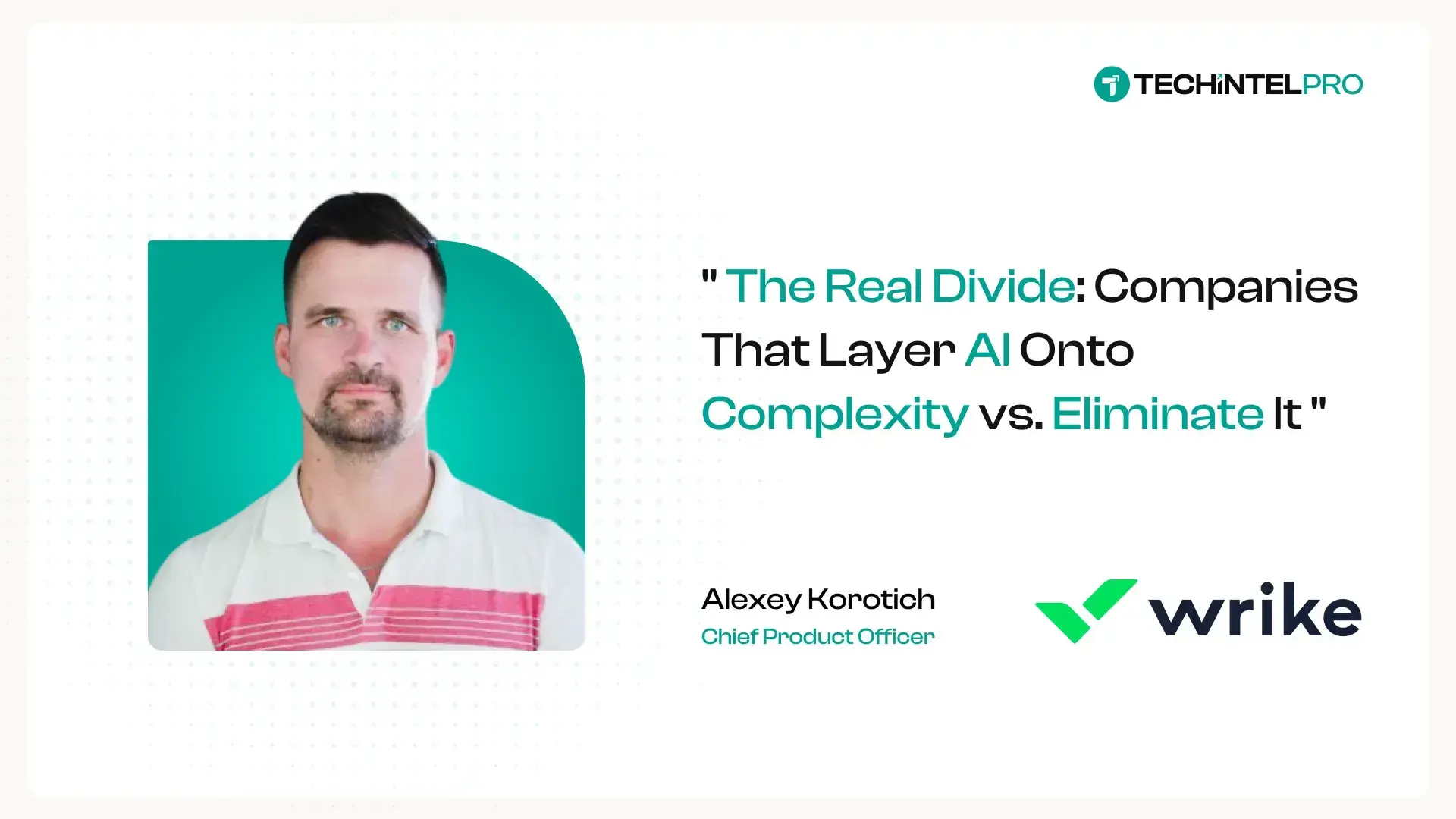
TechIntelPro spoke with Alexey Korotich, Chief Product Officer at Wrike, about what it really takes to scale AI in the enterprise, beyond the hype.
Drawing on more than 15 years of experience in enterprise software, security, and product leadership, Korotich discusses why governance and context must be foundational, not an afterthought, and what separates companies poised for a genuine productivity leap from those layering AI onto broken workflows.
One of the biggest lessons that’s influenced my vision is that enterprise software only works if it fits how people actually work. It’s easy to build something technically elegant that doesn’t really survive contact with the real workflow, the real team dynamics, or the real constraints inside an organization. Over time, I’ve learned that the best products have to balance flexibility with structure and governance. They need to give teams room to work in the way that makes sense for them, while providing the accountability, visibility and consistency that enterprises need. That’s really the lens I bring to Wrike. I’m focused on ensuring the platform adapts to customer processes and not the other way around and now, AI has made that even more important.
The biggest misconception is that AI is somehow delivering transformation on its own. While it can create value, plugging AI into a broken or fragmented workflow does not fix the underlying problem. In many cases, it just exposes where the process, the handoffs or the accountability model were already weak. The other misconception is that scaling AI is a sole technology problem. To properly scale AI, leaders must ensure it’s woven into how teams, departments and companies operate. That means balancing trust, governance, change-management, and context all at once. When one of those elements is missing, it becomes harder to scale AI in a way that’s reliable and repeatable across the organization. Successful AI adoption hinges on the right foundation, where the workflow environment, control, accountability and collaboration enable AI to become an operating advantage and not just a layer of experimentation.
At Wrike, context sits at the center of our AI strategy. AI is only as useful as the information and structure behind it, and the Work Intelligence® Graph gives Wrike a living, dynamic map of how work actually flows across an organization. That means AI can operate with better awareness of context, drawing on areas like relationships and workflow history, instead of making decisions in a vacuum. Just as important, that context sits inside a governed environment, so actions are traceable, auditable, and aligned with enterprise controls. That combination is what makes AI more reliable and more usable at scale. In many AI deployments today, the model may generate useful output, but it often lacks the operational context needed to take action in a way that is consistent with how the business actually runs. Our approach is different because the AI is grounded in the system where the work, the process, and the history already live. That gives it the structured context it needs to produce more relevant outputs and support more dependable execution.
The biggest shift has been moving from thinking about AI as a set of features to thinking about it as part of the infrastructure for how work gets done. That means being very deliberate about context, control, collaboration, and adaptability to keep these pillars as the foundation for the platform. In order for AI to be useful in the enterprise, it has to understand the workflow context around the work, operate within the proper permissions and governance model, and fit naturally into the way teams collaborate. Another important shift is in how we frame support and features for customers. Our customers are increasingly focused on getting real ROI from AI, which means providing a structured path to adoption through both out-of-the-box agents and agent-building capabilities for more tailored use cases. We also focus on making sure that path is accessible. Enterprise AI will only scale if it is approachable for users across skill levels, which is why Wrike is focused on making powerful capabilities easy to adopt, customize, and put to work without requiring deep technical expertise.
We treat governance as a foundational design principle, not an afterthought. In practice, that means AI operates within the same permissions, access controls, and accountability structures as the rest of the platform. It is auditable, traceable, and governed from the start, because enterprise customers need trusted systems. We also believe governance has to scale with autonomy. Not every AI capability carries the same level of risk, so the controls have to be proportional to what the agent is allowed to do. That is why human control remains a core part of the strategy, ensuring teams can move fast without creating blind spots for IT, security or compliance. Ultimately, the objective is not just capability, but trusted capability that enterprises can scale with confidence.
Over the last few years, my role has become more cross-functional and more dynamic. In an AI-native environment, product leadership is focused on aligning technology, governance, workflow design, and customer expectations in a much faster-moving landscape. The most critical leadership capabilities are judgment, adaptability, and systems thinking, and being close to the details while still seeing the bigger picture and industry trends. Product leaders also have to be very clear-eyed about what’s real versus what’s hype, because there’s a lot of noise right now.
AI can absolutely unlock a productivity revolution, but only if companies are willing to change the way work is actually done. If AI is limited to a thin layer on top of existing workflow complexity, it may deliver small, individual gains but not real industry-wide transformation. What will ultimately make the difference is whether companies invest in workflow redesign, governance, and the operating discipline needed to make AI work at scale. The real divide will be between companies that layer AI onto complexity and companies that use it to eliminate complexity.
Alexey Korotich is Wrike’s Chief Product Officer. Alexey has more than 15 years of experience in enterprise software design, security, product development, and management. His ability to define the long-term vision and management requirements for new, category-defining enterprise solutions has led to numerous successful go-to-market plans and launches.

Wrike is the trusted work delivery platform for people and AI.
Most organizations are already using AI to handle real work. Without the right infrastructure, it's ungoverned, unauditable, and out of control. That's the problem we solve.
Wrike gives enterprises the governed, context-rich foundation they need to put people and AI to work together on their most consequential workflows — without losing control of how work gets done.
What makes Wrike different is what sits behind the AI. Our Work Intelligence® Graph is built on 500B+ historical data points and two decades of enterprise work management. It gives AI the structured context to act reliably, inside the same roles, permissions, and access controls your people already work within.
The result? Organizations don't just manage work. They deliver without doubt.
Governance sets the boundaries. Autonomy follows when people trust the system. Scale is what happens when you stop hitting the ceiling that limits delivery.
More than 20,000 organizations worldwide, including Siemens, Walmart, NVIDIA, and The Estée Lauder Companies, trust Wrike to deliver their most important work.
Learn more at wrike.com.
Tell others what you think of TechIntelPro.



 Rate us on G2