
Gartner predicts that more than 40% of agentic AI projects will be canceled by the end of next year. The models aren't the reason. The reason is that the data feeding them still lives in documents, and most organizations are running AI on top of a document infrastructure built for a problem they solved a decade ago.
Three eras, and most companies are stuck in the second
Document management has evolved through three eras, and the gap between where a company sits and where it thinks it sits explains most failed AI programs.
The first was storage. Scan the paper, get the boxes out of the building, satisfy the auditor. A real-estate problem, and the industry solved it well.
The second was retrieval. Add indexes and folder structures so a person can find a file. Better, but still built around a human doing the finding.
The third is intelligence, and it changes the requirement entirely. The consumer of the document is no longer a person who can tell something looks wrong. It's a system that acts on whatever it's given, confidently, at machine speed.
Most organizations digitized for storage, then bolted on search, and are now asking that stack to support autonomous decisions. That's the mismatch. A scanned PDF is a picture of information. It satisfies era one beautifully and era three not at all.
Why point solutions break at the third era
The instinct is to buy a capability: an OCR engine, a search tool, a workflow product, an AI layer. Each solves a slice. Stitched together, they create the exact conditions AI can't survive.
Extraction that happens in a separate system from storage means the structured data and the source document drift apart. Search that sits above a repository it didn't classify is doing full-text guessing and calling it retrieval. Workflow that triggers on data it can't trace back to an authoritative record automates the wrong answer faster.
I see this constantly. An organization selects a set of documents, sends them out to be processed, and brings the results back. It works once, for those documents. It does nothing for the next thousand, or when the source changes.
The alternative is to put everything in a platform where documents are classified, extracted, governed and made actionable as they're ingested and consumed, not in batches after the fact. Compliance and accuracy stop being projects and become properties of the system.
What a complete platform actually has to do
Three capabilities have to live in the same platform, on the same content, under the same governance.
- Search that understands entities, not just strings. Retrieval has to know that a document belongs to a customer, a case or an employee, and which version is current. Without entity resolution, AI retrieves something plausible instead of something correct.
- Extraction at the point of capture. Classify and extract when content enters the system, not months later in a remediation effort. Data extracted at ingestion can be validated, corrected and governed. Data extracted downstream inherits every problem upstream.
- Workflow that acts on verified information. Automation is where the value is realized, and it's also where errors become expensive. The workflow layer has to see the confidence score, the source document and the audit trail, which it can only do if it's part of the same platform.
Separate these three and you get a demo. Combine them and you get an operating system for information.
Digitized is not the same as AI-ready
Three questions test any repository:
- Can you find it?
- Can you prove it's the current version?
- Can you verify where it came from and who touched it?
If the answer to any of those is no, you don't have a data asset. You have a digital pile of files.
The failures underneath are structural, not cosmetic. Five copies exist and none is marked current, so AI picks one. Signed forms sit orphaned with no reliable link to the customer they belong to. The same customer carries three IDs across three silos with no crosswalk. Superseded documents live beside current ones, and AI treats both as equally authoritative.
Accuracy compounds the problem quietly. 95% character-level extraction sounds strong until it meets a ten-character account number, where it produces roughly a 40% chance of at least one wrong character. Multiply that across millions of documents feeding an automated workflow with no validation step.
That's why certified humans belong in the loop. Not everywhere. Where being wrong is expensive. AI handles the routine volume and people resolve the exceptions, which only works if the platform can identify an exception in the first place.
Where to start
Don't start with the model. Start with a decision you want to automate, then work backward to the documents that decision depends on.
Inventory what you have and who owns it. Pick one workflow rather than one technology, because claims intake or accounts payable done deeply beats an enterprise rollout done shallowly. Tie every document to an entity ID. Capture with intent, classifying and extracting at ingestion. Treat metadata and governance as the addressing system rather than paperwork. Design the exception path before you scale, because the exception path is the architecture. And use governance for steering, not braking.
Who wins
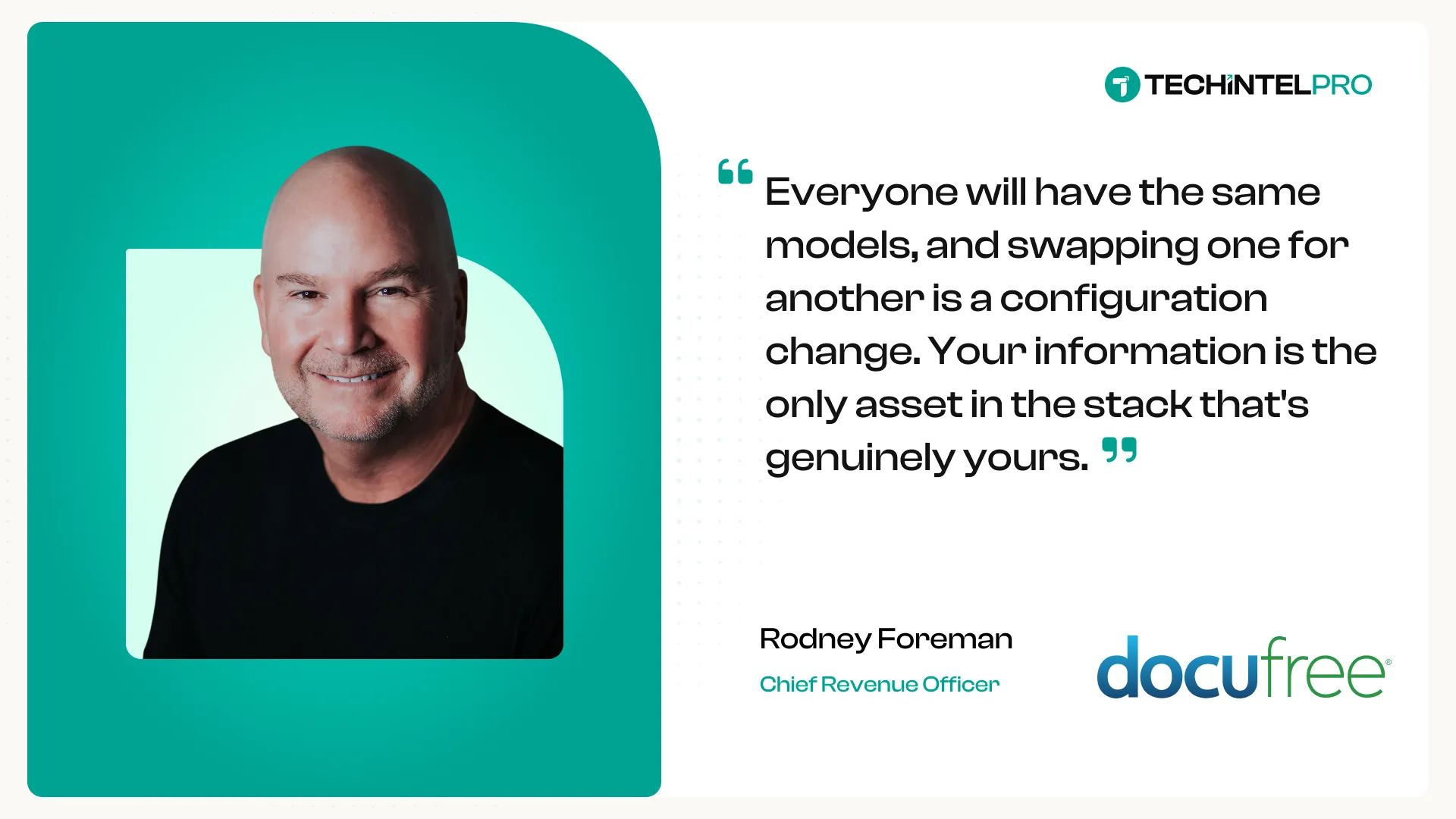
Nobody wins on model access. Everyone will have the same models, and swapping one for another is a configuration change. Your information is the only asset in the stack that's genuinely yours.
The winners will have done the unglamorous work: inventory, taxonomy, entity resolution, retention, all inside a platform that searches, extracts and automates as one system.
The companies that struggle won't fail loudly. They'll run three pilots, get mediocre results, quietly decide AI is overhyped, and move on. The technology worked. The document layer underneath it didn't. They'll never know the difference, because nobody audits the data when it's easier to blame the model.


 Rate us on G2