
For years, security awareness training has worked on simple principles to teach people to spot a phish.
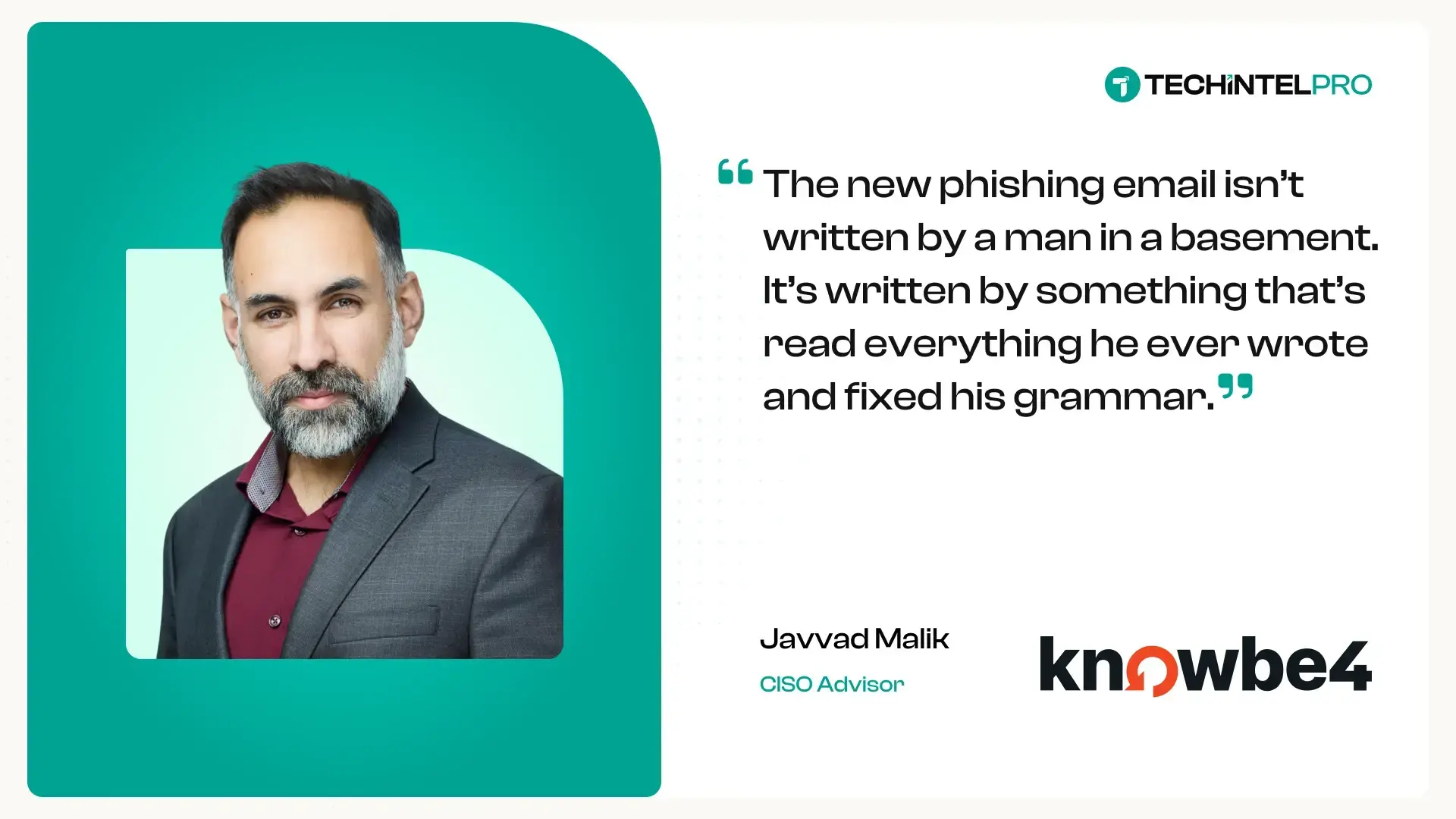
Look for bad spelling, grammar, or if you receive a suspicious link in an email that reads like it was written by a man in a basement using a stolen laptop and an incomplete grasp of the English language.
It was not bad advice for its time. A lot of phishing really did look like that. The problem is that attackers have now acquired tools that can write better than half the people sending internal all-staff emails.
The Changing Attack Landscape
With AI capabilities, criminals can send messages that are cleaner, more convincing, and much easier to personalise at scale. The criminal can now produce fluent Japanese, polished German, or the kind of easy Arabic-English mix that feels entirely normal in a Gulf office chat. This is important because trust is often built on tiny familiar details, the flow of a sentence, the greeting, the right phrase in the right context. AI is getting very good at faking that.
Which means awareness needs to evolve. Otherwise, it’ll just be teaching people to look for red flags which do not exist anymore.
The second big shift is that criminals are not sticking to email. They go where the trust is. That means Teams, Slack, WhatsApp, SMS, LinkedIn, voice notes, collaboration platforms, internal chat, and anywhere else work now happens. A Teams message feels like work. A Slack ping feels routine. A WhatsApp from the boss feels urgent. A short voice note sounds more human than a paragraph of text. Add AI into the mix and suddenly the attacker does not need writing skills, language skills, or much imagination. They need a target and a prompt.
KnowBe4's own research backs this up: the 2026 Phishing Threat Trends Report found that 86% of phishing attacks now show signs of AI involvement, Teams-based attacks are up 41%, and calendar invite phishing has surged 49%. The inbox stopped being the only front line a while ago.
Securing the Digital Workforce
This is why the idea of the digital workforce matters. Work is no longer done solely by humans tapping away at keyboards and making coffee disappear. It is a mix of humans, copilots, chatbots, automations, and increasingly agentic systems making decisions or carrying out tasks on our behalf. That means trust now must flow across a workforce made up of both people and machines. Humans can be tricked. AI can be manipulated. Humans can place too much faith in polished language or a familiar tone. AI can place too much faith in poisoned instructions, dodgy context, assume a lone blog post has authority. Both can make mistakes. Both can be attacked. Both need guardrails.
That is why "spot the phish" is no longer enough as the organising principle for awareness. We trained people to look for the clumsy signs of deception when what they increasingly need is help making better trust decisions under pressure.
It means teaching people to slow down when a request is unusual, urgent, secretive, or oddly timed, even if the writing is immaculate. It means building the habit of verifying requests through a second channel, especially when money, credentials, sensitive data, or access are involved. It means normalising challenge rather than treating it as awkward. It means making reporting simple enough that people actually do it instead of planning to do it after lunch and then forgetting forever.
Historically some regions benefited, accidentally, from the fact that many attackers simply could not speak the local language well enough to be believable. If you were targeting Japanese employees, for example, there was once a natural ceiling on how convincing you could be unless you actually knew Japanese. AI has removed much of that friction. The same goes for regional blends of language and tone, including the way people switch between Arabic and English in business conversations across the Middle East. What used to require cultural fluency can now be approximated cheaply and at scale. This is worrying because familiarity is one of the oldest shortcuts to trust.
The Future of Training
So where does that leave organisations? Ideally, somewhere beyond the annual slide deck about suspicious links.
Awareness still matters, probably more than ever, but it has to mature. KnowBe4's 2026 Phishing by Industry Benchmarking Report found the global baseline Phish-proneTM Percentage sits at 33.2% before any training, and drops to just 4.2% after a year of sustained training. Training clearly works. But the goal is no longer to train people to spot a cartoon villain in their inbox twirling his moustache and asking for gift cards. The goal is to help the digital workforce make sound trust decisions when the request looks normal, sounds normal, arrives in the right channel, and may even come in a voice that resembles someone they know.
That also means organisations have to do their bit. If employees are expected to verify strange requests, give them a simple way to do it. If finance approvals can be pushed through chat with no secondary check, that is not an awareness problem, it is a process problem. If AI agents are making decisions or moving data, then they need the same sort of boundaries, monitoring, and verification logic we expect from humans. Trust cannot just be a vibe. It has to be designed.
The old world of phishing awareness was built around spotting bad fakes. The new world is about questioning good ones. Attackers are training AI to sound human. The least we can do is train our digital workforce, human and machine alike, to be a bit more sceptical about what sounds right.

 Rate us on G2