For the better part of two decades, the goal of digital marketing was the same: get to the top of the page. Build the right content, earn the right links, optimize the right keywords, and you'd be rewarded with visibility, clicks, and customers.
That model is being dismantled in real time, and most marketing teams haven't fully reckoned with what's replacing it.
Welcome to the Answer Era. And if you're not thinking about Answer Engine Optimization, you're already behind.
What Changed And Why It Matters
Search engines used to be librarians. You asked a question, they pointed you to a shelf. The goal was to be the most prominent book on that shelf. Answer engines are different. Google's AI Overviews, ChatGPT, Perplexity, voice assistants, these don't point users anywhere. They synthesize information from across the web and deliver a single, confident response. There's no page two. There's no list of ten blue links to scroll through. There's an answer, and then there's everything else.
The implication for marketers is significant: the new goal isn't to rank. It's to be the answer.
That may sound simple, but it’s not. The criteria for becoming the answer are fundamentally different from the criteria for ranking a page, and most of what the industry spent the last twenty years optimizing for doesn't directly translate.
SEO vs. AEO: The Core Distinction
SEO was, at its heart, a content and authority game. Write the right content, structure it correctly, earn credible backlinks, and search algorithms will reward you with visibility. AEO, on the other hand, is a signals game. Answer engines aren't just reading your website. They're pulling from a much wider set of inputs to determine whether your business is the most credible, relevant, and trustworthy answer to a given query.
Those inputs include your business listing data, your review volume and sentiment, your paid media performance signals, your social content, and the consistency of your information across every platform where your business appears. Your entire digital footprint, not just your website, becomes the data set that answer engines use to evaluate whether you deserve to be the answer.
This is a fundamentally different challenge. And it requires a fundamentally different approach.
The Visibility Cliff
Here's what makes AEO urgent in a way that SEO never quite was: the drop-off in visibility is near-total. In the old search model, ranking fifth or sixth still meant some clicks. Ranking on page two was suboptimal, but not catastrophic. There was a long tail of visibility for brands that hadn't fully cracked the algorithm.
In the answer model, there's no long tail. If you're not the answer, or one of the two or three businesses cited in an AI-generated response, you effectively don't exist for that query. The user got their answer, and they’re done.
For multi-location businesses, this dynamic is especially acute. When someone asks "best [service] near me" and an answer engine responds with a specific recommendation, the brands not mentioned don't get a consolation click. They get nothing. And as AI-generated answers become the default response for more and more queries, that nothing becomes an increasingly large share of potential customer interactions.
The brands that figure out AEO early will capture an outsized share of that attention. The ones that don't will find their organic visibility compressing faster than any algorithm update has ever compressed it before.
Why Most Brands Are Unprepared
The honest reason most brands are unprepared for AEO is structural. The teams, tools, and workflows that exist inside most marketing organizations were built for the old model. Content teams optimize pages, SEO specialists chase rankings, paid media teams manage bids.
Listings and reviews are often handled by whoever has capacity, and social is its own silo. None of these functions was designed to work together toward a single, unified objective: becoming the most credible answer across every channel where answer engines are listening.
That's not a criticism of the teams doing this work. It's a recognition that the game changed faster than organizational structures typically adapt. The playbook that generated results in 2020 is still being run in 2026 by the majority of marketing organizations, even as the environment it was built for has materially shifted.
What the Answer Era Requires
Winning in an AEO environment requires treating your entire marketing stack as a coordinated signal system, not a collection of independent channels each optimized for its own metrics. Your business listings aren't just contact information, but structured data that answer engines use to understand who you are, where you operate, and what you do. Inconsistent or incomplete listing data is one of the fastest ways to become invisible in AI-generated responses.
Your reviews aren't just reputation management, but also third-party validation signals that answer engines use to evaluate credibility and relevance. The volume, recency, and content of your reviews directly influence whether you show up as a trusted answer.
Your paid media performance isn't just lead generation. The conversion signals from your campaigns, which queries drive action, which landing pages satisfy intent, feed into the broader ecosystem's understanding of what your brand is actually relevant for. Your social content isn't just brand building. It's a freshness and context signal that reinforces topical authority and keeps your digital footprint active and current.
Separately, each of these functions is doing its job. Together, they're either building or undermining your position as the answer.
The Opportunity in the Disruption
The shift to AEO isn't just a threat to brands that have been coasting on SEO investment. It's an opportunity for brands willing to think differently about how their marketing channels work together.
The companies that will win the Answer Era aren't necessarily the ones with the most content, the highest domain authority, or the biggest paid media budgets. They're the ones whose marketing infrastructure sends the most consistent, credible, and comprehensive signals across every channel answer engines are evaluating.
That's a solvable problem, but it requires treating it as a systems challenge, not a content challenge.
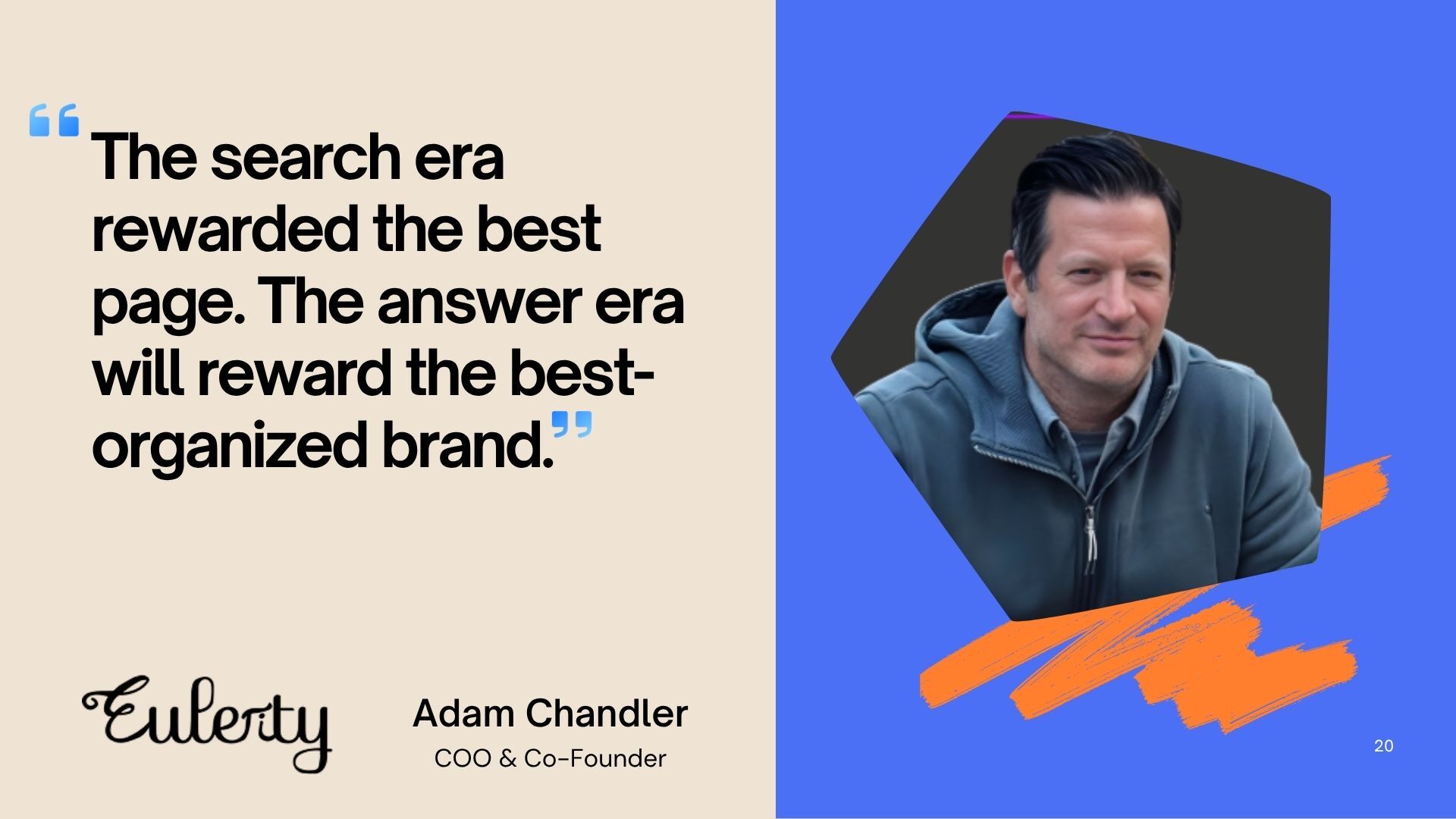
The search era rewarded the best page. The answer era will reward the best-organized brand.
Eulerity unifies paid and organic media — ads, social, reviews, and listings — under one agentic AI engine, giving multi-location brands the infrastructure to become the answer across every channel that matters. Learn more at eulerity.com.


 Rate us on G2