As governments and enterprises across the Middle East accelerate investments in AI infrastructure1 as part of broader digital transformation and sovereign AI initiatives, much of the conversation has centered on compute. GPUs, CPUs, memory, interconnects, power density, and performance benchmarks sit at the center of IT architecture planning discussions. That focus made sense during the early phase of AI adoption, when the primary challenge was simply getting models trained and operational at scale.
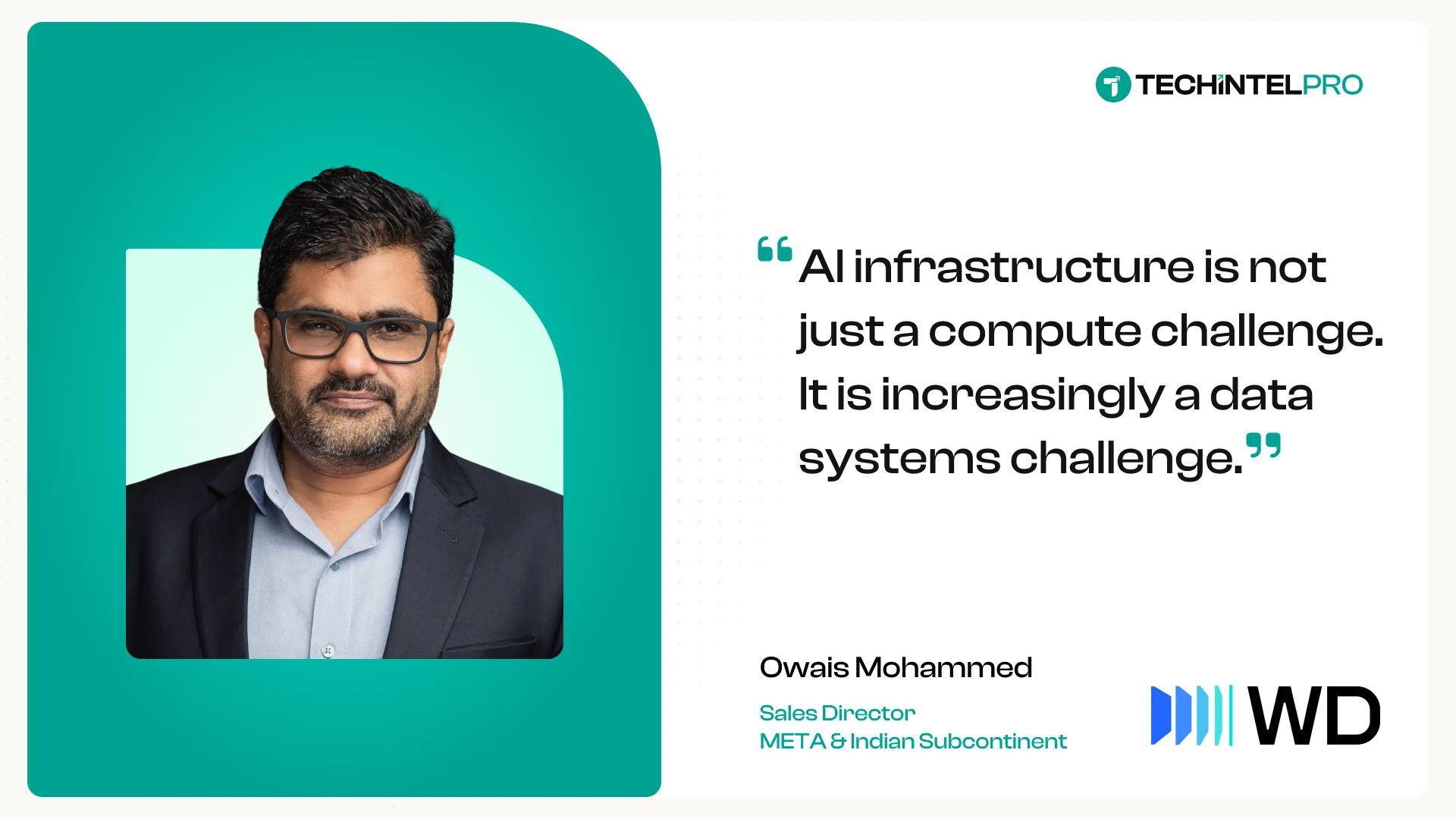
But as AI deployment matures across industries, a more fundamental reality is beginning to emerge: AI infrastructure is not just a compute challenge. It is increasingly a data systems challenge.
Across the region, organizations are increasingly focused not just on deploying AI, but on building infrastructure that can scale sustainably over time.
At scale, how organizations manage, retain, move, and optimize data will ultimately determine whether AI delivers sustained business value. While compute creates moments of intelligence, data is what allows those AI systems to evolve, improve, and operate reliably over time.
The shift is driven not only by processing power, but by the scale, persistence, and compounding nature of the data AI systems continuously generate.
Unlike compute and memory infrastructure, which follow refresh cycles and can be reused across workloads, data doesn’t behave that way.
AI data environments expand continuously with every training run, every token, every inference cycle, and every interaction. Over time, that accumulation starts to define the system in ways that compute alone does not. Production AI environments increasingly behave less like compute systems and more like data systems — with major architectural, operational, and economic implications.
The Operational Impact of AI Data Growth
For the majority of the last ten years, compute buildouts and storage shipments scaled in unison. During the first wave of cloud expansion, server deployments and HDD investment rose in parallel. It was easy to view them as two sides of the same coin. And it holds at the point of build: when you deploy a compute cluster, storage follows. But it’s the next step in the AI cycle that changes this equation. Once inference begins, storage keeps growing. Compute does not.
AI is the inflection point accelerating this divergence. Compute and storage are now on fundamentally different trajectories, and the divergence is structural.
In the AI era, compute remains episodic, especially for training. Capacity shifts from training to inference, gets repurposed across workloads, and becomes more efficient over time. As software improves, the same infrastructure delivers more output, naturally moderating the pace of incremental investment.
AI inference no longer simply consumes data — it continuously generates it. A single 5-second AI video generation can produce logs, traces, intermediate outputs, and metadata that rival the output itself in size, even before retention for tuning, compliance, or audit. At scale, that data growth becomes structural.
This marks a fundamental shift from earlier enterprise workloads, where retention decisions were governed by what needed to be kept versus discarded.
AI operates under a different incentive structure. Data is rarely discarded because it carries future value. In practice, data doesn’t expire; it persists.
AI Infrastructure Must Support the Full Data Lifecycle
As AI systems move into production, the question shifts from “how fast can you run a model” to “how effectively can you sustain everything around it?”
In a modern AI data center, the long-term behavior of the environment is increasingly defined by what it needs to retain over time rather than simply how quickly it can process information. Compute, memory, networking, and power all play critical roles, but they don’t carry state. They don’t preserve value over time.
Compute creates moments of intelligence, while memory remains transient. Data state is what makes those moments durable and useful.
The nature of what’s being stored is also evolving. There’s the data used to build and operate models, which has always been important. But there’s also a rapidly growing layer of data generated by those models – content, code, analytics, synthetic data used for refinement, digital representations, and institutional knowledge that becomes embedded in the system to make specialized agents uniquely useful to different use cases.
This second category is often underestimated, but in production environments, many challenges emerge not from running the model itself, but from managing everything that follows. That’s the point at which storage stops being a supporting component and becomes foundational to how AI systems deliver long-term operational and business value.
AI infrastructure depends on multiple tiers working together. Memory (HBM/DRAM) enables high-speed processing and real-time computation, while storage provides the durable, scalable foundation where data persists, grows, and compounds over time. Together, they enable AI systems to operate – but only storage carries the accumulated state that defines long-term system behavior.
AI data centers are composed of multiple storage tiers optimized for different workloads across the data lifecycle.
High-performance tiers support active inference and real-time access, while capacity-optimized tiers store most retained data – logs, embeddings, outputs, and historical context that accumulate continuously over time.
Treating storage as a single tier may work at a small scale, but it becomes inefficient and fragile as systems grow. Designing across tiers is what enables AI infrastructure to scale effectively.
The Limits of Traditional AI Infrastructure Planning
A common assumption in early AI infrastructure planning is that storage should scale in proportion to GPU deployments. It’s a convenient model, and useful during the buildout stage, but it doesn’t hold up well when inference volumes and the number of users begin to scale rapidly.
Treating storage as an extension of compute and memory is one of the costliest mistakes in AI infrastructure design.
For many organizations across MEA, AI infrastructure planning also requires balancing rapid innovation with operational efficiency, sustainability considerations, and evolving data governance requirements.
What works at a small scale often breaks at AI scale – because architectures that ignore data growth, economics, and resilience cannot sustain long-term operation.
The reason is that compute and data follow fundamentally different economic curves. Compute investments might be episodic, particularly for training, tied to discrete deployment cycles. Storage, by contrast, scales continuously with data growth, retention policies, replication strategies, and governance requirements.
When storage is treated as an extension of compute rather than foundational infrastructure, two gaps emerge. The first is architectural: storage is planned as a downstream consideration, even though it is responsible for durability and availability over time – capex, power, and physical space need to be planned for the data lifecycle, not the GPU refresh cycle. The second is economic: storage growth is tied to data accumulation, not hardware refresh cycles. Costs expand in ways that aren’t fully anticipated when the data estate is small. As it grows into exabytes, TCO becomes the key driver for technology decisions. And with that, the economics are drastically shifting away from flash and toward hard drives.
These gaps should not be ignored. Initially, well-functioning systems will begin to show strain because the data layer wasn’t designed to grow with the same level of intent. At AI scale, economics increasingly becomes architecture. The cost of storing, retaining, and managing data determines how much data can be kept and, therefore, how much models can improve.
Redefining AI Infrastructure Performance at Scale
As systems grow, the definition of performance broadens. Availability becomes just as important as speed. If data can’t be reliably accessed, the system doesn’t function, regardless of how much compute capacity is available.
Durability, replication, and predictability begin to take on a more central role, shaping both system behavior and cost structures. Assuring durability, while keeping costs competitive, gets progressively harder with scale, because data is constantly read and written to assure durability.
At AI scale, failure is not an exception – it is a constant. Infrastructure must be designed to withstand continuous failure and recovery without degrading performance or reliability. Resilience is not a feature – it is a design choice.
At that point, it becomes clear that performance is not a characteristic of any single device. It’s an emergent property of the storage system as a whole – how data is placed, how it moves, and how it is managed across a distributed architecture. Data keeps moving behind the scenes to the lowest cost and is constantly being read and written for durability, even when the user is not accessing it.
Building AI Infrastructure for Sustained, Long-Term Scale
What we’re seeing now is a transition from experimental AI environments to systems that are expected to run continuously and reliably. The assumptions that guide infrastructure decisions at this stage will have long-term consequences, particularly as data continues to accumulate.
The teams that navigate this transition successfully will recognize early that AI data centers scale not just on compute, but on data – and that storage needs to be treated accordingly.
This isn’t a question of choosing one device or technology over another. It’s about designing with the full data lifecycle in mind, from creation to retention, and ensuring that the underlying architecture can support that lifecycle, scale, cost, durability, and availability demands over time.
And it means choosing storage technology based on where the data estate will be in three to five years, not where it is today.
Because once these systems are in production, the ability to revisit foundational decisions becomes very limited and costly.
Long-Term Value Will Be Defined by Data
Compute will continue to define moments of progress in AI. But data determines whether those moments can be sustained, repeated, and built upon to create sustainable AI business value.
Organizations that successfully scale AI over the coming years will likely be those that design infrastructure strategies around long-term data growth, resiliency, and operational sustainability.
That’s what it means to build AI infrastructure with data at the center.


 Rate us on G2