
The use of AI in customer service is now a reality. As service organizations accelerate AI adoption, it’s important to understand the critical necessity of pairing AI with real-time automation. Without automation’s execution power, organizations may not be able to fully harness all the value AI has to offer.
AI can analyze interactions, detect patterns, and recommend next steps. But that intelligence won’t always generate desired outcomes; it must be translated into action to bring about the desired result. Real-time automation operationalizes the insights and intelligence generated by AI, taking those decisions the last mile to execution and desired results.
Evolving from Speed to Judgment
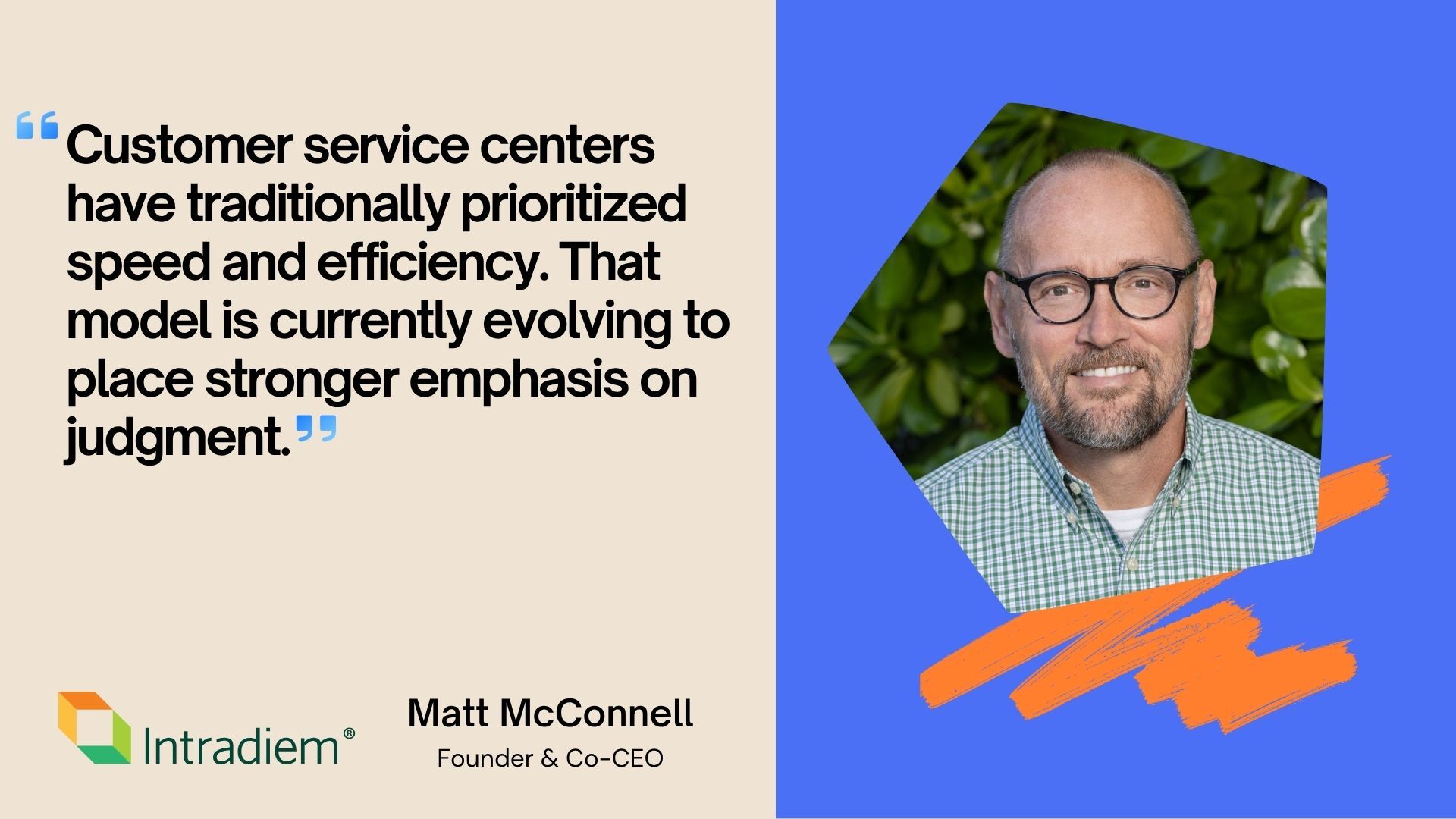
Customer service centers have traditionally prioritized speed and efficiency, using standardized interactions and tightly controlled workflows to manage high volumes of customer inquiries. That model is currently evolving to place a stronger emphasis on judgment. When AI and automation handle simple inquiries and repetitive processes, contact center workers have more bandwidth for situations that require human judgment. That includes a broad range of financially or personally sensitive situations where customers need reassurance, clarity, options, and, above all, thoughtful problem solving.
AI and other recent advancements in technology are enabling this shift and transforming the ideal profile of customer-facing contact center employees. They must be adaptable problem-solvers who can interpret context and navigate ambiguity. And, they must leverage AI-generated insights as guidance rather than as scripts or directives. Real-time automation supports this transition toward higher-value tasks by reducing administrative burdens and ensuring that the right information is available and actionable in real time.
In order to facilitate this development, employee training must evolve, too. Organizations need to place more emphasis on critical thinking, emotional intelligence, and decision-making skills. Time and again, businesses have tried to leverage technology to cut costs at the expense of employees, and time and again, those efforts have disappointed. Why? Because decision-making, empathy, and judgment are uniquely human skills that cannot be replicated or replaced by technology.
Rather than removing the human element from customer service interactions, a thoughtful blending of AI and automation will strengthen it. Customer service interactions often involve emotion and urgency, and resolving such sensitive interactions requires a significant dose of trust and reassurance.
Turning Customer Service Centers into Revenue Drivers
As repetitive work is offloaded to technology, the role of the agent becomes more focused and more impactful. With AI providing real-time context around customer history and sentiment, and automation ensuring that the right actions are taken at the right moment, agents can engage in more thoughtful, relevant conversations. Instead of working through tasks, they’re able to focus on the person on the other end of the interaction.
This shift changes the nature of the conversation. Agents are no longer rushing to resolve and move on; they’re better positioned to listen, to ask the right questions, and to respond with greater clarity and confidence. That deeper level of engagement allows them to identify retention risks, uncover cross-sell opportunities, and reinforce customer loyalty in a way that feels natural rather than forced. Customers are far more receptive when conversations feel authentic and centered on their needs.
That’s where the real transformation happens. Trust builds through such interactions, and that trust directly influences whether a customer stays, expands, or advocates for the brand. In this way, service interactions become more than problem-solving moments; they become opportunities to deepen relationships and create long-term value.
This is how the long-held perception of customer service centers as cost centers begins to shift. It creates the conditions for better conversations. When employees have the tools, context, and time to engage meaningfully, value creation follows naturally.
At the same time, delivering this kind of experience requires consistency across channels. Customers expect continuity whether they are interacting online, over the phone, or in a physical location. AI provides visibility into customer behavior and operational conditions across these environments, while automation ensures that those insights are translated into action in real time.
Maintaining the Human Touch in Customer Service
By bringing these capabilities together, organizations can respond dynamically to changing demand patterns and customer needs. The result is a more agile service model, one where customers experience seamless interactions, and employees are better supported in managing their workload. That combination of consistency, responsiveness, and human connection is what ultimately turns service into a driver of revenue and brand strength.
What sets leading organizations apart is how deliberately they bring AI and automation together to support that outcome. AI helps them understand what’s happening in each interaction and what should happen next. Automation ensures that those insights are acted on in real time, within the flow of work. When these capabilities are aligned, they create an environment where employees are supported in delivering better outcomes as situations unfold.
This is the foundation of a more sustainable and effective service model. Performance is no longer defined by how quickly interactions are handled, but by how consistently organizations can deliver meaningful, high-quality outcomes for customers without overwhelming their teams. That requires investing in both sides of the equation—intelligence and execution—and designing systems that strengthen, rather than constrain, human performance.
As this model continues to take hold, the defining qualities of great customer service are becoming clearer. Empathy, judgment, and authenticity are not being diminished by technology; they’re being elevated by it. The future of customer service is being shaped by how effectively organizations can use AI and automation together to create the conditions for better human interactions, stronger customer relationships, and more resilient business performance.


 Rate us on G2


