
For thousands of years, philosophers and scientists have wrestled with what it means to make a logical decision. Aristotle’s systematic study of logic, developed more than two millennia ago, centred on a deceptively simple idea: start with a set of premises, apply a valid form of reasoning, and arrive at a conclusion that follows. Logic lets us distinguish a sound line of reasoning from one that merely happens to reach an appealing answer.
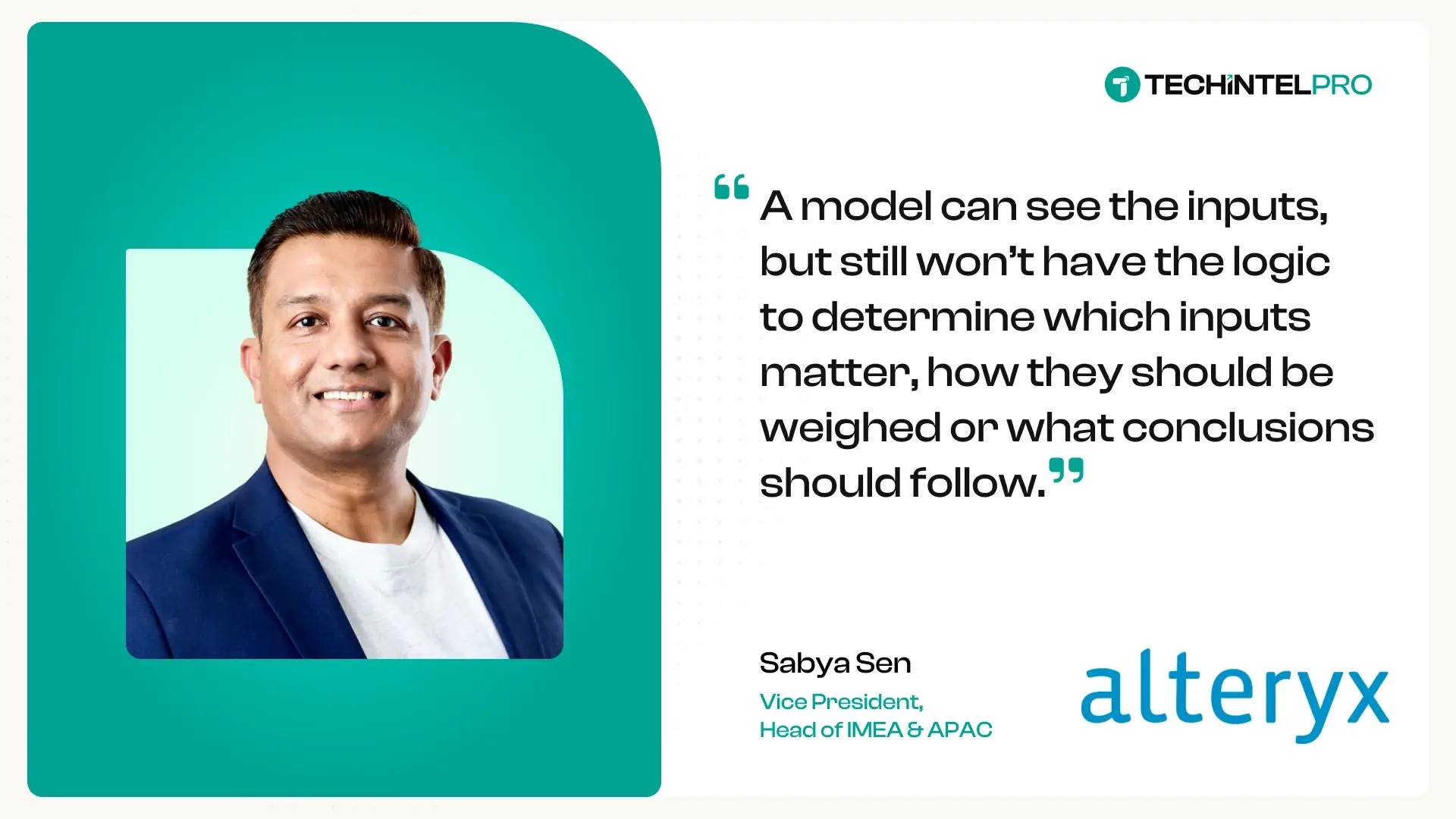
Today’s large language models can recognise patterns across enormous bodies of data, synthesise what they find and generate remarkably sophisticated responses. But recognising information is different from applying the logic that governs what that information means. A model can see the inputs, but still won’t have the logic to determine which inputs matter, how they should be weighed or what conclusions should follow.
That distinction becomes critical inside a business. Every organisation has developed its own logic for turning information into decisions: definitions, calculations, rules, exceptions and processes that have been refined over years and embedded in workflows, applications, formulas and code. Business users carry that logic in their experience and apply it almost instinctively. PwC’s 2026 CEO Survey found that 37% of Saudi CEOs report extensive AI use in setting business direction. Using AI at that level calls for business rules that can be applied consistently.
Enterprise AI should be able to work from the same foundation. Today, organisations routinely ask models to recreate their best guess at how the business works, introducing inaccuracies while consuming unnecessary tokens. Instead, organisations should make trusted business logic directly available for AI to execute, reducing costs and hallucinations while giving models a reliable foundation for reasoning.
Give AI logic it can execute
When organisations want AI to understand their business, the instinct is often to give it more context – more documents, more data, longer prompts and more instructions. However, more volume does not guarantee better understanding. Business logic can. Over time, that logic gets encoded in many forms, but the underlying logic is what makes the result repeatable and trusted.
Consider a retailer preparing its sales forecast ahead of Ramadan. Sales policies can tell an AI model how forecasting should work, but the model still has to interpret how to compare previous Ramadan trading periods, identify the right records, apply promotions and perform the calculations. A validated forecasting process applies the retailer’s established rules to the relevant records and produces a consistent result. AI can then interpret demand fluctuations and help assess stock requirements, working from calculations the business has already defined and tested.
The model can then focus on work that benefits from probabilistic reasoning and spend its tokens on what actually requires reasoning: interpreting the results, investigating what changed, identifying patterns and determining what to do next.
Reuse the logic you already trust
Reducing AI costs and improving performance requires more than better prompts. The larger opportunity is architectural: identify the business logic that AI repeatedly needs and make it reusable, so models don't have to reconstruct the same definitions, calculations and processes every time.
First, centralise reusable business logic. Core metrics like customer churn or revenue retention should use approved, unified logic to allow agents to draw on shared definitions and avoid inferring them independently. This is especially relevant in the UAE, where 45% of CEOs report extensive AI use across sales, marketing and customer service.
Second, give models the answer they need, not the entire data set. A question about regional performance may require a breakdown of what changed, not an evaluation of every single transaction in the company’s history. Passing relevant data into the model window keeps processing fast and focused, while leaving the underlying data available for deeper investigation when needed.
Finally, make established logic executable. Reusable functions enable models to trigger validated calculations and workflows rather than generating and troubleshooting raw code on the fly. This reduces input volume, generates trusted outputs, and makes performance easier to evaluate because the underlying calculations remain consistent.
Keep the business in control
Making business logic available to AI does not mean assuming every existing process will remain accurate as the business evolves. Organisations have accumulated years of formulas, code, workflows and institutional knowledge, but some of that logic is outdated or inconsistent. In fact, a 2025 survey found that 94% of UAE data leaders lacked full visibility into AI decision-making. Before putting it in the hands of AI, companies need to understand where the logic comes from, who owns it and whether it still produces a trusted result.
A practical starting point is a recurring business question. Identify how the organisation answers it today, trace the underlying definitions, calculations and rules, and determine which data and processes those decisions depend on. From there, teams can validate the logic and make it available to AI through a governed, monitored interface.
AI can then apply probabilistic reasoning to interpret results and surface possible courses of action. The organisation should remain in control of the logic that defines the business, its customers and how revenue is calculated.
The goal is to give the model access to the logic the organisation has already established, so it can spend its effort on the questions that actually require reasoning.
From there, the possibilities extend well beyond answering individual questions. AI agents across functions will be able to work from the same definitions and rules, coordinate decisions across workflows, and build on one another’s outputs without each system having to reconstruct the business from scratch. When companies make that distinction, enterprise AI can move beyond reconstructing how the business works and start helping people determine what to do next.


 Rate us on G2