Silicon Valley once joked that nobody ever got fired for buying IBM, a testament to an era when CIOs, CTOs, and centralized IT procurement committees dictated software development toolkits from high-level boardrooms far removed from the daily realities of writing code. That era is officially over. Across the Middle East and North Africa (MENA), a dramatic bottom-up disruption is rewriting the rules of technology procurement. Driven by an enthusiastic, younger demographic and a hyper-accelerated appetite for AI experimentation, younger developers and individual contributors are actively influencing corporate budget strategies.
Drawing on more than two decades of observing how engineering ecosystems evolve, it is clear that while Western markets have historically given developers a major voice in tool selection, the MENA region has traditionally operated on a more centralized playbook. Historically, tech procurement here has been intensely top-down, often driven by high-level government partnerships and massive enterprise agreements that cascade software mandates from the boardroom down to the desks.
However, this rigid approach is changing. When organizations sign top-level agreements and force a one-size-fits-all stack onto their teams, it often leaves developers wrestling with suboptimal software that hinders productivity. The appetite for better tools is so strong that we frequently see corporate users buying personal licenses and paying for them out of pocket, simply because the mandated enterprise choices don't cut it for modern development. To unlock true innovation, regional leaders must realize that securing practitioner buy-in is becoming essential, shifting the conversation from blind compliance toward a model that actually listens to the needs at the command line.
Youth and Autonomy in the Sandbox
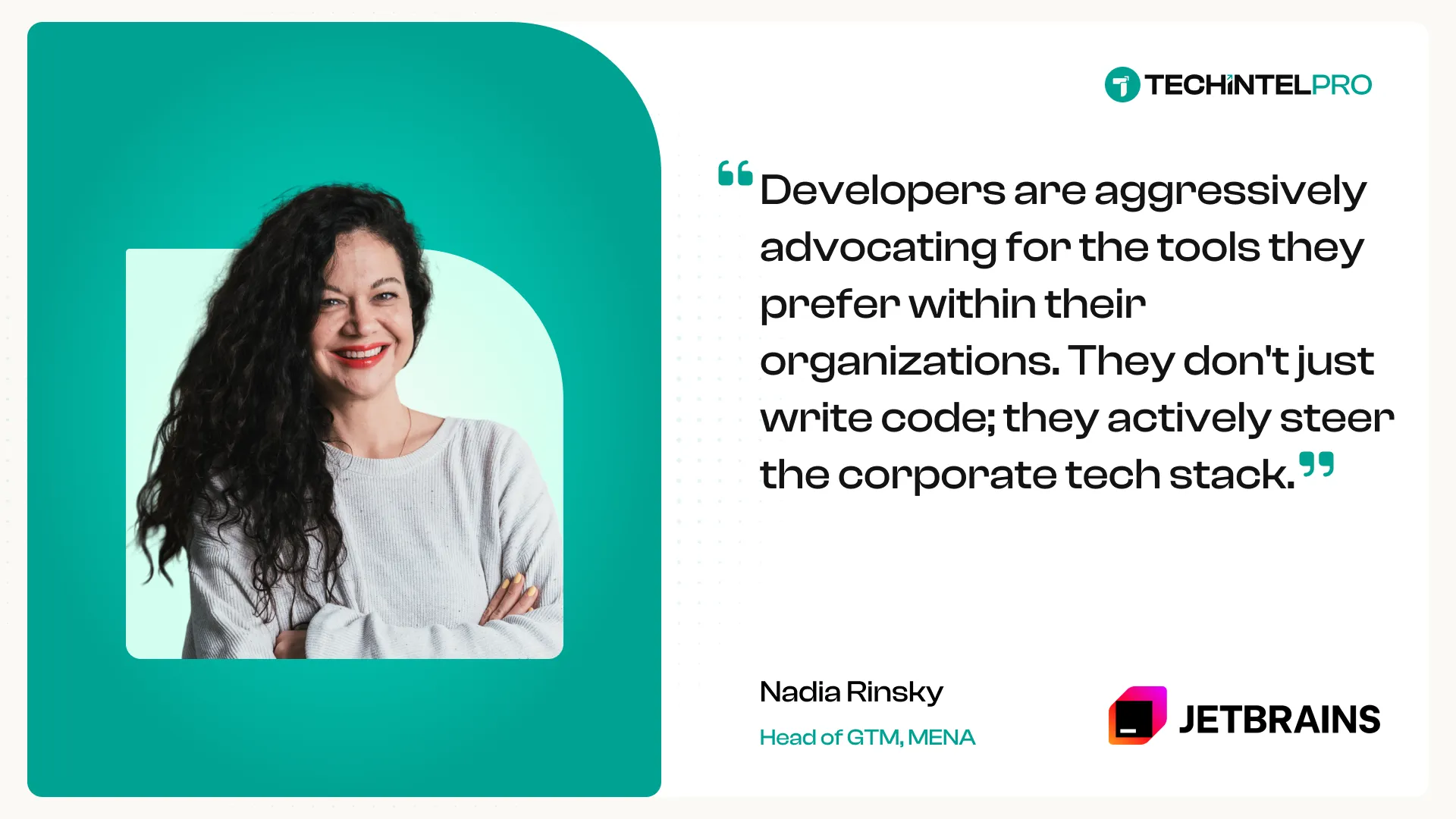
This demographic pressure is precisely why the region is on the precipice of a major shift. MENA is home to one of the world's youngest developer populations, with a staggering 61% of practitioners under the age of 30, compared to a 50% global benchmark. According to the results in the JetBrains State Developer Ecosystem Report, rather than passively waiting for corporate mandates, these younger developers are actively engineering their own technical environments. An impressive 55% of developers in this cohort report having significant or final authority over new technology purchases, standing in sharp contrast to the 40% global average. Furthermore, 81% of these developers aggressively advocate for the tools they prefer within their organizations. They do not just write code; they actively steer the corporate tech stack.
Beyond the Hype: Practical AI Infrastructure
For this younger workforce, artificial intelligence is no longer an experimental luxury or an occasional novelty. It has rapidly matured into core professional infrastructure. In competitive, accelerating markets, 96% of developers already leverage at least one AI tool for work, moving well beyond basic experimentation into daily workflows. However, as developer decision-makers gain organizational influence, the way teams evaluate AI success is becoming far more realistic and grounded. Mature teams recognize that shallow metrics, like tracking the sheer number of lines of code generated or simple pull-request volume, amount to little more than AI theater. Writing code is no longer the primary constraint. Instead, massive volumes of AI-generated code create secondary bottlenecks in review, validation, vulnerabilities, and long-term codebase maintenance.
Orchestrating Real Value
Grounded developer leaders are shifting the conversation away from how much code AI wrote toward what actual value was delivered to the business. They are focusing on practical productivity indicators: reduced cycle times, fewer human hours spent on repetitive manual tasks, and faster delivery of stable software. This shift in perspective is actively driving the next generation of developer platforms. Development is moving away from traditional, isolated local IDE setups toward automated, AI-native environments that can run anywhere. The future lies in orchestration platforms that seamlessly manage collaboration between humans and fleets of AI agents across the entire software development lifecycle, from writing and reviewing code to running CI checks and deploying changes.
Breaking Down Economic and Sovereign Barriers
The rise of the developer decision-maker is not without localized friction, as autonomous tech stacks frequently collide with real-world economic and regulatory barriers. In many growing economies, talent is exceptionally strong, but access to premium software is highly uneven. For instance, 20% of developers in the MENA region report that it is difficult or entirely impossible to purchase paid IDEs or code editors – more than double the global average of 9%. To overcome these structural hurdles, empowered developers are championing open, interoperable architectures. Industry protocols like the Model Context Protocol (MCP) and the Agent Client Protocol (ACP) are becoming critical requirements, ensuring that next-generation AI tools can securely connect to context and work across diverse environments rather than being locked behind a single proprietary ecosystem.
Governance by Design: Safe Autonomy
Simultaneously, as these young teams build out the digital backbone for local e-commerce, mobile, and fintech sectors, they face strict regional data residency rules and sovereign cloud strategies. Developer platforms can no longer assume a one-size-fits-all public cloud model. Pragmatic developers are demanding hybrid, sovereign-ready architectures where code, data, and AI models are hosted under precise local controls. When autonomous systems begin making decisions, calling APIs, and interacting with production workflows, traditional static security policies quickly fall short. The solution being driven by modern developer decision-makers is governance by design. Instead of relying on manual approval boards that act as bureaucratic bottlenecks, forward-thinking teams are embedding automated guardrails directly into the workflow.
This federated approach balances developer freedom with enterprise risk appetite. Organizations define clear, overarching boundaries regarding approved AI models, verified servers, and permissions. Within those predefined guardrails, developers retain absolute autonomy to experiment, build, and deploy without waiting for manual checkpoints at every step. By utilizing isolated sandboxes, least-privilege access, and deep observability, teams can dramatically reduce the blast radius of any automated error while keeping development fast and agile. Ultimately, the individual contributor is evolving into a manager of workflows, remaining fully accountable for quality, security, and performance. By commanding technology budgets and demanding open, automated infrastructure, this younger workforce is successfully reshaping the operational rules of global enterprise tech.


 Rate us on G2