Anjan Sahoo
For enterprise engineering leaders, the pressure does not end when the code is generated.
An AI coding assistant can produce working software in seconds. But getting that code governed, secured, audited, rights-cleared, and released at scale is another challenge altogether.
That gap is becoming harder to ignore. Organizations want autonomous velocity, yet many still rely on fragmented pipelines, manual compliance checks, and cultural habits built for a pre-AI world.
Digital.ai and knowmad mood are bringing those two sides closer together through a partnership designed to help regulated enterprises — especially in the DACH region — move from AI-generated code to governed, production-ready delivery more efficiently.
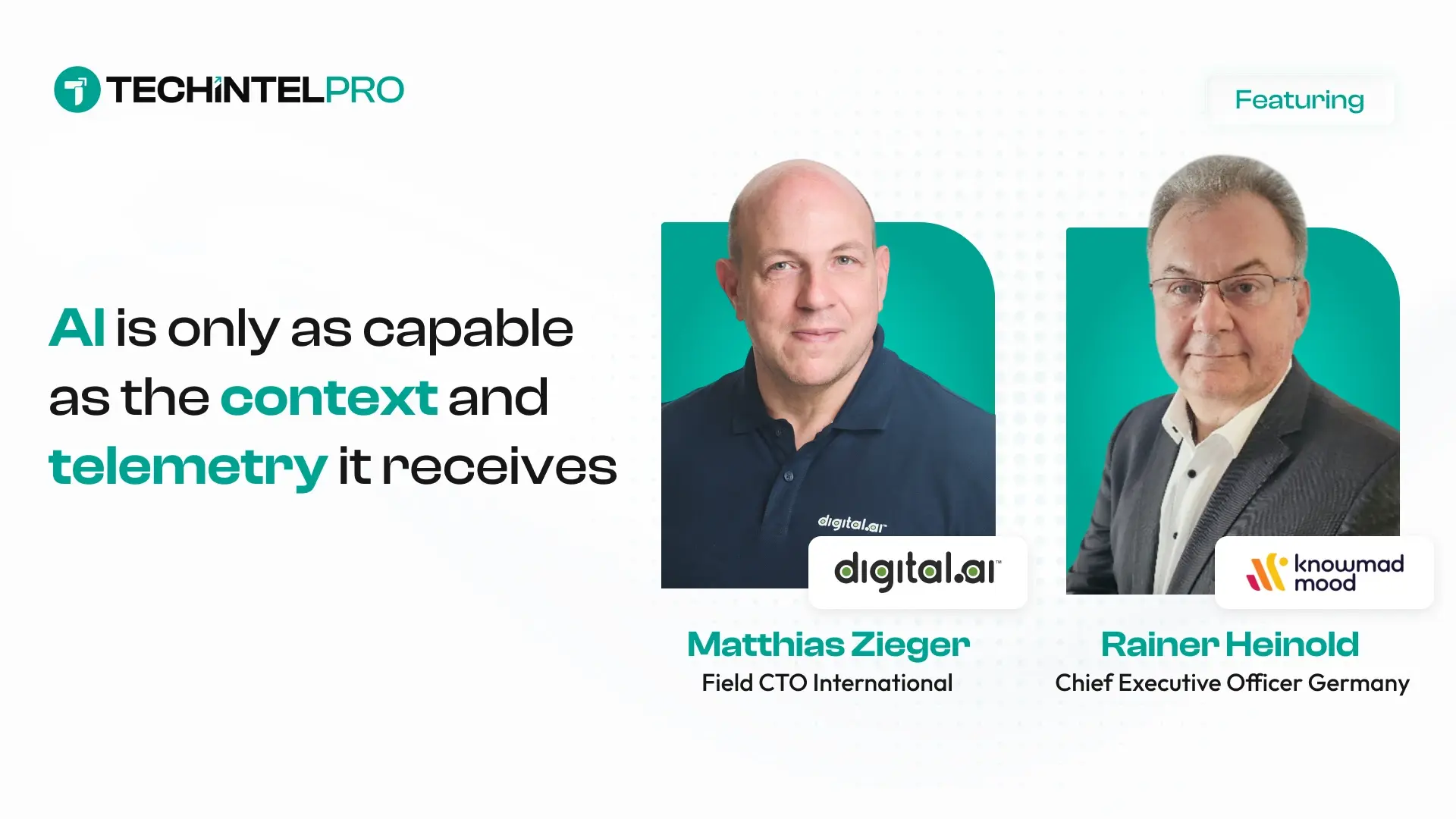
For Matthias Zieger, Field CTO International at Digital.ai, the biggest opportunity is closing the operational gap that has traditionally followed the creative act of coding.
“The primary gap is the disconnect between AI code generation and automated governance and agent observability and control,” he says. Enterprises are rapidly adopting AI coding assistants, expecting 10x velocity. However, their planning, release, security, and compliance pipelines remain manual or fragmented. Generating code faster without automated compliance gates, risk scoring, and end-to-end traceability simply accelerates the accumulation of technical and regulatory debt.
Rainer Heinold, CEO at knowmad mood, sees the same challenge from the execution side.
“It’s a technical challenge, of course! But cultural change and a lack of governance, driven by missing KPIs for for generative AI, are the bigger issues right now,” he says. Many developers still underestimate the problems caused by shadow AI, or they simply fully trust in the quality of the generated code. “We can’t keep maintaining our software supply chain manually. What’s needed is an automated approach with guardrails.”
When the workflow becomes the bottleneck
Creative and engineering teams are often measured on what they produce, but much of their time can disappear into everything surrounding that production.
A developer generates hundreds of lines of AI-assisted code. Someone then needs to review it for security, enforce policy, add audit trails, and push it through release gates. Multiply that across an entire organization and the administrative burden becomes enormous.
“Do that for hundreds of change sets during a sprint, and your team is spending more time on file logistics than actually delivering value,” Matthias notes in spirit. Organizations want autonomous velocity at scale, but they lack the unified platform engineering and telemetry required to govern AI-generated code safely.
For Digital.ai, the expectation has always been to move quickly while remaining compliant. Matthias points out that the company has spent years refining its agentic DevSecOps orchestration so that speed does not come at the expense of control.
That urgency is especially visible in regulated industries.
“We build trust with security and compliance teams by replacing ‘black-box automation’ with deterministic policy controls and auditability,” Matthias says. Trust requires three non-negotiables: Policy-as-Code Guards, Immutable Audit Trails, and Human-in-the-Loop Safeguards.
Why this partnership, why now
There is another opportunity sitting inside many DACH organizations: the need for local expertise that pure platform vendors often cannot supply alone.
Digital.ai provides the core engine, intelligence, and control plane. But DACH enterprises demand local deployment expertise, strict data residency and data sovereignty architecture, and deeply embedded compliance integration.
“Contextual execution and regulatory trust,” Matthias explains. Leaning on knowmad mood bridges the platform-to-operational gap: Digital.ai supplies the agentic DevSecOps orchestration, while knowmad mood brings local, high-touch execution tailored to regional governance models — BaFin, GDPR, Works Councils, Automotive, Semiconductors, and more.
Rainer sees the partnership through the lens of shared history. knowmad mood’s roots go back to CollabNet, which is part of Digital.ai’s own DNA.
“Traditional value-add reselling focuses on a single vendor portfolio,” he says. “With our new partnership, we can expand beyond a single vendor portfolio and enhance Digital.ai’s core platform solutions with sector-specific additions that integrate seamlessly into a complete, robust infrastructure.”
The result is not a classic vendor-reseller handoff. The two organizations review customer requirements together and work on a joint proposal from the earliest stages.
Compliance and governance as a design constraint, not an afterthought
AI is quickly becoming part of modern software delivery, but its most useful role may not be deciding what makes good code. It may be taking care of the repetitive, high-risk work that makes good code harder to release.
For Matthias, the sweet spot is clear.
“AI agents operate strictly within pre-defined security, quality, and risk parameters, defined as Code — not Office Docs, Wikis or SharePoint Sites,” he says. Every automated decision generates a verifiable chain of custody.
Rainer takes an equally cautious view shaped by the DACH market.
“There is much higher skepticism against SaaS-delivered solutions in the DACH region,” he notes. “Whereas Anglo-American organizations have already adopted up to 90% SaaS solutions, we see much lower numbers (~30%) in the DACH region. Stricter regulations naturally slow adoption. I believe the solution is a hybrid setup around AI, with a mix of SaaS and On-prem AI for specific purposes – similar to what we have with Cloud technology today.
What the partnership actually looks like in practice
The bigger shift is happening in how organizations think about the platform-partner relationship itself.
A platform alone provides capabilities, but integration into complex, legacy enterprise environments often stalls on operational friction. A service partner alone lacks direct engineering control over the platform’s orchestration mechanisms.
Together, the two companies have already solved problems neither could have solved alone.
One concrete example: automating audit readiness across heterogeneous, air-gapped environments common in Automotive, Medical, and Software-Defined Products. Digital.ai supplied out-of-the-box automated audit trail capabilities and risk scoring. knowmad mood configured local data residency patterns and pipeline integrations. The result reduced release audit preparation time from weeks of manual evidence gathering to zero-touch continuous compliance export.
Rainer emphasizes the long-term service layer.
“No vendor can staff every specialized need in every market,” he says. Partners add the most value by developing and maintaining custom integrations, building sector-specific add-ons such as reports or templates, and providing client- and domain-specific 24x7 support across time zones.
Where this is headed
The future of software delivery is likely to be defined by how well all the pieces work together.
Capture of intent, agentic validation, security and risk scoring, progressive delivery, governance, and business metrics are increasingly becoming parts of one connected journey.
For Matthias, that means the platform-partner relationship must include shared telemetry and closed-loop feedback.
“As the platform vendor, we must deliver robust agentic guardrails, explainable decision engines, and open APIs,” he says. “The execution partner must continuously feed real-world operational constraints and domain-specific edge cases back into the deployment and release patterns. The partner isn’t just implementing software — they are actively tuning agentic guardrails to match the customer’s real-world risk threshold.”
Looking five years ahead, Matthias paints a picture of self-healing, outcome-driven delivery pipelines. Developers commit intent; agentic pipelines continuously validate security and risk, optimize performance, handle orchestration, enforce governance, and execute progressive delivery — reporting metrics directly to business and technology leaders.
The one thing most enterprises are underestimating?
“Data hygiene and governance architecture,” Matthias says. “AI is only as capable as the context and telemetry it receives. Most enterprises underestimate the foundational groundwork required to standardize toolchain telemetry, access controls, and policy definitions before AI agents can operate safely without creating catastrophic compliance or operational failures. AI will not magically fix the technical and process debt your organization accumulated over the last 5–10 years.”
A live AI-assisted change can reach production while the business value is still relevant. A complex regulated release can become continuously auditable. And the engineering team does not need to spend weeks making either outcome happen manually.