Most AI-powered SaaS tools struggle to deliver reliable enterprise intelligence because language models cannot inherently access real-time organizational data. SaaS RAG integration enables organizations to operationalize enterprise AI by connecting applications directly with internal knowledge bases, ensuring responses are aligned with current business context and data governance requirements.
Retrieval-Augmented Generation (RAG) combines large language models with enterprise-grade retrieval systems, allowing SaaS applications to generate responses grounded in real-time business data instead of relying solely on pre-trained knowledge. As per Pinecone’s RAG guide, RAG improves response reliability by retrieving relevant information before generation, helping AI systems stay context-aware and factually accurate.
As enterprises expand AI adoption, SaaS vendors are now moving toward agentic RAG workflows, where AI systems do more than answer prompts — they independently retrieve data, validate information, reason through tasks, and trigger workflows across connected applications.
Why SaaS Platforms Need RAG
Traditional SaaS products live in environments where information is always changing. Things like product docs, CRM data, support tickets, compliance updates, and internal policies update constantly. Because of this, static AI models often fall behind, since their knowledge can quickly become outdated.
This creates two major business challenges:
- AI-generated responses may contain obsolete information
- Systems may hallucinate inaccurate or fabricated outputs
RAG addresses these issues by connecting AI models to live enterprise data sources. Rather than depending solely on a model’s internal memory to produce responses, the system first retrieves verified information and uses it as grounding context to generate more accurate answers.
For instance, a customer support SaaS platform with SaaS RAG integration can access the latest troubleshooting guides, user account activity, and product updates before formulating a response, leading to a marked improvement in both customer experience and operational accuracy.
The Emergence of Agentic RAG Workflows
Modern enterprise AI systems are evolving beyond simple retrieval pipelines. Advanced SaaS providers are increasingly deploying agentic RAG workflows that allow AI agents to autonomously orchestrate multiple actions and decision layers.
As explained in LangChain’s Agentic RAG framework overview, agentic systems can dynamically plan tasks, query multiple knowledge sources, validate retrieved information, and iteratively refine outputs.
Instead of executing a single retrieval request, these workflows can:
- Break down complex objectives into smaller tasks
- Search across multiple enterprise systems simultaneously
- Validate contradictory information
- Trigger automated actions
- Continuously improve outputs through feedback loops
For SaaS companies, this creates highly intelligent operational systems capable of automating sales processes, IT support, customer onboarding, analytics generation, and internal knowledge management.
Multi-Tenant RAG Architecture and Enterprise Scalability
As AI becomes deeply embedded inside SaaS platforms, scalability and security become critical concerns. Here, multi-tenant RAG architecture plays a decisive role.
In multi-tenant SaaS environments, multiple customers share the same infrastructure while requiring strict isolation of their data. Without proper safeguards, AI retrieval systems risk exposing one organization’s information to another.
Modern RAG architectures solve this problem through:
- Tenant-aware vector databases
- Metadata-based retrieval filtering
- Secure indexing pipelines
- Permission-aware search systems
According to Weaviate’s multi-tenancy documentation, tenant isolation is essential for maintaining both performance and enterprise-grade security in AI retrieval systems.
Another essential capability is ACL (Access Control List) syncing. ACL synchronization ensures that AI retrieval permissions stay continuously aligned with enterprise identity and access management systems such as Microsoft Entra ID or Google Workspace.
This synchronization prevents unauthorized information retrieval and helps SaaS providers maintain regulatory compliance while protecting sensitive customer data.
Improving Retrieval with Better Context Precision
The quality of a RAG system depends heavily on retrieval performance. Even advanced language models can generate poor outputs if the retrieved context is irrelevant or incomplete.
So, modern SaaS AI systems focus heavily on improving context precision & recall.
- Precision ensures retrieved data is highly relevant
- Recall ensures important information is not missed
Balancing both metrics is essential for enterprise-grade AI reliability.
One emerging retrieval technique improving performance is late interaction retrieval. Unlike traditional vector retrieval methods that compress documents into single embeddings, late interaction systems compare queries and document tokens at a finer level of granularity.
As detailed in Elastic’s Late Interaction Retrieval overview, this approach preserves richer semantic relationships and improves retrieval accuracy for complex enterprise search environments.
For SaaS applications managing technical documentation, contracts, legal records, or large knowledge repositories, late interaction retrieval can dramatically enhance answer relevance while reducing retrieval noise.
SaaS AI Hallucination Mitigation Is Now Essential
AI hallucinations remain one of the biggest barriers to enterprise trust in generative AI systems. Businesses cannot rely on software that produces fabricated financial insights, inaccurate compliance recommendations, or misleading operational guidance.
RAG significantly reduces hallucinations by grounding model outputs in verified enterprise information. However, leading SaaS platforms are implementing additional safeguards such as:
- Source attribution
- Confidence scoring
- Retrieval verification layers
- Human review checkpoints
- Real-time validation systems
As per Google Cloud’s guide to AI hallucinations, grounding AI responses with external knowledge sources is one of the most effective ways to reduce hallucinated outputs in enterprise AI environments.
These safeguards are especially important in industries such as healthcare, finance, cybersecurity, and legal technology, where accuracy and compliance are mission-critical.
AI-Powered SaaS: What’s Coming Next
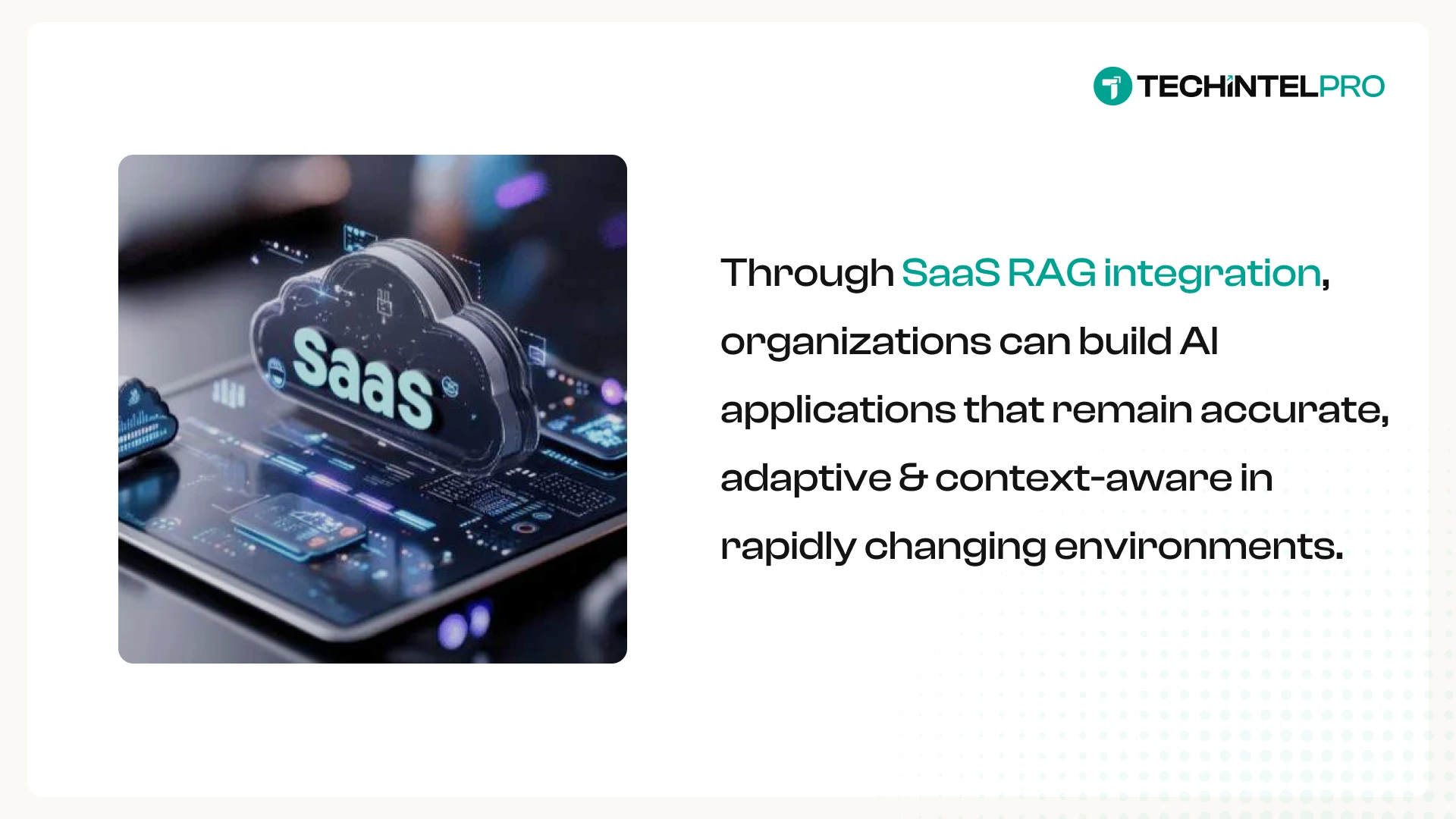
The future of SaaS will be defined by intelligent systems capable of reasoning over live enterprise data in real time. Through SaaS RAG integration, organizations can build AI applications that remain accurate, adaptive, and context-aware even in rapidly changing environments.
At the same time, innovations in agentic RAG workflows, multi-tenant RAG architecture, late interaction retrieval, and ACL (access control list) syncing are enabling SaaS platforms to scale AI securely across enterprise ecosystems.
As market signals suggest, RAG will continue to evolve beyond being just an enhancement layer for AI applications, becoming the foundation for the next generation of intelligent SaaS platforms.